Gutscheinbedingungen

*Gültig bis 20.07.2026 auf alle Bücher. Ausgeschlossen sind Zeitschriften, Prozentbücher und Abos | Einlösbar in allen Buchhandlungen von Orell Füssli, Barth Bücher, Buchladen Rapunzel, Papeterie Köhler, Schuler Orell Füssli, Stauffacher und ZAP unter Vorweisung des Gutscheins, auf www.orellfüssli.ch durch Eingabe des Gutscheincodes. Beim Service „eBooks verschenken“ und bei eBook-Käufen via eReader nicht einlösbar | Mindesteinkaufswert: Fr. 30.- | Nicht mit anderen Rabatten kumulierbar.

  • Produktbild: Ventricular Fibrillation and Sudden Coronary Death
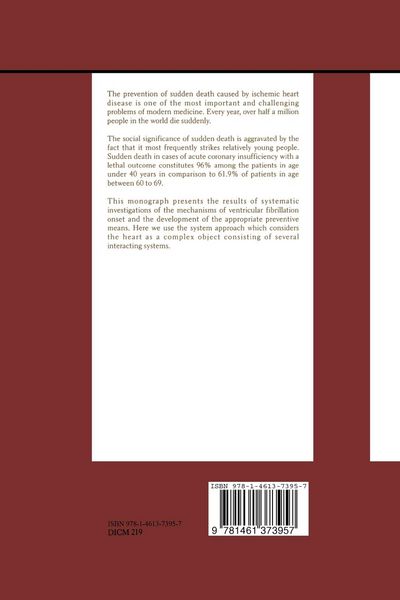
  • Produktbild: Ventricular Fibrillation and Sudden Coronary Death
Band 219

Ventricular Fibrillation and Sudden Coronary Death

Fr. 241.00

inkl. gesetzl. MwSt., Versandkostenfrei


Beschreibung

Produktdetails

Einband

Taschenbuch

Erscheinungsdatum

04.10.2012

Verlag

Springer Us

Seitenzahl

213

Maße (L/B/H)

23.5/15.5/1.4 cm

Gewicht

373 g

Auflage

Softcover reprint of the original 1st ed. 1999

Sprache

Englisch

ISBN

978-1-4613-7395-7

Beschreibung

Produktdetails

Einband

Taschenbuch

Erscheinungsdatum

04.10.2012

Verlag

Springer Us

Seitenzahl

213

Maße (L/B/H)

23.5/15.5/1.4 cm

Gewicht

373 g

Auflage

Softcover reprint of the original 1st ed. 1999

Sprache

Englisch

ISBN

978-1-4613-7395-7

Herstelleradresse

Springer-Verlag KG
Sachsenplatz 4-6
1201 Wien
AT

Email: GPSR Kontakt

Noch keine Bewertungen vorhanden

Verfassen Sie die erste Bewertung zu diesem Artikel

Helfen Sie anderen Kundinnen und Kunden durch Ihre Meinung.

Kundinnen und Kunden meinen

Bewertungen (0)

  • Produktbild: Ventricular Fibrillation and Sudden Coronary Death
  • Produktbild: Ventricular Fibrillation and Sudden Coronary Death
  • 1. The Ventricular Fibrillation and Heart’s Blood Supply.- 1.1 The types of cardiac blood supply.- 1.2 Hemodynamic changes.- 1.3 Collateral blood supply of the heart.- 1.4 The size of the ischemie zone.- 1.5 Po2 in the ischemie zone.- 1.6 Conclusion.- 2. Ventricular Fibrillation and Electrophysiological Changes.- 2.1 Role of the VPB in the onset of VF after CAO.- 2.2 Role of ionic current, membrane potentials, automatism, excitability, and conductivity changes in the appearance of VF after CAO.- 2.3 Study of mechanisms of ventricular arrhythmia using mathematical modeling and computer simulation.- 2.4 Conclusions.- 3. Ventricular Fibrillation and Changes in Metabolism of the Heart after Local Ischemia.- 3.1 Ischemic changes in the ox-red equilibrium.- 3.2 Ischemic disturbances in acid-base equilibrium.- 3.3 Ischemic disturbances in ion equilibrium.- 3.4 Conclusion.- 4. Role of the Sympathoadrenal System in the Appearance of Ventricular Fibrillation after Coronary Artery Occlusion.- 4.1 Afferent cardiac nerve activity and ventricular fibrillation after coronary artery occlusion.- 4.2 Afferent activity of the aortal nerve after CAO.- 4.3 Catecholamine balance in the heart and ventricular fibrillation after coronary artery occlusion.- 4.4 Conclusions.- 5. Role of Adrenaline in the Mechanisms of Ventricular Fibrillation Onset after Occlusion of Coronary Artery.- 5.1 Effect of adrenaline on the ox-red equilibrium of the heart.- 5.2 Effect of adrenaline on the acid-base equilibrium.- 5.3 Effect of adrenaline on ionic equilibrium.- 5.4 Influence of adrenaline on the heart’s electrophysiological processes.- 5.5 The comparison of the effects of arrhythmic and non- arrhythmic doses of adrenaline on a metabolism.- 5.6 Comparison of the effects of coronary artery occlusion andadrenaline on metabolism and electrophysiological processes in the heart.- 6. The Prevention of Ventricular Fibrillation after Coronary Artery Occlusion.- 6.1 The main directions of the antifibrillatory influences.- 6.2 Method of computer control of the use of antifibrillatory substances.- 6.3 The methods of prognostication of ventricular fibrillation.- 6.4 Evaluation of effectiveness of antifibrillatory influences.- 6.5 Conclusions.- 7. Mechanism of Ventricular Fibrillation Onset After Coronary Artery Occlusion.- 7.1 Electrophysiological hypotheses of ventricular fibrillation mechanism.- 7.2 Metabolic hypotheses of ventricular fibrillation.- 7.3 Neurohumoral hypotheses of ventricular fibrillation.- 7.4 Author’s hypothesis based on the systemic approach to study of ventricular fibrillation mechanisms.- 7.5 Ventricular fibrillation as a result of adrenal overcompensation.- Implications.- References.