• Produktbild: The Simulation of Thermomechanically Induced Stress in Plastic Encapsulated IC Packages
  • Produktbild: The Simulation of Thermomechanically Induced Stress in Plastic Encapsulated IC Packages
  • Produktbild: The Simulation of Thermomechanically Induced Stress in Plastic Encapsulated IC Packages

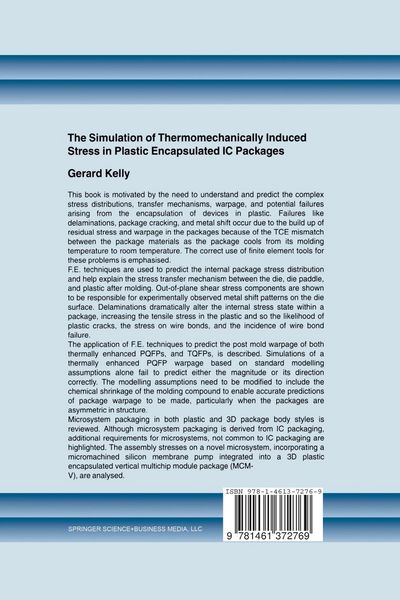
The Simulation of Thermomechanically Induced Stress in Plastic Encapsulated IC Packages

Fr. 137.00

inkl. gesetzl. MwSt., Versandkostenfrei


Beschreibung

Produktdetails

Einband

Taschenbuch

Erscheinungsdatum

08.10.2012

Verlag

Springer Us

Seitenzahl

134

Maße (L/B/H)

23.5/15.5/0.9 cm

Gewicht

254 g

Auflage

1999

Sprache

Englisch

ISBN

978-1-4613-7276-9

Beschreibung

Produktdetails

Einband

Taschenbuch

Erscheinungsdatum

08.10.2012

Verlag

Springer Us

Seitenzahl

134

Maße (L/B/H)

23.5/15.5/0.9 cm

Gewicht

254 g

Auflage

1999

Sprache

Englisch

ISBN

978-1-4613-7276-9

Herstelleradresse

Springer-Verlag GmbH
Tiergartenstr. 17
69121 Heidelberg
DE

Email: ProductSafety@springernature.com

Kundinnen und Kunden meinen

0 Bewertungen

Informationen zu Bewertungen

Zur Abgabe einer Bewertung ist eine Anmeldung im Konto notwendig. Die Authentizität der Bewertungen wird von uns nicht überprüft. Wir behalten uns vor, Bewertungstexte, die unseren Richtlinien widersprechen, entsprechend zu kürzen oder zu löschen.

Die Bewertungen sind nach Format, Anzahl Sterne und Datum sortiert.

Verfassen Sie die erste Bewertung zu diesem Artikel

Helfen Sie anderen Kund*innen durch Ihre Meinung

Kundinnen und Kunden meinen

0 Bewertungen filtern

  • Produktbild: The Simulation of Thermomechanically Induced Stress in Plastic Encapsulated IC Packages
  • Produktbild: The Simulation of Thermomechanically Induced Stress in Plastic Encapsulated IC Packages
  • Produktbild: The Simulation of Thermomechanically Induced Stress in Plastic Encapsulated IC Packages
  • 1. An Introduction to Plastic Packaging.- 1.1 Manufacturing sequence for a PQFP.- 1.2 Properties of packaging materials.- 1.3 Stress induced failures of plastic packages.- References.- 2. A Review of Package Stress Modelling.- 2.1 Introduction.- 2.2 Analytical approaches to package modelling.- 2.3 Finite element methods.- References.- 3. Thermomechanical Stress in a PQFP.- 3.1 Introduction.- 3.2 Origin of thermomechanical stress in TCE mismatched materials.- 3.3 Finite element analysis of a PQFP.- 3.4 2D representation of a 3D structure.- 3.5 Interpretation of die encapsulation stress.- 3.6 Mechanism of stress transfer.- 3.7 Deformation of the package structure.- 3.8 Die surface compressive stress distribution.- 3.9 Material and geometric factors which influence encapsulation stress.- References.- 4. The Correlation of Modelling with Measurements and Failure Modes.- 4.1 Introduction.- 4.2 Measurement of die stress with stress sensors.- 4.3 Simulated die surface stress.- 4.4 Comparison between measured and modelled encapsulation stress.- 4.5 Analytical model.- 4.6 The correlation of simulations with failure modes.- 4.7 Influence of delamination on stress.- 4.8 Analysis of stress in a wire bond.- References.- 5. Accurate Prediction of PQFP Warpage.- 5.1 Introduction.- 5.2 Warpage of a 208 lead power PQFP package.- 5.3 Variation of power PQFP warpage with temperature.- 5.4 Significance of chemical shrinkage for asymmetric packages.- 5.5 Warpage of a small body size PQFP.- 5.6 Warpage of a large body size PQFP.- 5.7 Warpage sensitivity of both large and small body size PQFPs.- 5.8 Asymmetric structure of BGA packages.- References.- 6. Microsystem Packaging in Plastic and in 3D.- 6.1 Introduction.- 6.2 Microsystem packaging — Lessons from IC packaging.- 6.3 3D packagingmethodologies.- 6.4 3D microsystem packaging — a European example.- 7. Concluding Remarks.- 7.1 Problems remaining to be solved.- 7.2 A comment on the numerical tools.- 7.3 For the Future.- References.- References.- Appendices.- A- Analytical model of encapsulation stress.- A.1 Force equilibrium.- A.2 Strain compatibility.- B- Fundamentals of stress and strain.- B.1 Direct and shear stress conventions.- B.2 Longitudinal strain and Poisson’s ratio.- C- Axial stress and bending stress.