
• Produktbild: The Voice of Conscience
  • Produktbild: The Voice of Conscience

The Voice of Conscience A Political Genealogy of Western Ethical Experience

Fr. 221.00

inkl. gesetzl. MwSt., Versandkostenfrei


Beschreibung

Produktdetails

Einband

Gebundene Ausgabe

Erscheinungsdatum

12.09.2013

Verlag

Bloomsbury 3PL

Seitenzahl

264

Maße (L/B/H)

23.5/15.7/2 cm

Gewicht

584 g

Sprache

Englisch

ISBN

978-1-62356-678-4

Beschreibung

Zitat

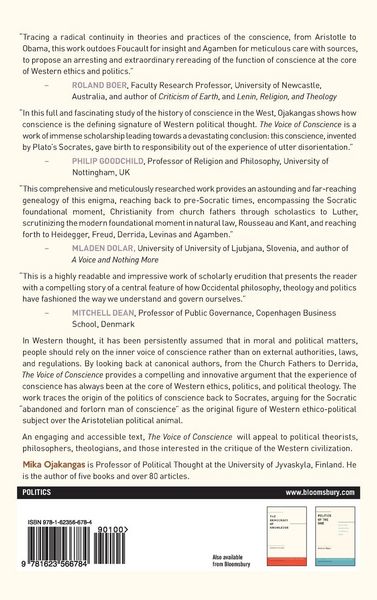
In this full and fascinating study of the history of conscience in the West, Ojakangas shows how conscience is the defining signature of Western political thought. Voice of Conscience is a work of immense scholarship leading towards a devastating conclusion: this conscience, invented by Plato's Socrates, gave birth to responsibility out of the experience of utter disorientation. -- Philip Goodchild, Professor of Religion and Philosophy, University of Nottingham, UK If you have ever been troubled, ever so slightly, by the resort to conscience at crucial moments of politics and life; if you have ever harboured a suspicion that the conscience is not quite revealing its true colours, then Voice of Conscience is the book for you. Tracing a radical continuity in theories and practices of the conscience, from Aristotle to Obama, this work outdoes Foucault for insight and Agamben for meticulous care with sources, to propose an arresting and extraordinary rereading of the function of conscience at the core of Western ethics and politics. The climax of the book, in which the basis of Western sovereignty is precisely the abandoned outcast, cut free from all ties that bind, reveals both the promise and subtle snares of the conscience itself. -- Roland Boer, Faculty Research Professor, University of Newcastle, Australia. Author of Criticism of Heaven (2007), of Criticism of Earth (2012), and of Lenin, Religion, and Theology (2013) Why has the metaphor of the voice of conscience been such a determining and persistent guide for the entire Western ethical thought? Mika Ojakangas considers it as 'the fundamental dogma of the Western tradition in ethics', its 'anti-dogmatic dogmatics', constituting the inner autonomy, conviction and faith beyond all external laws. This comprehensive and meticulously researched work provides an astounding and far-reaching genealogy of this enigma, reaching back to pre-Socratic times, encompassing the Socratic foundational moment, Christianity from church fathers through scholastics to Luther, scrutinizing the modern foundational moment in natural law, Rousseau and Kant, and reaching forth to Heidegger, Freud, Derrida, Levinas and Agamben. The voice of conscience, introducing a 'measureless measure' beyond social and political laws, ultimately aims at the void at the heart of being, yet far from being the firm support it purports to be, there is an agenda of political theology to be unraveled at its core. The most comprehensive account so far, a quintessential reading. -- Mladen Dolar, University of Ljubljana, the author of A Voice and Nothing More Mika Ojakanas demonstrates the different ways, from Socrates to Derrida and Lacan, the same puzzles and tropes reappear by which conscience can be both a source of repression and of our freedom, a foundation of ethical autonomy and basis of law, authority, nation and state. This is a highly readable and impressive work of scholarly erudition that presents the reader with a compelling story of a central feature of how Occidental philosophy, theology and politics have fashioned the way we understand and govern ourselves. -- Mitchell Dean, Professor of Public Governance Department of Management, Politics and Philosophy Copenhagen Business School and author of The Signature of Power (2013)

Produktdetails

Einband

Gebundene Ausgabe

Erscheinungsdatum

12.09.2013

Verlag

Bloomsbury 3PL

Seitenzahl

264

Maße (L/B/H)

23.5/15.7/2 cm

Gewicht

584 g

Sprache

Englisch

ISBN

978-1-62356-678-4

Herstelleradresse

Libri GmbH
Europaallee 1
36244 Bad Hersfeld
DE

Email: gpsr@libri.de

Kundinnen und Kunden meinen

0 Bewertungen

Informationen zu Bewertungen

Zur Abgabe einer Bewertung ist eine Anmeldung im Konto notwendig. Die Authentizität der Bewertungen wird von uns nicht überprüft. Wir behalten uns vor, Bewertungstexte, die unseren Richtlinien widersprechen, entsprechend zu kürzen oder zu löschen.

Die Bewertungen sind nach Format, Anzahl Sterne und Datum sortiert.

Verfassen Sie die erste Bewertung zu diesem Artikel

Helfen Sie anderen Kund*innen durch Ihre Meinung

Kundinnen und Kunden meinen

0 Bewertungen filtern

Die Leseprobe wird geladen.
  • Produktbild: The Voice of Conscience
  • Produktbild: The Voice of Conscience
  • Acknowledgements
    1. Introduction
    2. National Socialism and the Inner Truth
    The Call of Heidegger's Conscience
    Nihilism of Judgment: Arendt
    3. Conscience in Moral and Political Theology
    Church Fathers between the Law and the Spirit
    Synderesis and Conscientia: Scholasticism
    Divine Instinct
    The Spark of the Soul: Eckhart and Tauler
    A Voluntarist Bias of William Ockham?
    The Lutheran Revocation
    The Return of the Repressed: Spiritualists and Pietists
    Calvin's Compromise
    The Puritan God within
    On the Modern Protestant Conscience
    4. Conscience in Early Modern Moral and Political Philosophy
    The Witness of Natural Law from Suárez to Pufendorf
    The Candle of the Lord: Cambridge Platonists
    A Crisis of Conscience: Hobbes, Spinoza, Locke
    5. The Conscience of the Enlightenment
    The Moral Sense from Shaftesbury to Smith
    The Judgement of Intuitive Reason: Clarke, Butler, Price, Reid and Beyond
    The French Experience: from Bayle to Rousseau
    The German Model: Wolff versus Crusius
    Immanuel Kant and the Infinite Guilt
    German Idealism: Conscience as Conviction
    6. From Political Theology to Theologized Politics
    7. Remarks on Late Modern Conscience
    Internalized Coercion: Nietzsche and Freud
    The Voice of the Other: Levinas and Derrida
    Ethics of the Real: Lacan
    8. The Western Politics of Conscience
    On the Socratic Origins of the Politics of Conscience
    Conclusion