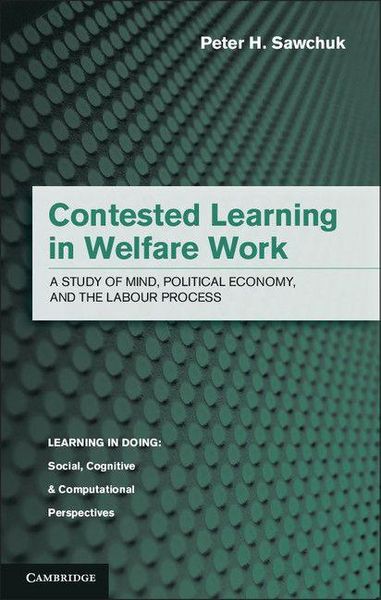
Contested Learning in Welfare Work A Study of Mind, Political Economy, and the Labour Process
Fr. 158.00
inkl. gesetzl. MwSt.,
Beschreibung
Produktdetails
Einband
Gebundene Ausgabe
Erscheinungsdatum
08.08.2013
Verlag
Cambridge AcademicSeitenzahl
392
Maße (L/B/H)
23.5/15.7/2.8 cm
Gewicht
650 g
Sprache
Englisch
ISBN
978-1-107-03467-9
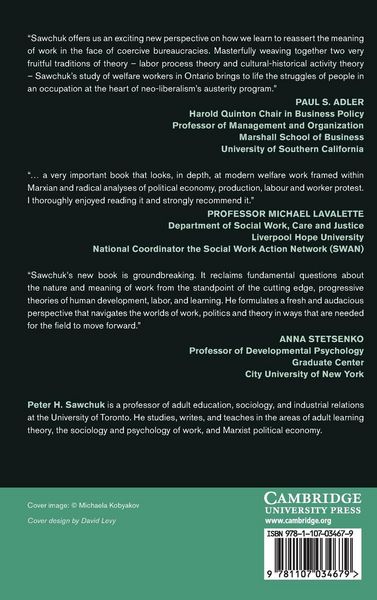
Drawing on the field of cultural historical psychology and the sociologies of skill and labour process, Contested Learning in Welfare Work offers a detailed account of the learning lives of state welfare workers in Canada as they cope, accommodate, resist and flounder in times of heightened austerity. Documented through in-depth qualitative and quantitative analysis, Peter Sawchuk shows how the labour process changes workers, and how workers change the labour process, under the pressures of intensified economic conditions, new technologies, changing relations of space and time, and a high-tech version of Taylorism. Sawchuk traces these experiences over a seven-year period that includes major work reorganisation and the recent economic downturn. His analysis examines the dynamics between notions of de-skilling, re-skilling and up-skilling, as workers negotiate occupational learning and changing identities.
Kundinnen und Kunden meinen
Verfassen Sie die erste Bewertung zu diesem Artikel
Helfen Sie anderen Kund*innen durch Ihre Meinung