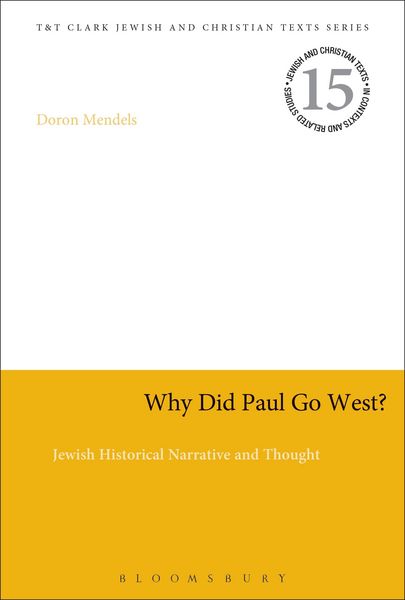
Produktbild: Why Did Paul Go West?

Why Did Paul Go West? Jewish Historical Narrative and Thought

Fr. 206.00

inkl. gesetzl. MwSt., Versandkostenfrei


Beschreibung

Produktdetails

Einband

Gebundene Ausgabe

Erscheinungsdatum

23.05.2013

Verlag

T. & T. Clark Ltd.

Seitenzahl

192

Maße (L/B/H)

24/16.1/1.5 cm

Gewicht

458 g

Sprache

Englisch

ISBN

978-0-567-36469-2

Beschreibung

Zitat

Doron Mendels is one of our finest historians of Judaism in the Hellenistic age. In the series of essays that make up this splendid volume, he offers numerous fresh insights into early Jewish historiography. The essays are notable for their combination of theoretical sophistication and careful textual analysis. The series of studies on the political theology and rhetorical strategies of 1 Maccabees are especially welcome and whet one's appetite for Mendels' forthcoming commentary on this vitally important book. -- Daniel C. Harlow, Calvin College, USA. While Professor Doron Mendels' book Why did Paul go West? focuses on the Hellenistic period, its great interest lies not only in its investigation of the ancient world, but above all in the way in which this investigation is made fruitful for an understanding of current historical and political realities. Indeed, the originality of its contribution is found both in what Doron Mendels terms a "polyphonic reading" of I Maccabees, revealing Hellenistic practices of remembering and reconfiguring (at times subverting) the past, and also in its groundbreaking examination of the deeper implications of this biblical text for an understanding of the modern conception of "political theology." Professor Mendels brilliantly demonstrates how the Hellenistic context of Jewish history, in which God and the prophets no longer seemed to guide the people, clearly foreshadows what 20th century political theory has termed a political "state of exception", thus raising the problem of sovereignty in a way that has lost nothing of its significance for our contemporary world. -- Professor Jeffrey Andrew Barash, University of Picardie, Amiens, France. Professor Mendels - a prolific scholar of early Judaism and perceptive contributor with new theoretical insights on ancient history - provocatively challenges the Judaism-Hellenism dualism. In recent decades it has been intellectual fashion to deconstruct the time-honoured Judaism-Hellenism dichotomy and to assert that all forms of early Judaism simultaneously were part and parcel of Hellenism. Mendels dissolves the absolute nature of the argument by highlighting the vast differences in terms of Hellenistic influence that existed between various forms of Judaism in the Western and Eastern part of the Roman Empire. The discussion is brought considerably further by nuanced reinstallation of former scholarship's dualism. -- Professor Anders Klostergaard Petersen, Aarhus University, Denmark.

Produktdetails

Einband

Gebundene Ausgabe

Erscheinungsdatum

23.05.2013

Verlag

T. & T. Clark Ltd.

Seitenzahl

192

Maße (L/B/H)

24/16.1/1.5 cm

Gewicht

458 g

Sprache

Englisch

ISBN

978-0-567-36469-2

Herstelleradresse

Libri GmbH
Europaallee 1
36244 Bad Hersfeld
DE

Email: gpsr@libri.de

Kundinnen und Kunden meinen

0 Bewertungen

Informationen zu Bewertungen

Zur Abgabe einer Bewertung ist eine Anmeldung im Konto notwendig. Die Authentizität der Bewertungen wird von uns nicht überprüft. Wir behalten uns vor, Bewertungstexte, die unseren Richtlinien widersprechen, entsprechend zu kürzen oder zu löschen.

Die Bewertungen sind nach Format, Anzahl Sterne und Datum sortiert.

Verfassen Sie die erste Bewertung zu diesem Artikel

Helfen Sie anderen Kund*innen durch Ihre Meinung

Kundinnen und Kunden meinen

0 Bewertungen filtern

  • Produktbild: Why Did Paul Go West?
  • 1. Why Did Paul Go West?
    2. How Was Antiquity Treated in Societies with a Hellenistic Heritage? And Why Did the Rabbis Avoid Writing History?
    3. Can We Read a Historical Text as a Musical Score? A New Approach to Polyphony and Simultaneity in 1 Maccabees
    4. The Conceptual Linearity of Historical Narrative and Its Distortion. A Preliminary Note
    5. Memory and Memories. The Attitude of 1 and 2 Maccabees toward Hellenization and Hellenism
    6. Phases of Inscribed Memory Concerning the Land of Israel in Palestinian Judaism of the Second Century BCE. The Case of 1 Maccabees
    7. Etiquette I: Was the Rejection of Gifts One of the Reasons for the Outbreak of the Maccabean Revolt? A Preliminary Note on the Role of Gifting in the Book of 1 Maccabees
    8. Etiquette II: Honor and Humiliation as a Factor in Hasmonean Politics According to the Narrator of 1 Maccabees
    9. Political Theology I: Deus Duplex to Deus Silens. The State of Exception in the Political Theology of 1 Maccabees
    10. Political Theology II: 1 Maccabees and Liberation from a Competing King-God and the Phenomenon of Rifts Inherent in Ancient Israel
    Selected Bibliography