
• Produktbild: Exponential Random Graph Models for Social Networks
  • Produktbild: Exponential Random Graph Models for Social Networks

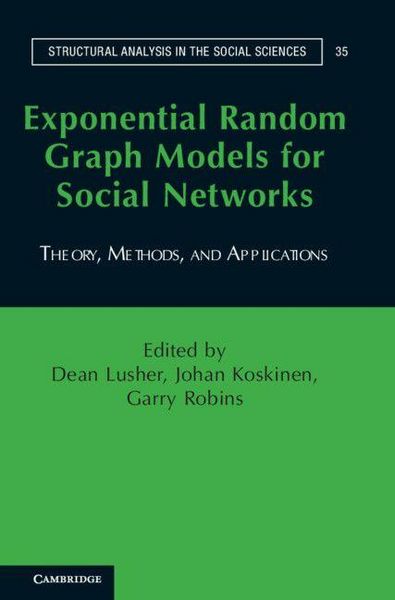
Exponential Random Graph Models for Social Networks Theory, Methods, and Applications

Fr. 128.00

inkl. gesetzl. MwSt., Versandkostenfrei


Beschreibung

Produktdetails

Einband

Gebundene Ausgabe

Erscheinungsdatum

31.01.2013

Herausgeber

Dean Lusher + weitere

Verlag

Cambridge Academic

Seitenzahl

360

Maße (L/B/H)

23.5/15.7/2.6 cm

Gewicht

600 g

Sprache

Englisch

ISBN

978-0-521-19356-6

Beschreibung

Zitat

Advance praise: 'I've been waiting impatiently for this book and I was definitely not disappointed. Finally we have a sourcebook on ERGMs that is both comprehensive and comprehensible. Most of the chapters are written for quantitative researchers who are not statisticians. Many illustrative empirical applications are worked through. Software packages are discussed. For the researcher who is intrigued by the possibility of analyzing network data with an ERGM, or who is already trying to do so, this is an indispensable resource.' Peter Carrington, University of Waterloo 'This collection offers readers an intuitive understanding of ERGMs, followed by a formal explanation of their statistical underpinnings as well as a methodological cookbook based on current software. Next, network scholars at the forefront of advancing theoretical and methodological contributions present eight compelling empirical studies. These studies illustrate how ERGMs offer exciting opportunities to advance theoretical understandings of network phenomena at the intra-organizational, inter-organizational, and societal levels.' Noshir Contractor, Jane S. and William J. White Professor of Behavioral Sciences, Northwestern University 'p*, the exponential family of random graph distributions introduced by Frank and Strauss in 1986, has indeed become the best statistical model in network science. This edited volume is a must-have - Lusher, Koskinen, and Robins have put together a thorough compilation for both the p* novice and enthusiast. It is the handbook to own - and use!' Stanley Wasserman, Indiana University

Produktdetails

Einband

Gebundene Ausgabe

Erscheinungsdatum

31.01.2013

Herausgeber

Verlag

Cambridge Academic

Seitenzahl

360

Maße (L/B/H)

23.5/15.7/2.6 cm

Gewicht

600 g

Sprache

Englisch

ISBN

978-0-521-19356-6

Herstelleradresse

Libri GmbH
Europaallee 1
36244 Bad Hersfeld
DE

Email: Libri GmbH

Kundinnen und Kunden meinen

0 Bewertungen

Informationen zu Bewertungen

Zur Abgabe einer Bewertung ist eine Anmeldung im Konto notwendig. Die Authentizität der Bewertungen wird von uns nicht überprüft. Wir behalten uns vor, Bewertungstexte, die unseren Richtlinien widersprechen, entsprechend zu kürzen oder zu löschen.

Die Bewertungen sind nach Format, Anzahl Sterne und Datum sortiert.

Verfassen Sie die erste Bewertung zu diesem Artikel

Helfen Sie anderen Kund*innen durch Ihre Meinung

Kundinnen und Kunden meinen

0 Bewertungen filtern

Die Leseprobe wird geladen.
  • Produktbild: Exponential Random Graph Models for Social Networks
  • Produktbild: Exponential Random Graph Models for Social Networks
  • Introduction Dean Lusher, Johan Koskinen and Garry Robins; 1. What are exponential random graph models Garry Robins and Dean Lusher; 2. The formation of social network structure Dean Lusher and Garry Robins; 3. A simplified account of ERGM as a statistical model Garry Robins and Dean Lusher; 4. An example of ERGM analysis Dean Lusher and Garry Robins; 5. Exponential random graph model fundamentals Johan Koskinene and Galina Daraganova; 6. Dependence graphs and sufficient statistics Johan Koskinen and Galina Daraganova; 7. Social selection, dyadic covariates and geospatial effects Garry Robins and Galina Daraganova; 8. Autologistic actor attribute models Galina Daraganova and Garry Robins; 9. ERGM extensions: models for multiple networks and bipartite networks Peng Wang; 10. Longitudinal models Tom Snijders and Johan Koskinen; 11. Simulation, estimation and goodness of fit Johan Koskinen and Tom Snijders; 12. Illustrations: simulation, estimation and goodness of fit Garry Robins and Dean Lusher; 13. Personal attitudes, perceived attitudes and social structures: a social selection model Dean Lusher and Garry Robins; 14. How to close a hole: exploring alternative closure mechanisms in inter-organizational networks Alessandro Lomi and Francesca Pallotti; 15. Interdependencies between working relations: multivariate ERGMs for advice and satisfaction Yu Zhao and Olaf Rank; 16. Brain, brawn or optimism? The structure and correlates of emergent military leadership Yuval Kalish and Gil Luria; 17. An ALAAM analysis of unemployment: the dual importance of who you know and where you live Galina Daraganova and Philippa Pattison; 18. Longitudinal changes in face-to-face and text message-mediated friendship networks Tasuku Igarashi; 19. The differential impact of directors' social and financial capital on corporate interlock formation Nicholas Harrigan and Matthew Bond; 20. Comparing networks: a structural correspondence between behavioural and recall networks Eric Quintane; 21. Modelling social networks: next steps Philippa Pattison and Tom Snijders.