• Produktbild: Optimal Learning Environments to Promote Student Engagement
  • Produktbild: Optimal Learning Environments to Promote Student Engagement

Optimal Learning Environments to Promote Student Engagement

Fr. 192.00

inkl. gesetzl. MwSt., Versandkostenfrei


Beschreibung

Produktdetails

Einband

Gebundene Ausgabe

Erscheinungsdatum

29.05.2013

Verlag

Springer Us

Seitenzahl

368

Maße (L/B/H)

24.1/16/2.5 cm

Gewicht

746 g

Auflage

2013

Sprache

Englisch

ISBN

978-1-4614-7088-5

Beschreibung

Rezension

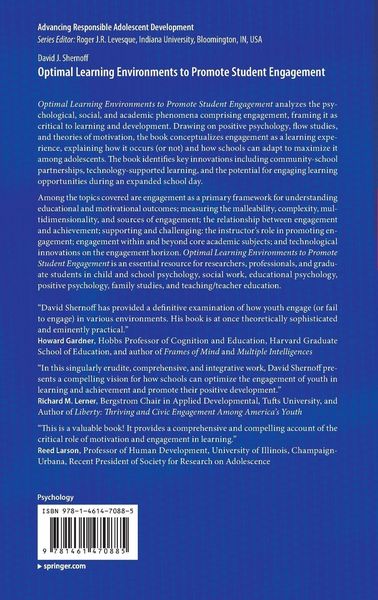
"David Shernoff has provided a definitive examination of how youth engage (or fail to engage) in various environments. His book is at once theoretically sophisticated and eminently practical."

Howard Gardner, Hobbs Professor of Cognition and Education, Harvard Graduate School of Education, and author of Frames of Mind and Multiple Intelligences

---

"In this singularly erudite, comprehensive, and integrative work, David Shernoff presents a compelling vision for how schools can optimize the engagement of youth in learning and achievement and promote their positive development. This book provides scholars, educators, and policy makers with a unique conceptual template for enhancing the lives of diverse young people and for strengthening the schools and communities of our nation."

Richard M. Lerner, Bergstrom Chair in Applied Developmental Science and Director, Institute for Applied Research in Youth Development, Tufts University, and Author of Liberty: Thriving and Civic Engagement Among America's Youth

---

"This is a valuable book! Schools are not living up their potentials and a major reason is their failure to truly engage students. Shernoff's book provides a comprehensive and compelling account of the critical role of motivation and engagement in learning. The chapters present the research on every aspect of the topic: how engagement effects achievement; how effective teachers sustain high engagement; the design of classroom activities to maximize motivation; and the ways that new model programs, successful alternative schools, and after-school programs facilitate absorption in learning."

Reed Larson, Professor of Human Development, University of Illinois, Champaign-Urbana, Recent President of Society for Research on Adolescence, and Editor-in-Chief (with Lene Jensen) of New Directions forChild and Adolescent Development

---

"Shernoff's book on learning environments and student engagement is a good resource for school and district leaders to establish the why of optimal learning environments-the theoretical underpinnings of student motivation, engagement, and learning. It also gives concrete guidance in the what and how for considering strategies for engagement in typical classrooms, as well as a brief discussion of alternative, out-of-school, and technology-based programs."

Susan Catapano & Jeremy Hilburn
PsycCRITIQUES
February 24, 2014, Vol. 59, No. 8, Article 7

Produktdetails

Einband

Gebundene Ausgabe

Erscheinungsdatum

29.05.2013

Verlag

Springer Us

Seitenzahl

368

Maße (L/B/H)

24.1/16/2.5 cm

Gewicht

746 g

Auflage

2013

Sprache

Englisch

ISBN

978-1-4614-7088-5

Herstelleradresse

Springer-Verlag GmbH
Tiergartenstr. 17
69121 Heidelberg
DE

Email: ProductSafety@springernature.com

Kundinnen und Kunden meinen

0 Bewertungen

Informationen zu Bewertungen

Zur Abgabe einer Bewertung ist eine Anmeldung im Konto notwendig. Die Authentizität der Bewertungen wird von uns nicht überprüft. Wir behalten uns vor, Bewertungstexte, die unseren Richtlinien widersprechen, entsprechend zu kürzen oder zu löschen.

Die Bewertungen sind nach Format, Anzahl Sterne und Datum sortiert.

Verfassen Sie die erste Bewertung zu diesem Artikel

Helfen Sie anderen Kund*innen durch Ihre Meinung

Kundinnen und Kunden meinen

0 Bewertungen filtern

  • Produktbild: Optimal Learning Environments to Promote Student Engagement
  • Produktbild: Optimal Learning Environments to Promote Student Engagement
  • 1. Introduction: Towards Optimal Learning Environments in Schools.- 2. Aims of Education Revisited (Einstein’s E = MC2 of Education).- 3. The Nature Engagement in Schools.- 4. Measuring Student Engagement in High School Classrooms and What We Have.- 5. Engagement as an Individual Trait and its Relationship to Achievement.- 6. Connecting to “The How” of Classroom Engagement: Instruction and Optimal.- 7. Connecting to “The Who”: The Primacy of Supportive.- 8.  Connecting to “The What”: Engaging Approaches to Traditional Subject Matter.- 9. Engagement Beyond the Core Academic Subjects.- 10. Private School Models and The Case of Montessori Schools.- 11. Alternative Public School Models.- 12. Learning from Research on Youth Engagement During Out-of-School Time.- 13. Model After-School Programs.- 14. Technological Innovations on the Horizon.- 15. Re-engineering the Schools of Tomorrow: Towards Community Sponsorship.