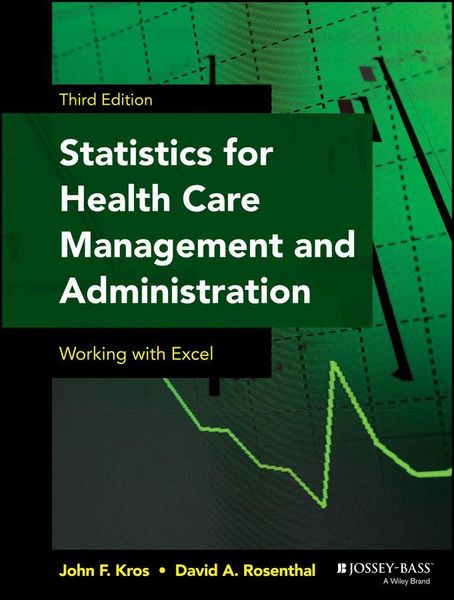
Produktbild: Statistics for Health Care Management and Administration

Statistics for Health Care Management and Administration Working with Excel

Fr. 139.00

inkl. gesetzl. MwSt., Versandkostenfrei


Beschreibung

Produktdetails

Einband

Taschenbuch

Erscheinungsdatum

11.01.2016

Verlag

John Wiley & Sons

Seitenzahl

560

Maße (L/B/H)

23.4/17.5/3 cm

Gewicht

885 g

Auflage

3rd Revised edition

Sprache

Englisch

ISBN

978-1-118-71265-8

Beschreibung

Produktdetails

Einband

Taschenbuch

Erscheinungsdatum

11.01.2016

Verlag

John Wiley & Sons

Seitenzahl

560

Maße (L/B/H)

23.4/17.5/3 cm

Gewicht

885 g

Auflage

3rd Revised edition

Sprache

Englisch

ISBN

978-1-118-71265-8

Herstelleradresse

Libri GmbH
Europaallee 1
36244 Bad Hersfeld
DE

Email: GPSR Kontakt

Noch keine Bewertungen vorhanden

Verfassen Sie die erste Bewertung zu diesem Artikel

Helfen Sie anderen Kundinnen und Kunden durch Ihre Meinung.

Kundinnen und Kunden meinen

Bewertungen (0)

Die Leseprobe wird geladen.
  • Produktbild: Statistics for Health Care Management and Administration
  • Preface xiii

    Introducing Excel xiii

    So How Did We Get to Here? xiii

    Intended Level of the Textbook xiv

    Textbook Organization xiv

    Leading by Example(s) xv

    Acknowledgments xvii

    The Authors xix

    Part 1 1

    Chapter 1 Statistics and Excel 3

    1.1 How This Book Differs from Other Statistics Texts 3

    1.2 Statistical Applications in Health Policy and Health Administration 4

    Exercises for Section 1.2 14

    1.3 What Is the ''Big Picture''? 15

    1.4 Some Initial Definitions 16

    Exercises for Section 1.4 26

    1.5 Five Statistical Tests 28

    Exercises for Section 1.5 30

    Chapter 2 Excel as a Statistical Tool 33

    2.1 The Basics 33

    Exercises for Section 2.1 35

    2.2 Working and Moving Around in a Spreadsheet 36

    Exercises for Section 2.2 41

    2.3 Excel Functions 41

    Exercises for Section 2.3 46

    2.4 The =IF() Function 47

    Exercises for Section 2.4 50

    2.5 Excel Graphs 51

    Exercises for Section 2.5 56

    2.6 Sorting a String of Data 57

    Exercise for Section 2.6 60

    2.7 The Data Analysis Pack 61

    2.8 Functions That Give Results in More than One Cell 63

    Exercises for Section 2.8 66

    2.9 The Dollar Sign ($) Convention for Cell References 67

    Chapter 3 Data Acquisition: Sampling and Data Preparation 71

    3.1 The Nature of Data 71

    Exercises for Section 3.1 78

    3.2 Sampling 79

    Exercises for Section 3.2 93

    3.3 Data Access and Preparation 94

    Exercises for Section 3.3 107

    3.4 Missing Data 108

    Chapter 4 Data Display: Descriptive Presentation, Excel Graphing Capability 111

    4.1 Creating, Displaying, and Understanding Frequency Distributions 111

    Exercises for Section 4.1 129

    4.2 Using the Pivot Table to Generate Frequencies of Categorical Variables131

    Exercises for Section 4.2 135

    4.3 A Logical Extension of the Pivot Table: Two Variables 135

    Exercises for Section 4.3 140

    Chapter 5 Basic Concepts of Probability 141

    5.1 Some Initial Concepts and Definitions 141

    Exercises for Section 5.1 150

    5.2 Marginal Probabilities, Joint Probabilities, and Conditional Probabilities 150

    Exercises for Section 5.2 160

    5.3 Binomial Probability 161

    Exercises for Section 5.3 171

    5.4 The Poisson Distribution 173

    Exercises for Section 5.4 178

    5.5 The Normal Distribution 178

    Chapter 6 Measures of Central Tendency and Dispersion: Data Distributions 183

    6.1 Measures of Central Tendency and Dispersion 183

    Exercises for Section 6.1 196

    6.2 The Distribution of Frequencies 197

    Exercises for Section 6.2 208

    6.3 The Sampling Distribution of the Mean 209

    Exercises for Section 6.3 219

    6.4 Mean and Standard Deviation of a Discrete Numerical Variable 220

    Exercises for Section 6.4 222

    6.5 The Distribution of a Proportion 222

    Exercises for Section 6.5 227

    6.6 The t Distribution 227

    Exercises for Section 6.6 232

    Part 2 235

    Chapter 7 Confidence Limits and Hypothesis Testing 237

    7.1 What Is a Confidence Interval? 237

    Exercises for Section 7.1 243

    7.2 Calculating Confidence Limits for Multiple Samples 244

    Exercises for Section 7.2 246

    7.3 What Is Hypothesis Testing? 247

    Exercises for Section 7.3 249

    7.4 Type I and Type II Errors 250

    Exercises for Section 7.4 266

    7.5 Selecting Sample Sizes 267

    Exercises for Section 7.5 269

    Chapter 8 Statistical Tests for Categorical Data 271

    8.1 Independence of Two Variables 271

    Exercises for Section 8.1 282

    8.2 Examples of Chi-Square Analyses283

    Exercises for Section 8.2 289

    8.3 Small Expected Values in Cells 290

    Exercises for Section 8.3 292

    Chapter 9 t Tests for Related and Unrelated Data 295

    9.1 What Is a t Test? 295

    Exercises for Section 9.1 302

    9.2 A t Test for Comparing Two Groups 303

    Exercises for Section 9.2 316

    9.3 A t Test for Related Data 318

    Exercises for Section 9.3 321

    Chapter 10 Analysis of Variance 323

    10.1 One-Way Analysis of Variance 323

    Exercises for Section 10.1 339

    10.2 ANOVA for Repeated Measures 340

    Exercises for Section 10.2 348

    10.3 Factorial Analysis of Variance 349

    Exercises for Section 10.3 362

    Chapter 11 Simple Linear Regression 365

    11.1 Meaning and Calculation of Linear Regression 365

    Exercises for Section 11.1 373

    11.2 Testing the Hypothesis of Independence 374

    Exercises for Section 11.2 380

    11.3 The Excel Regression Add-In 381

    Exercises for Section 11.3 388

    11.4 The Importance of Examining the Scatterplot 388

    11.5 The Relationship between Regression and the t Test 391

    Exercises for Section 11.5 392

    Chapter 12 Multiple Regression: Concepts and Calculation 395

    12.1 Introduction 395

    Exercises for Section 12.1 406

    Chapter 13 Extensions ofMultiple Regression 409

    13.1 Dummy Variables in Multiple Regression 409

    Exercises for Section 13.1 420

    13.2 The Best Regression Model 421

    Exercises for Section 13.2 431

    13.3 Correlation and Multicolinearity 432

    Exercises for Section 13.3 435

    13.4 Nonlinear Relationships 435

    Exercises for Section 13.4 447

    Chapter 14 Analysis with a Dichotomous Categorical Dependent Variable 449

    14.1 Introduction to the Dichotomous Dependent Variable 450

    14.2 An Example with a Dichotomous Dependent Variable:

    Traditional Treatments 451

    Exercises for Section 14.2 462

    14.3 Logit for Estimating Dichotomous Dependent Variables 463

    Exercises for Section 14.3 475

    14.4 A Comparison of Ordinary Least Squares, Weighted Least Squares, and Logit 476

    Exercises for Section 14.4 480

    Appendix A Multiple Regression and Matrices 481

    An Introduction to Matrix Math 481

    Addition and Subtraction of Matrices 482

    Multiplication of Matrices 483

    Matrix Multiplication and Scalars 484

    Finding the Determinant of a Matrix 484

    Matrix Capabilities of Excel 486

    Explanation of Excel Output Displayed with Scientific Notation 489

    Using the b Coefficients to Generate Regression Results 490

    Calculation of All Multiple Regression Results 491

    Exercises for Appendix A 494

    References 497

    Glossary 499

    Index 513