Gutscheinbedingungen

*Gültig bis 05.07.2026 auf (fast) alles. Ausgeschlossen sind Smartboxen, Zeitschriften, Tickets, Lebensmittel, Gaming-Elektroartikel, Tinte/Toner, Gutscheine, Geschenkkarten, Blumen und Abos | Einlösbar in allen Buchhandlungen von Orell Füssli, Barth Bücher, Buchladen Rapunzel, Papeterie Köhler, Schuler Orell Füssli, Stauffacher und ZAP unter Vorweisung des Gutscheins, auf www.orellfüssli.ch durch Eingabe des Gutscheincodes. Beim Service „eBooks verschenken“ und bei eBook-Käufen via eReader nicht einlösbar | Mindesteinkaufswert: Fr. 30.- | Nicht mit anderen Rabatten kumulierbar.

  • Produktbild: Biomembranes
  • Produktbild: Biomembranes
Band 10

Biomembranes

Aus der Reihe Biomembranes

Fr. 137.00

inkl. gesetzl. MwSt., Versandkostenfrei


Beschreibung

Produktdetails

Einband

Taschenbuch

Erscheinungsdatum

12.12.2012

Verlag

Springer Us

Seitenzahl

242

Maße (L/B/H)

22.9/15.2/1.5 cm

Gewicht

376 g

Auflage

Softcover reprint of the original 1st ed. 1979

Sprache

Englisch

ISBN

978-1-4615-6566-6

Beschreibung

Produktdetails

Einband

Taschenbuch

Erscheinungsdatum

12.12.2012

Verlag

Springer Us

Seitenzahl

242

Maße (L/B/H)

22.9/15.2/1.5 cm

Gewicht

376 g

Auflage

Softcover reprint of the original 1st ed. 1979

Sprache

Englisch

ISBN

978-1-4615-6566-6

Herstelleradresse

Springer-Verlag KG
Sachsenplatz 4-6
1201 Wien
AT

Email: GPSR Kontakt

Noch keine Bewertungen vorhanden

Verfassen Sie die erste Bewertung zu diesem Artikel

Helfen Sie anderen Kundinnen und Kunden durch Ihre Meinung.

Kundinnen und Kunden meinen

Bewertungen (0)

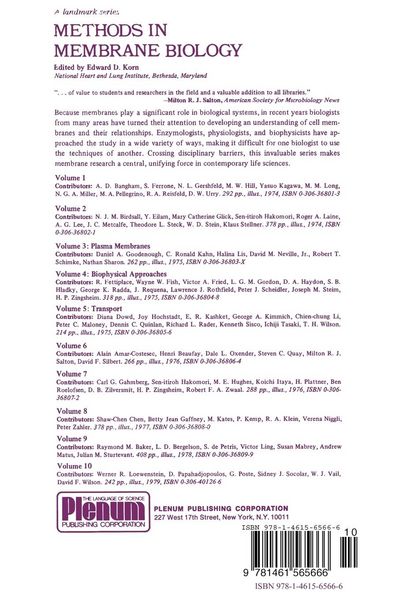
  • Produktbild: Biomembranes
  • Produktbild: Biomembranes
  • 1 The Renal Proximal Tubule.- I. Introduction.- II. Morphologic Asymmetry.- III. Biochemical Asymmetry.- IV. Transport Asymmetry.- A. Sugar Transport.- B. Amino Acid Transport.- C. Phosphate Transport.- D. Uric Acid Transport.- E. Lactate Transport.- F. Paraaminohippurate Transport.- G. Anion Channels.- V. Interdependence of Tubular Transport Systems.- VI. Hormone Receptors.- VII. Structural Determinants of Epithelial Plasma Membrane Asymmetry.- VIII. Proximal Tubule Dysfunction.- A. Type I—Altered Gene Product.- B. Type II—The Fanconi Syndrome—Disorder of Membrane Energization.- C. Homology between Red Cell Membrane and the Antiluminal Membrane of the Renal Proximal Tubule.- IX. Conclusion.- X. References.- 2 The Involvement of the Golgi Apparatus in the Biosynthesis and Secretion of Glycoproteins and Polysaccharides.- I. Introduction.- II. Polysaccharide and Glycoprotein Formation.- A. Transport of Initial Glycosyl Donors to the Lumen of the Endomembrane System.- B. Assembly of Sugar Polymers on Intermediate Carriers.- C. Types of Glycoprotein and Polysaccharide Formed by the Endomembrane System.- D. Assembly of Complexes within the Golgi Apparatus.- III. Transport of the Polymers from the Endomembrane System.- A. Transport as Lipoglycoprotein.- B. Transport of Vesicles.- IV. Membrane Fusion.- A. Biochemistry of Membranes at Fusion.- B. Ultrastructure of the Membranes at Fusion.- C. Ultrastructure during the Formation of Transport Vesicles from Membranes.- D. The Fusion Process.- E. Membrane Recycling.- V. Control of Polysaccharide Formation for Secretion.- A. Formation of the Golgi Apparatus.- B. Membrane Differentiation and Change in the function of the Golgi Apparatus.- C. Control of the Activity of the Golgi Apparatus by Enzymic Regulation.- D. Control of Vesicle Fusion at the Plasma Membrane.- VI. References.- 3 Notes on the Heterogeneity, Circulation, and Modification of Membranes, with Emphasis on Secretory Cells, Photoreceptors, and the Toad Bladder.- I. Introduction.- II. Membrane Heterogeneity and the Endoplasmic Reticulum.- A. Lateral Heterogeneity in the Plasma Membrane.- B. Heterogeneity in the Endoplasmic Reticulum.- C. Three Zones of Smooth ER in Retinal Photoreceptors.- D. The Membranes of ER-Derived Organelles.- III. Membrane Diversification.- A. Bulk Transport Phenomena.- B. Specificity of Membrane Growth and Assembly.- C. Selective Redistribution of Membrane Constituents.- D. Ongoing Studies of Membrane Modification: Microorganisms and the Toad Bladder.- IV. Concluding Comments.- V. References.- 4 Lipoprotein of the Outer Membrane of Escherichia coli.- I. Introduction.- A. Is the Outer Membrane Foreign to You?.- B. What Is the Outer Membrane?.- II. Structure.- A. Bound Form of the Lipoprotein.- B. Free Form of the Lipoprotein.- C. Location and Amount of the Lipoprotein.- D. Conformation of the Lipoprotein.- III. Biosynthesis.- A. Specific Biosynthesis in Vivo.- B. Effects of Antibiotics.- C. Cell-Free Synthesis.- D. Prolipoprotein: Precursor of the Lipoprotein.- E. Structure of the Lipoprotein mRNA.- IV. Modification and Assembly.- A. Posttranslational Modification.- B. Molecular Assembly Models.- C. Interactions with Other Proteins.- D. Effects of Lipid Fluidity.- E. In Vitro Assembly.- V. Genetic Approaches.- A. Isolation of Mutants of the Lipoprotein.- B. Gene-Dosage Effects.- C. Genetic Engineering.- D. Other Gram-Negative Bacteria.- VI. Other Approaches.- A. Electron Spin Resonance (ESR); Nuclear Magnetic Resonance (NMR).- B. Mitogenic Activity.- C. Identification of Lysozyme Specificity.- VII. Conclusions.- VIII. References.- 5 Electrochemical Proton Gradient across the Membranes of Photophosphorylating Bacteria.- I. Introduction.- II. Electrochemical Potential Gradient across the Chromatophore Membrane.- A. Registration of Electric Potential Difference.- B. Registration of the Transmembranous Difference of Proton Concentrations.- III. Electrochemical Potential Gradient across the Bacteriorhodopsin Membrane.- A. Characteristics of Bacteriorhodopsin.- B. Registration of the Electrochemical Potential Gradient.- C. Proton Binding and Release during the Photoreaction Cycle.- IV. Functions of the Transmembrane Electrochemical Potential Gradient.- A. Energy Pool.- B. Polyfunctional Regulator.- V. Addendum.- VI. References.