• Produktbild: Physics-Based Deformable Models
  • Produktbild: Physics-Based Deformable Models
Band 389

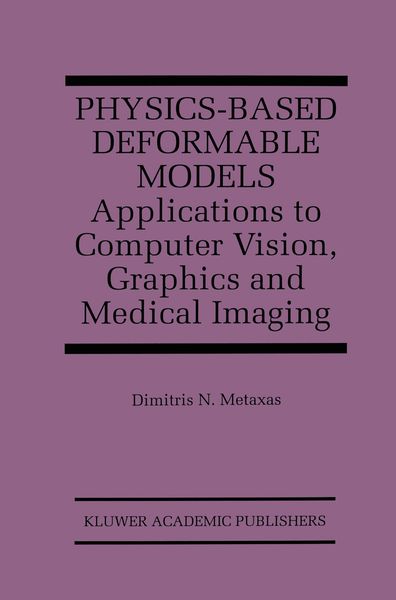
Physics-Based Deformable Models Applications to Computer Vision, Graphics and Medical Imaging

Fr. 191.00

inkl. gesetzl. MwSt., Versandkostenfrei


Beschreibung

Produktdetails

Einband

Taschenbuch

Erscheinungsdatum

12.10.2012

Verlag

Springer Us

Seitenzahl

308

Maße (L/B/H)

23.5/15.5/1.8 cm

Gewicht

499 g

Auflage

Softcover reprint of the original 1st ed. 1997

Sprache

Englisch

ISBN

978-1-4613-7909-6

Beschreibung

Produktdetails

Einband

Taschenbuch

Erscheinungsdatum

12.10.2012

Verlag

Springer Us

Seitenzahl

308

Maße (L/B/H)

23.5/15.5/1.8 cm

Gewicht

499 g

Auflage

Softcover reprint of the original 1st ed. 1997

Sprache

Englisch

ISBN

978-1-4613-7909-6

Herstelleradresse

Springer-Verlag GmbH
Tiergartenstr. 17
69121 Heidelberg
DE

Email: ProductSafety@springernature.com

Kundinnen und Kunden meinen

0 Bewertungen

Informationen zu Bewertungen

Zur Abgabe einer Bewertung ist eine Anmeldung im Konto notwendig. Die Authentizität der Bewertungen wird von uns nicht überprüft. Wir behalten uns vor, Bewertungstexte, die unseren Richtlinien widersprechen, entsprechend zu kürzen oder zu löschen.

Die Bewertungen sind nach Format, Anzahl Sterne und Datum sortiert.

Verfassen Sie die erste Bewertung zu diesem Artikel

Helfen Sie anderen Kund*innen durch Ihre Meinung

Kundinnen und Kunden meinen

0 Bewertungen filtern

  • Produktbild: Physics-Based Deformable Models
  • Produktbild: Physics-Based Deformable Models
  • 1 Introduction.- 1.1 Illustrative Examples of Modeling and Estimation.- 1.2 Chapter Outline.- 2 Geometry of Deformable Models.- 2.1 Related Work.- 2.2 Hybrid Deformable Models.- 3 Kinematics and Dynamics.- 3.1 Kinematics.- 3.2 Dynamics.- 3.3 Choosing the Order of the Motion Equations.- 4 Finite Element Implementation.- 4.1 Choosing the Appropriate Elements.- 4.2 Various Model Tessellations.- 4.3C0Elements.- 4.4C1Triangular Elements.- 4.5 Approximation of the Lagrange Equations.- 5 Applied Forces.- 5.1 Computer Vision and Medical Imaging Applications.- 5.2 Computer Graphics Applications.- 5.3 Force–Based Estimation.- 6 Model Implementation.- 6.1 Integrating the Motion Equations.- 6.2 Model Initialization.- 6.3 Computer Vision Experiments.- 6.4 Computer Graphics Experiments.- 7 Constrained Nonrigid Motion.- 7.1 Holonomic Constraints and Lagrange Multipliers.- 7.2 Stabilized Constraints.- 7.3 Fast Constraint Force Computation for Multibody Objects.- 7.4 Experiments with Constraints.- 8 Shape and Nonrigid Motion Estimation.- 8.1 Recursive Estimation.- 8.2 Kalman Filter Implementation.- 8.3 Recursive Estimation of Shape and Nonrigid Motion.- 9 Multi–Level Shape Representation.- 9.1 Related Work.- 9.2 Deformable Models: Geometry and Dynamics.- 9.3 Locally Adaptive Finite Elements.- 9.4 Summary of Model Fitting to Range Data.- 9.5 Experiments.- 10 Topologically Adaptive Models Based on Blending.- 10.1 Related Work.- 10.2 Blended shapes.- 10.3 Reconstruction and evolution.- 10.4 Experiments.- 11 Integration of Qualitative Segmentation and Pbm Methods.- 11.1 Related Work.- 11.2 Qualitative Model Extraction.- 11.3 Quantitative Shape and Motion Recovery.- 12 Motion–Based Part Segmentation and Tracking.- 12.1 Related Prior Work.- 12.2 Deformable Models: Extensions.- 12.3Inferring structure in 2D.- 12.4 Two–dimensional human body model acquisition.- 12.5 Three–dimensional Human Body model acquisition.- 12.6 Human Body Tracking.- 12.7 Experimental Results.- 13 Volumetric Analysis of the Left Ventricular Wall Motion From Mri–Spamm.- 13.1 Related Work.- 13.2 Data Extraction Techniques for Cardiac Motion Studies.- 13.3 Volumetric Deformable Models with Parameter Functions.- 13.4 Model Force Computation.- 13.5 Model Parameters.- 13.6 Implementation of Model Fitting Procedure.- 13.7 Experimental Results.- 14 Visualizing Respiratory Mechanics Based on Anatomical and Physiological Modeling.- 14.1 Related Work.- 14.2 Basic Anatomy and Physiology.- 14.3 Methods.- 14.4 Results.- 15 Recursive Dynamics and Adaptive Control for Animating Articulated Figures.- 15.1 System Description.- 15.2 Efficient Forward Dynamics.- 15.3 Collision handling.- 15.4 Dynamic Control.- 15.5 Results.- 16 Animating Liquids.- 16.1 Navier–Stokes Equations.- 16.2 Solving the Navier–Stokes equations.- 16.3 Tracking fluid position.- 16.4 Buoyancy.- 16.5 Summary of the Navier–Stokes Algorithm.- 16.6 Control.- 16.7 Examples.- 17 Conclusions.- A.- References.