
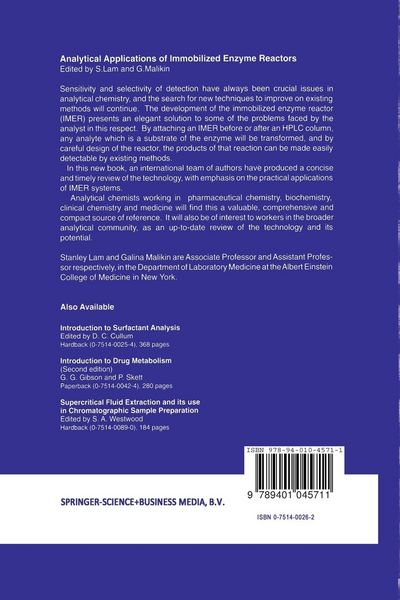
• Produktbild: Analytical Applications of Immobilized Enzyme Reactors
  • Produktbild: Analytical Applications of Immobilized Enzyme Reactors

Analytical Applications of Immobilized Enzyme Reactors

Fr. 241.00

inkl. gesetzl. MwSt., Versandkostenfrei


Beschreibung

Produktdetails

Einband

Taschenbuch

Erscheinungsdatum

30.10.2012

Herausgeber

S. Lam + weitere

Verlag

Springer Netherland

Seitenzahl

276

Maße (L/B/H)

23.5/15.5/1.6 cm

Gewicht

446 g

Auflage

1. Auflage

Sprache

Englisch

ISBN

978-94-010-4571-1

Beschreibung

Rezension

The editors, both experts in the field, succeeded in finding 18 co-authors who published numerous papers in the area of immobilized enzyme reactors. The result is a monograph with important practical information for those who want to use this type of chemistry in combination with liquid chromatography...a valuable tool for those developing new applications. - Journal of Chromatography; Overall, this book presents a very useful and well referenced introduction to the use of IMERs in chromatography. - Analyst; ...well written and accessible to the non-specialist...this is a well produced book, with a good number of illustration and references and a clear typeface...A useful reference book if you already use IMER technology, and equally useful if you are not a user but want to know more and get up to speed in this area. - Chromatographia

Produktdetails

Einband

Taschenbuch

Erscheinungsdatum

30.10.2012

Herausgeber

Verlag

Springer Netherland

Seitenzahl

276

Maße (L/B/H)

23.5/15.5/1.6 cm

Gewicht

446 g

Auflage

1. Auflage

Sprache

Englisch

ISBN

978-94-010-4571-1

Herstelleradresse

Springer-Verlag KG
Sachsenplatz 4-6
1201 Wien
AT

Email: ProductSafety@springernature.com

Kundinnen und Kunden meinen

0 Bewertungen

Informationen zu Bewertungen

Zur Abgabe einer Bewertung ist eine Anmeldung im Konto notwendig. Die Authentizität der Bewertungen wird von uns nicht überprüft. Wir behalten uns vor, Bewertungstexte, die unseren Richtlinien widersprechen, entsprechend zu kürzen oder zu löschen.

Die Bewertungen sind nach Format, Anzahl Sterne und Datum sortiert.

Verfassen Sie die erste Bewertung zu diesem Artikel

Helfen Sie anderen Kund*innen durch Ihre Meinung

Kundinnen und Kunden meinen

0 Bewertungen filtern

  • Produktbild: Analytical Applications of Immobilized Enzyme Reactors
  • Produktbild: Analytical Applications of Immobilized Enzyme Reactors
  • 1 Immobilized enzyme reactors: developmental, practical and theoretical considerations.- 1.1 Introduction.- 1.2 Immobilized enzyme reactors (IMERs).- 1.3 IMER configurations.- 1.4 Enzyme kinetics theory.- 1.5 Flow reactor systems.- 1.6 Flow properties.- References.- 2 Flow reaction detection system designs for sugars and amino acids.- 2.1 Sugars.- 2.2 Amino acids.- 2.3 Conclusion.- References.- 3 Analysis of mono-, oligo- and polysaccharides by enzyme reaction detection.- 3.1 Introduction.- 3.2 Significance of carbohydrates.- 3.3 Flow analysis systems.- 3.4 Chromatographic detectors.- 3.5 Enzymes for carbohydrate analysis.- 3.6 Sample pretreatment.- 3.7 Applications.- Acknowledgements.- References.- 4 Uremic toxin analysis with pre- and post-column immobilized enzyme reactors.- 4.1 Introduction.- 4.2 Hypoxanthine, xanthine and uric acid.- 4.3 Creatinine, urea and electrolytes.- 4.4 Conclusion.- Acknowledgement.- References.- 5 Hydroxysteroids analysis by HPLC with semi-specific post-column immobilized enzyme reactors.- 5.1 Introduction.- 5.2 Post-column enzyme detection of hydroxysteroids.- 5.3 Preparation of the immobilized enzyme reactor.- 5.4 Characterization of the enzyme reactors.- 5.5 HPLC of hydroxysteroids.- 5.6 Enhanced chiral resolution of steroid epimers with stereospecific dehydrogenases.- References.- 6 HPLC of bile acids.- 6.1 Introduction.- 6.2 Detection of products of reaction.- 6.3 Preparation of the reactor.- 6.4 Analytical system.- 6.5 Analysis using an immobilized enzyme reactor.- 6.6 Discussion.- References.- 7 Determination of glucuronide and sulfate conjugates.- 7.1 Introduction.- 7.2 Principle of enzyme detection.- 7.3 Immobilization procedure and preparation of IMER.- 7.4 Reaction conditions and considerations.- 7.5 Selectivity, linearity and reproducibility.- 7.6 Detection of products of reaction.- 7.7 Biomedical applications.- 7.8 Conclusions.- References.- 8 Nicotinamide coenzymes: enzyme reaction detection and signal amplification by substrate recycling.- 8.1 Introduction.- 8.2 Glucose-6-phosphate dehydrogenase reactor.- 8.3 Enzyme reactor for signal amplification by substrate recycling.- References.- 9 Determination of blood ethanol with immobilized alcohol dehydrogenase and oxidase.- 9.1 Introduction.- 9.2 Alcohol dehydrogenase reaction.- 9.3 Preparation of reactors.- 9.4 Detection.- 9.5 Analysis of ethanol in blood.- 9.6 Discussion.- 9.7 Conclusion.- Acknowledgement.- References.- 10 Miscellaneous applications with immobilized enzyme reactors.- 10.1 HPLC of aldehydes with enzyme reaction detection.- 10.2 Trace analysis of zinc by immobilized metalloenzyme reactors.- References.- List of abbreviations.