Gutscheinbedingungen

*Gültig bis 20.07.2026 auf alle Bücher. Ausgeschlossen sind Zeitschriften, Prozentbücher und Abos | Einlösbar in allen Buchhandlungen von Orell Füssli, Barth Bücher, Buchladen Rapunzel, Papeterie Köhler, Schuler Orell Füssli, Stauffacher und ZAP unter Vorweisung des Gutscheins, auf www.orellfüssli.ch durch Eingabe des Gutscheincodes. Beim Service „eBooks verschenken“ und bei eBook-Käufen via eReader nicht einlösbar | Mindesteinkaufswert: Fr. 30.- | Nicht mit anderen Rabatten kumulierbar.

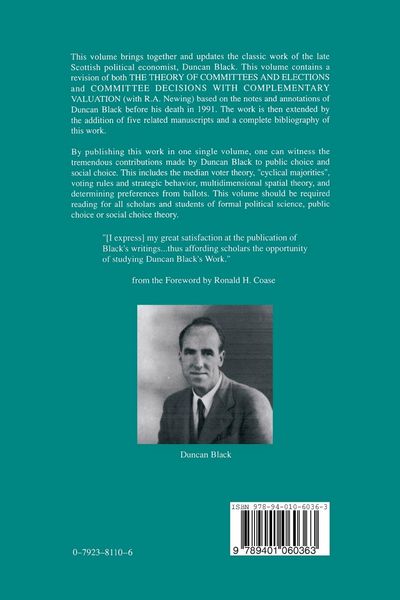
  • Produktbild: The Theory of Committees and Elections by Duncan Black and Committee Decisions with Complementary Valuation by Duncan Black and R.A. Newing
  • Produktbild: The Theory of Committees and Elections by Duncan Black and Committee Decisions with Complementary Valuation by Duncan Black and R.A. Newing

The Theory of Committees and Elections by Duncan Black and Committee Decisions with Complementary Valuation by Duncan Black and R.A. Newing

Fr. 265.00

inkl. gesetzl. MwSt., Versandkostenfrei


Beschreibung

Produktdetails

Einband

Taschenbuch

Erscheinungsdatum

05.11.2012

Herausgeber

Iain S. McLean + weitere

Verlag

Springer Netherland

Seitenzahl

457

Maße (L/B/H)

23.5/15.5/2.8 cm

Gewicht

774 g

Auflage

Second Edition 1998

Sprache

Englisch

ISBN

978-94-010-6036-3

Beschreibung

Produktdetails

Einband

Taschenbuch

Erscheinungsdatum

05.11.2012

Herausgeber

Verlag

Springer Netherland

Seitenzahl

457

Maße (L/B/H)

23.5/15.5/2.8 cm

Gewicht

774 g

Auflage

Second Edition 1998

Sprache

Englisch

ISBN

978-94-010-6036-3

Herstelleradresse

Springer-Verlag GmbH
Tiergartenstr. 17
69121 Heidelberg
DE

Email: ProductSafety@springernature.com

Noch keine Bewertungen vorhanden

Verfassen Sie die erste Bewertung zu diesem Artikel

Helfen Sie anderen Kundinnen und Kunden durch Ihre Meinung.

Kundinnen und Kunden meinen

Bewertungen (0)

  • Produktbild: The Theory of Committees and Elections by Duncan Black and Committee Decisions with Complementary Valuation by Duncan Black and R.A. Newing
  • Produktbild: The Theory of Committees and Elections by Duncan Black and Committee Decisions with Complementary Valuation by Duncan Black and R.A. Newing
  • Foreword; R.H. Coase. Introduction. Preface. Preface to 1958 Edition. Part 1: The Theory of Committees and Elections. 1. A Committee and Motions. 2. Independent Valuation. 3. Can a Motion be Represented by the Same Symbol on Different Schedules? 4. A Committee Using a Simple Majority: Single-peaked Preference Curves. 5. A Committee Using a Simple Majority: Other Shapes of Preference Curves. 6. A Committee Using a Simple Majority: Any Shapes of Preference Curves, Number of Motions Finite. 7. Cyclical Majorities. 8. When the Ordinary Committee Procedure is in Use the Members' Scales of Valuation may be Incomplete. 9. Which is the Most Suitable Method of Election? 10. Examination of Some Methods of Election in Single-Member Constituencies. 11. Proportional Representation. 12. The Decisions of a Committee Using a Special Majority. 13. The Elasticity of Committee Decisions with an Altering Size of Majority. 14. The Elasticity of Committee Decisions with Alterations in the Members' Preference Schedules. 15. The Converse Problem: the Group of Schedules to Correspond to a Given Voting Matrix. 16. A Committee Using a Simple Majority: Complementary Motions. 17. International Agreements, Sovereignty and the Cabinet. Part 2: History of the Mathematical Theory of Committees and Elections (Excluding Proportional Representation). 18. Borda, Condorcet and Laplace. 19. E.J. Nanson and Francis Galton. 20. The Circumstances in which Rev. C.L. Dodgson (Lewis Carroll) wrote his Three Pamphlets. 21. Appendix: Text of Dodgson's Three Pamphlets and of `The Cyclostyled Sheet'. Part 3: Committee Decisions with Complementary Valuation. Committee Decisions with Complementary Valuation. Part 4: Related Papers. Appendix 1: On Arrow's Impossibility Theorem. Appendix 2: The Unity of Political and Economic Science. Appendix 3: Transitivity and Non-transitivity of Majorities. Appendix 4: Partial Justification of the Borda Count. Appendix 5: Arrow's Work and the Normative Theory of Committees. Bibliography. Index.