• Produktbild: Fracture Mechanics of Metals, Composites, Welds, and Bolted Joints
  • Produktbild: Fracture Mechanics of Metals, Composites, Welds, and Bolted Joints

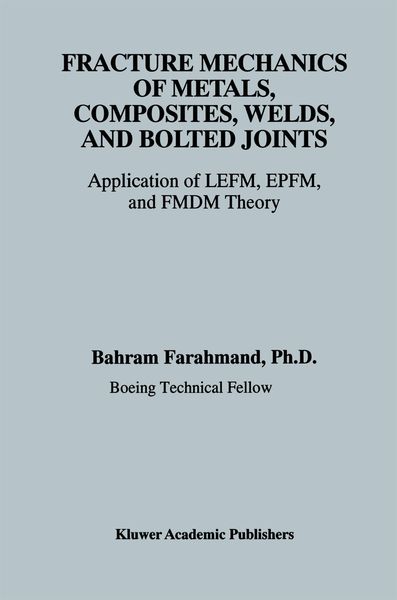
Fracture Mechanics of Metals, Composites, Welds, and Bolted Joints Application of LEFM, EPFM, and FMDM Theory

Fr. 192.00

inkl. gesetzl. MwSt., Versandkostenfrei


Beschreibung

Produktdetails

Einband

Taschenbuch

Erscheinungsdatum

09.11.2012

Verlag

Springer Us

Seitenzahl

408

Maße (L/B/H)

23.5/15.5/2.4 cm

Gewicht

669 g

Auflage

Softcover reprint of the original 1st ed. 2001

Sprache

Englisch

ISBN

978-1-4613-5627-1

Beschreibung

Produktdetails

Einband

Taschenbuch

Erscheinungsdatum

09.11.2012

Verlag

Springer Us

Seitenzahl

408

Maße (L/B/H)

23.5/15.5/2.4 cm

Gewicht

669 g

Auflage

Softcover reprint of the original 1st ed. 2001

Sprache

Englisch

ISBN

978-1-4613-5627-1

Herstelleradresse

Springer-Verlag GmbH
Tiergartenstr. 17
69121 Heidelberg
DE

Email: ProductSafety@springernature.com

Kundinnen und Kunden meinen

0 Bewertungen

Informationen zu Bewertungen

Zur Abgabe einer Bewertung ist eine Anmeldung im Konto notwendig. Die Authentizität der Bewertungen wird von uns nicht überprüft. Wir behalten uns vor, Bewertungstexte, die unseren Richtlinien widersprechen, entsprechend zu kürzen oder zu löschen.

Die Bewertungen sind nach Format, Anzahl Sterne und Datum sortiert.

Verfassen Sie die erste Bewertung zu diesem Artikel

Helfen Sie anderen Kund*innen durch Ihre Meinung

Kundinnen und Kunden meinen

0 Bewertungen filtern

  • Produktbild: Fracture Mechanics of Metals, Composites, Welds, and Bolted Joints
  • Produktbild: Fracture Mechanics of Metals, Composites, Welds, and Bolted Joints
  • Chapter1 Overview of Fracture Mechanics and Failure Prevention.- 1.0 Introduction.- 1.1 High Cycle Fatigue.- 1.2 Low Cycle Fatigue.- 1.3 Stress and Strain at Notch (Neuber Relationship).- 1.4 Linear Elastic Fracture Mechanics (LEFM) and Applications.- 1.5 Elastic-Plastic Fracture Mechanics (EPFM).- 1.6 Failure Prevention and Fracture Control Plan.- References.- Chapter2 Linear Elastic Fracture Mechanics (LEFM) and Applications.- 2.0 Introduction to Elastic Fracture.- 2.1 Griffith Theory of Elastic Fracture.- 2.2 The Stress Intensity Factor Approach, K.- 2.3 Fracture Toughness.- 2.4 Material Anisotropy and its Effect on Fracture Toughness.- 2.5 Factors Affecting Fracture Toughness.- 2.6 Residual Strength Capability of a Cracked Structure.- 2.7 Plasticity at the Crack Tip within Small Scale Yielding.- 2.8 Surface or Part Through Cracks.- 2.9 A Brief Description of ASTM Fracture Toughness Testing.- References.- Chapter3 Fatigue Crack Growth and Applications.- 3.1 Introduction.- 3.2 Crack Growth Rate Empirical Descriptions.- 3.3 Stress Ratio and Crack Closure Effect.- 3.4 Variable Amplitude Stress and the Retardation Phenomenon.- 3.5 Cycle by Cycle Fatigue Crack Growth Analysis.- 3.6 Environmental Assisted Corrosion Cracking.- References.- Chapter4 Elastic-Plastic Fracture Mechanics (EPFM) and Applications.- 4.0 Overview.- 4.1 Introduction.- 4.2 Introduction to Griffith Energy Balance Approach.- 4.3 The Path Independent J- Integral and its Application.- 4.4 Comments Concerning the Path Independent J-Integral Concept.- 4.5 J-Controlled Concept and Stable Crack Growth.- 4.6 Experimental Evaluation of J-Integral and JIC Testing.- 4.7 Determination of JIC Value Based on a Singie Specimen Test.- References.- Chapter5 The Fracture Mechanics of Ductile Metals Theory.- 5.0 Introduction.- 5.1 The Extended Griffith Theory.- 5.2 Fracture Mechanics Of Ductile Metals (FMDM).- 5.3 Determination of g1 = ?UF/?c Term.- 5.4 Determination of the g2= ?UU/?c Term.- 5.5 Octahedral Shear Stress Theory (Plane Strain Conditions).- 5.6 Applied Stress, ?, and Half Crack Length, c, Relationship.- 5.7 Mixed Mode Fracture and Thickness Parameters.- 5.8 The Stress-Strain Curve.- 5.9 Verification of FMDM Results with the Experimental Data.- 5.10 Fracture Toughness Computation by the FMDM Theory.- References.- Chapter6 Welded Joints and Applications.- 6.0 Introduction.- 6.1 Welding of Aluminum Alloys.- 6.2 Variable Polarity Plasma Arc (VPPA).- 6.3 Friction Stir Welding (FSW).- 6.4 Summary.- References.- Chapter7 Bolted Joints and Applications.- 7.1 Introduction.- 7.2 Bolted Joint Subjected to Cyclic Loading.- 7.3 Bolt Preload.- 7.4 Fatigue Crack Growth Analysis of Pads in a Bolted Joint.- 7.5 Riveted Joints.- 7.6 Material Anisotropy and its Application in Bolt Analysis.- References.- Chapter8 Durability and Damage Tolerance of Composites.- 8.1 Overview of Composite.- 8.2 Overview of Textiles Composites.- 8.3 Progressive Fracture Methodology.- 8.4 Composite Structural Analysis and Input and Output.- 8.5 Conclusions.- References.- Appendix A.