• Produktbild: Food and Nutritional Supplements
  • Produktbild: Food and Nutritional Supplements

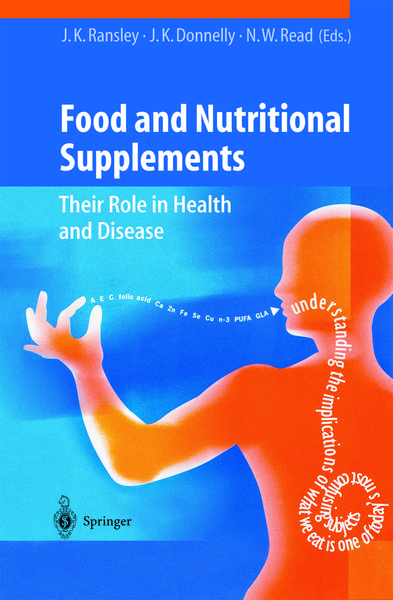
Food and Nutritional Supplements Their Role in Health and Disease

Fr. 73.90

inkl. gesetzl. MwSt., Versandkostenfrei


Beschreibung

Produktdetails

Einband

Taschenbuch

Erscheinungsdatum

23.10.2012

Herausgeber

J.K. Ransley + weitere

Verlag

Springer Berlin

Seitenzahl

197

Maße (L/B/H)

23.5/15.5/1.2 cm

Gewicht

335 g

Auflage

Softcover reprint of the original 1st ed. 2001

Sprache

Englisch

ISBN

978-3-642-62598-5

Beschreibung

Rezension

From the reviews:


"This book is recommended because each of the contributors has provided a concise but comprehensive coverage of the latest developments in our understanding of nutrition in relation to food and nutritional supplements. Therefore, an informed view has been created by the editors as a basis when making decisions about healthy eating or the use of dietary supplements." (Advances in Food Science, Vol. 24 (3), 2002)


"The purpose of this book is to examine the phenomenon of self medication with nutritional supplements from both a biological and psychological perspective. … This book is designed to meet the needs of those professionals who are called upon to advise patients and the general public. It also provides a valuable text for those who are researchers or decision makers in the food and pharmaceutical industries." (Food Trade Review, Vol. 72, February, 2002)

Produktdetails

Einband

Taschenbuch

Erscheinungsdatum

23.10.2012

Herausgeber

Verlag

Springer Berlin

Seitenzahl

197

Maße (L/B/H)

23.5/15.5/1.2 cm

Gewicht

335 g

Auflage

Softcover reprint of the original 1st ed. 2001

Sprache

Englisch

ISBN

978-3-642-62598-5

Herstelleradresse

Springer-Verlag KG
Sachsenplatz 4-6
1201 Wien
AT

Email: ProductSafety@springernature.com

Kundinnen und Kunden meinen

0 Bewertungen

Informationen zu Bewertungen

Zur Abgabe einer Bewertung ist eine Anmeldung im Konto notwendig. Die Authentizität der Bewertungen wird von uns nicht überprüft. Wir behalten uns vor, Bewertungstexte, die unseren Richtlinien widersprechen, entsprechend zu kürzen oder zu löschen.

Die Bewertungen sind nach Format, Anzahl Sterne und Datum sortiert.

Verfassen Sie die erste Bewertung zu diesem Artikel

Helfen Sie anderen Kund*innen durch Ihre Meinung

Kundinnen und Kunden meinen

0 Bewertungen filtern

  • Produktbild: Food and Nutritional Supplements
  • Produktbild: Food and Nutritional Supplements
  • 1 The Rise and Rise of Food and Nutritional Supplements an Overview of the Market.- 1.1 Introduction.- 1.2 The Products.- 1.3 What are People Taking?.- 1.3.1 Cod Liver on.- 1.3.2 Multivitamins.- 1.3.3 Single Vitamins.- 1.3.4 Evening Primrose Oil.- 1.3.5 Minerals.- 1.3.6 Garlic Products.- 1.3.7 Functional Foods.- 1.4 Growth Across Western Europe.- 1.5 Who Manufactures Vitamin, Mineral and Dietary Supplements?.- 1.6 Retail Distribution of Vitamins, Minerals and Dietary Supplements.- 1.7 What is Driving the Growth in this Market?.- 1.7.2 The Trend Towards Self-Medication.- 1.7.2.1 Concerns About Illness Drive Demand.- 1.7.2.2 Changes in the Pharmacy.- 1.7.2.3 Changes in Primary Health Care.- 1.8 Do Supplement Users Need to Take Supplements?.- 1.9 Regulating the Market.- 1.10 The Future for Vitamins, Minerals and Dietary Supplements.- 1.11 ConclusionM.- 1.12 References.- 2 Why do Health Professionals Need to Know More About Nutrition?.- 2.1 Introduction.- 2.1.1 The Implication of Diet in Disease.- 2.2 Our Hunger for Knowledge.- 2.3 Health Professionals: the Authorative Source of Nutrition Information?.- 2.4 Nutrition: the Orphan Discipline.- 2.5 What are the Obstacles to Giving Nutrition Advice?.- 2.6 The Updated Role of Health Professionals: a New Approach.- 2.6.1 Tailored Dietary Advice.- 2.6.2 Different People, Different Dietary Needs.- 2.6.3 Drug-Nutrient Interactions.- 2.6.4 The Impact of Diet in Health Economics.- 2.7 Conclusion.- 2.8 References.- 3 Nutrient Requirements in Health and Disease.- 3.1 Introduction.- 3.2 What Nutrients are Needed, and How Much?.- 3.3 Dietary Reference Values.- 3.4 Meeting the Targets.- 3.5 Pregnancy and Lactation — Life-Long Health Implications of Nutrition.- 3.6 The Weaning Process.- 3.7 Childhood.- 3.8 Younger Schoolchildren.- 3.9 Adolescence.- 3.10 Adulthood.- 3.11 Older Years.- 3.12 Conclusion.- 3.13 References.- 4 Placebo and Panacea: The Healing Effect of Nutritional Supplements.- 4.1 Why Do So Many People Feel Unwell.- 4.2 The Placebo or Healing Effect.- 4.3 Who Responds to Placebo Medication.- 4.4 Nutritional Supplements as Placebos.- 4.5 The Ethics of Prescribing or Marketing Placebos as Nutritional Supplements.- 4.6 References.- 5 Antioxidants Nutrition and Health.- 5.1 Introduction.- 5.2 Involvement of Free Radicals in Degenerative Disease and Modulation by Antioxidants.- 5.3 Cancer Aetiology.- 5.4 Cardiovascular Disease Aetiology.- 5.5 Reduction of Disease Risk by Antioxidant Nutrients.- 5.6 Cancer.- 5.7 Cardiovascular Disease.- 5.8 References.- 6 Nutritional and Non-Nutritional Uses of Vitamin B6.- 6.1 Introduction.- 6.2 Metabolism and Metabolie Functions of Vitamin B6.- 6.3 Requirements and Reference Nutrient Intakes.- 6.4 Potential Benefits of Higher Levels of Intake: Homocysteine Metabolism.- 6.5 Pharmacological Uses of Vitamin B6.- 6.5.1 Side-Effects of Oral Contraceptives.- 6.5.2 Impaired Glucose Tolerance and Diabetes Mellitus.- 6.5.3 Depression.- 6.5.4 The Premenstrual Syndrome.- 6.5.5 Morning Sickness.- 6.5.6 Carpal Tunnel Syndrome.- 6.5.7 Hypertension.- 6.6 Drug Interactions with Vitamin B6.- 6.7 Toxicity of Vitamin B6.- 6.8 References.- 7 Folic Acid and Disease Prevention:A Long Day’s Journey Into light.- 7.1 Introduction.- 7.2 Folate Prevention of Neural Tube Defects.- 7.3 Other Congenital Malformations and Folate.- 7.4 Folate, Homocysteine and Occlusive Vascular Disease.- 7.5 Folate Requirements and Provision.- 7.6 Changed Diet.- 7.7 Supplements.- 7.8 Food Fortification.- 7.9 Conclusions.- 7.10 References.- 8 The Addition of Micronutrients to Food.- 8.1 Introduction.- 8.2 The Historical Background.- 8.3 Some Definitions.- 8.4 The Rationale for the Addition of Nutrients to Food.- 8.5 Policy Considerations.- 8.6 Legislative Aspects of Micronutrients Addition to Food.- 8.7 The Efficacy of the Addition of Micronutrients to Food.- 8.8 References.- 9 Probiotics and Prebiotics in Health.- 9.1 Introduction.- 9.2 Probiotic Bacteria in Human Health: An Overview Colette Shortt and Seppo Salminen.- 9.2.1 Introduction.- 9.2.2 Probiotics and Dietary Modulation.- 9.2.3 Concept of Probiotic Bacteria.- 9.2.4 Selection of Probiotic Strains.- 9.2.5 Conclusion.- 9.3 Prebiotics in Human Health: An Overview Marcel Roberfroid.- 9.3.1 Introduction.- 9.3.2 The Prebiotics.- 9.3.3 Malabsorption of the Non-Digestible Oligosaccharides.- 9.3.4 Fermentation in the Large Bowel: The Prebiotic Effect.- 9.3.5 Physiological Effects in the Gastro-Intestinal Tract.- 9.3.6 Prebiotics and the Risk of Colon Cancer.- 9.3.7 Conclusion: Prebiotics, What Benefit( s) for Human Health?.- 9.3.8 Conclusions.- 9.3.8 Conclusions.- 9.4 References.- 10 Phytoestrogens and Health.- 10.1 Introduction.- 10.1.1 Phytoestrogens — What are They and Where do we Find Them?.- 10.1.2 Isoflavones.- 10.1.3 Coumestans.- 10.1.4 Lignans.- 10.2 Dietary Intake.- 10.2.1 Baby Foods.- 10.2.2 Key Points.- 10.2.3 Effectsion Health.- 10.3 Heart Disease.- 10.3.1 Phytoestrogens May Reduce Blood Cholesterol Levels.- 10.3.2 Other Possible Effects of Phytoestrogens on CHD Risk.- 10.3.3 Key Points.- 10.4 Cancer.- 10.4.1 General Effects of Phytoestrogens.- 10.4.2 Breast Cancer.- 10.4.3 Prost ate Cancer.- 10.4.4 Other Cancers.- 10.4.5 Key Points.- 10.5 Osteoporosis.- 10.6 Key points.- 10.7 Menop ausal Symptoms.- 10.7.1 Key Points.- 10.8 Potential Adverse Effects.- 10.9 Conclusions and Recommendations.- 10.10 References.- 11 Dietary Supplements and their Role in the Prevention and Treatment of Coronary Heart Disease.- 11.1 Introduction.- 11.2 Evidence.- 11.3 Early Attempts at Dietary Modification to Prevent CHD.- 11.4 The Diet Trials.- 11.4.1 Fish.- 11.4.2 Nuts.- 11.4.3 Fibre.- 11.5 Homocysteine.- 11.6 Antioxidants.- 11.6.1 Vitamin C.- 11.6.2 ss-carotene.- 11.6.3 Vitamin E.- 11.7 Alcohol.- 11.8 Plant Sterols and Stanols.- 11.9 Conclusion.- 11.10 References.- 12 The Scientific Basis for Fish Oil Supplementation in Rheumatoid Arthritis.- 12.1 Introduction.- 12.2 Fatty Acids in the Human Diet.- 12.3 The Immune System.- 12.3.1 What is the Immune System and How Does it Work?.- 12.3.2 Communication Within the Immune System: Cytokines.- 12.3.3 Inflammation.- 12.3.4 Integration of the Immune Response.- 12.3.5 The Immune System in Health and Disease.- 12.4 Rheumatoid Arthritis.- 12.5 Eicosanoids: The Link Between FattyAcids and the Immune System.- 12.5.1 Eicosanoid Synthesis.- 12.5.2 Roles for Eicosanoids in Inflammation and Immunity.- 12.5.3 Eicosanoids and RA.- 12.5.4 Fish Oil and Eicosanoids.- 12.6 Effects of Fish Oil on Immune Function.- 12.7 Fish Oil Intervention in Rheumatoid Arthritis.- 12.8 Conclusions and Comments.- 12.9 References.