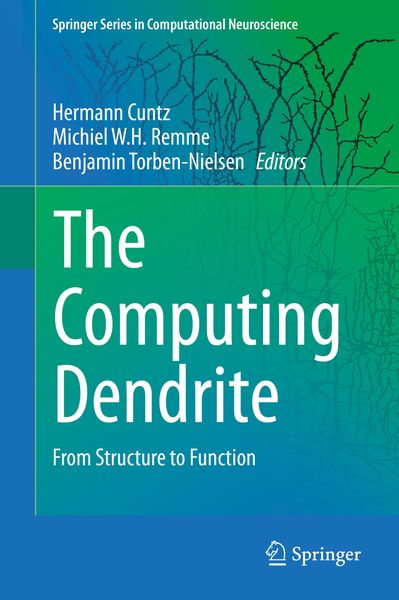
The Computing Dendrite From Structure to Function
-
- Hardcover ausgewählt
- Taschenbuch
- eBook
-
Sprache:Englisch
Fr. 192.00
inkl. gesetzl. MwSt.,
Beschreibung
Produktdetails
Einband
Gebundene Ausgabe
Erscheinungsdatum
23.11.2013
Abbildungen
XVIII, 101 illus., 66 illus. in color., farbige Illustrationen, schwarz-weiss Illustrationen
Herausgeber
Hermann Cuntz + weitereVerlag
Springer UsSeitenzahl
510
Maße (L/B/H)
24.1/16/3.4 cm
Gewicht
986 g
Auflage
2014
Sprache
Englisch
ISBN
978-1-4614-8093-8
Neuronal dendritic trees are complex structures that endow the cell with powerful computing capabilities and allow for high neural interconnectivity. Studying the function of dendritic structures has a long tradition in theoretical neuroscience, starting with the pioneering work by Wilfrid Rall in the 1950s. Recent advances in experimental techniques allow us to study dendrites with a new perspective and in greater detail. The goal of this volume is to provide a résumé of the state-of-the-art in experimental, computational, and mathematical investigations into the functions of dendrites in a variety of neural systems.
The book first looks at morphological properties of dendrites and summarizes the approaches to measure dendrite morphology quantitatively and to actually generate synthetic dendrite morphologies in computer models. This morphological characterization ranges from the study of fractal principles to describe dendrite topologies, to the consequences of optimization principles for dendrite shape. Individual approaches are collected to study the aspects of dendrite shape that relate directly to underlying circuit constraints and computation.
The second main theme focuses on how dendrites contribute to the computations that neurons perform. What role do dendritic morphology and the distributions of synapses and membrane properties over the dendritic tree have in determining the output of a neuron in response to its input? A wide range of studies is brought together, with topics ranging from general to system-specific phenomena—some having a strong experimental component, and others being fully theoretical. The studies come from many different neural systems and animal species ranging from invertebrates to mammals. With this broad focus, an overview is given of the diversity of mechanisms that dendrites can employ to shape neural computations.
Kundinnen und Kunden meinen
Verfassen Sie die erste Bewertung zu diesem Artikel
Helfen Sie anderen Kund*innen durch Ihre Meinung