• Produktbild: Towards a Theoretical Neuroscience: from Cell Chemistry to Cognition
  • Produktbild: Towards a Theoretical Neuroscience: from Cell Chemistry to Cognition
Band 8

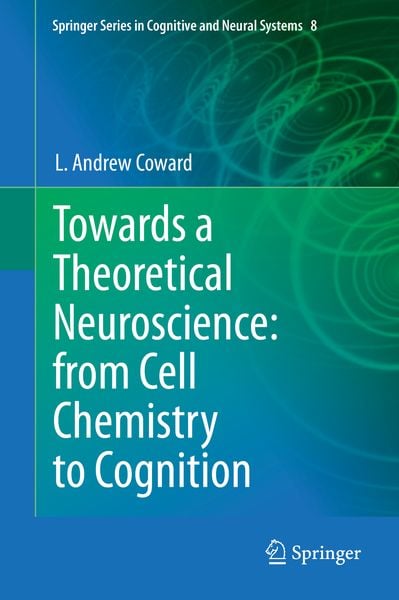
Towards a Theoretical Neuroscience: from Cell Chemistry to Cognition

Fr. 192.00

inkl. gesetzl. MwSt., Versandkostenfrei


Beschreibung

Produktdetails

Einband

Gebundene Ausgabe

Erscheinungsdatum

03.09.2013

Verlag

Springer Netherland

Seitenzahl

443

Maße (L/B/H)

24.1/16/3 cm

Gewicht

857 g

Auflage

1. Auflage

Sprache

Englisch

ISBN

978-94-007-7106-2

Beschreibung

Produktdetails

Einband

Gebundene Ausgabe

Erscheinungsdatum

03.09.2013

Verlag

Springer Netherland

Seitenzahl

443

Maße (L/B/H)

24.1/16/3 cm

Gewicht

857 g

Auflage

1. Auflage

Sprache

Englisch

ISBN

978-94-007-7106-2

Herstelleradresse

Springer-Verlag GmbH
Tiergartenstr. 17
69121 Heidelberg
DE

Email: ProductSafety@springernature.com

Kundinnen und Kunden meinen

0 Bewertungen

Informationen zu Bewertungen

Zur Abgabe einer Bewertung ist eine Anmeldung im Konto notwendig. Die Authentizität der Bewertungen wird von uns nicht überprüft. Wir behalten uns vor, Bewertungstexte, die unseren Richtlinien widersprechen, entsprechend zu kürzen oder zu löschen.

Die Bewertungen sind nach Format, Anzahl Sterne und Datum sortiert.

Verfassen Sie die erste Bewertung zu diesem Artikel

Helfen Sie anderen Kund*innen durch Ihre Meinung

Kundinnen und Kunden meinen

0 Bewertungen filtern

  • Produktbild: Towards a Theoretical Neuroscience: from Cell Chemistry to Cognition
  • Produktbild: Towards a Theoretical Neuroscience: from Cell Chemistry to Cognition
  • Introduction
    1. The nature of scientific understanding
    1.1 Understanding in the physical sciences
    1.2 Complex physical systems and chaotic behaviour
    1.3 Complex control systems
    1.4 The brain and hierarchies of description
    1.5 The basis for understanding the brain
    1.6 Computer modelling and its limitations
    1.7 Plan of the book 
    2. Higher Cognition
    2.1 Attention
    2.2 Memory
    2.3 Speech
    2.4 Arithmetic
    2.5 Face Recognition
    2.6 Emotions
    2.7 Hobbies and intellectual disciplines
    2.8 Tool Making
    2.9 Consciousness and self awareness.
    2.10 Individual Differences and Complex society
    2.11 Art, music and literature
    2.12 Higher cognition and the brain

    3. Brain Anatomy
    3.1 Major anatomical structures of the brain
    3.2 Roles of major anatomical structures
    3.3 Neurons, axons, dendrites and synapses
    3.4 Ion pumps
    3.5 Ion channels
    3.6 Synapses and their response to an incoming action potential
    3.7 Dendrite branches integrating action potentials arriving at synapses
    3.8 Generation of output action potentials
    3.9 Different types of neurotransmitter
    3.10 Flow of information between neurons
    3.11 Electrical Activity of the Brain
    3.12 Descriptive Gaps
    4. Neuron Physiology
    4.1 Neuron morphology and general electrical properties
    4.2 Molecules embedded in the neuron membrane4.3 Electrochemical signals within and between neurons
    4.4 Synapses and synaptic strengths
    4.5 Specific molecules
    4.6 Chemicals and information processing
    5. Intracellular message chains
    5.1 Gene expression
    5.2 Kinase cascades
    5.3 Neuron processes
    5.4 Multiple paths contribute to any neuron behaviour
    6. Major Anatomical Structures
    6.1 Sources of information
    6.2 High level structure of the human brain
    6.3 The Cortex
    6.4 The thalamus
    6.5 The basal ganglia
    6.6 The amygdala
    6.7 The hypothalamus and pituitary gland
    6.8 Habenula
    6.9 Cerebellum
    6.10 Basal forebrain
    6.11 Neurotransmitter distribution systems
    6.12 The hippocampal system
    6.13 Relating structure and function 
    7. Constraints on the physical architecture of the brain
    7.1 Conditions and behaviours
    7.2 Practical requirements
    7.3 Behavioural meanings of condition detections and exchanges
    7.4 Pressures on the definition of modules
    7.5 Hierarchy of modules and hierarchy of descriptions
    7.6 Sharing of resources across the processing of different input states
    7.7 Integration of module inputs on different levels of detail
    7.8 Limitations to receptive field changes
    7.9 Entanglement of condition definition and detection
    7.10 Corollaries of receptive field consistency
    7.11 Modulation of total receptive field detection
    7.12 Development of a modular hierarchy
    7.13 Cascades of condition definition/detection
    7.14 Associations between receptive fields and behaviours
    7.15 Types of behaviour
    7.16 Structure of competition
    7.17 Modulation of behaviour type
    7.18 Management of frequent action sequences
    7.19 Identification of provisional connections
    7.20 Practical requirements and architectural constraints 
    8. Appearance of architectural constraints in the brain
    8.1 Brain structures and information processes
    8.2 Information model for the cortex
    8.3 Information model for the thalamus
    8.4 Information model for the basal ganglia
    8.5 Information model for the amygdala and hypothalamus
    8.6 Information model for the hippocampal system
    8.7 Information model for the basal forebrain
    8.8 Information model for the cerebellum
    8.9 Information model for the neurotransmitter distribution systems
    8.10 Application of information models  
    9. Memory and the organisation of experience
    9.1 Organisation of experience into similarity circumstances
    9.2 Detection of similarity circumstances
    9.3 Semantic memory
    9.4 Priming memory
    9.5 Episodic memory
    9.6 Procedural memory
    9.7 Hierarchies of description
    10. Attention and working memory
    10.1 Attention
    10.2 Working memory10.3 Condition definition/detection resource sharing by frequency modulation 
    11. Understanding complex cognitive phenomena
    11.1 Imagined situations and false memories
    11.2 Familiarity and deja vu
    11.3 Prospective memory
    11.4 Speech processing
    11.5 Cognitive deficits following brain damage
    11.6 Consciousness and self awareness
    11.7 Literature, music and art

    12. Towards a Theoretical Neuroscience