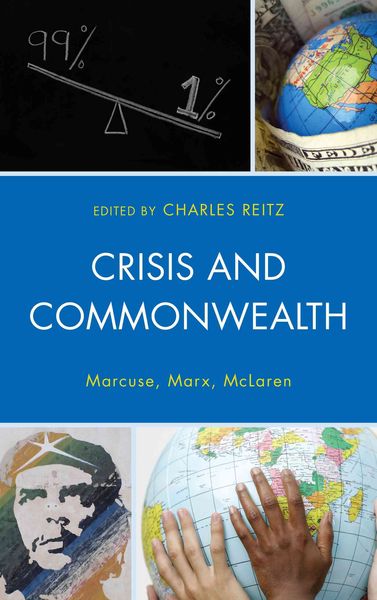
Crisis and Commonwealth Marcuse, Marx, McLaren
-
- Hardcover ausgewählt
- Taschenbuch
- eBook
-
Sprache:Englisch
Fr. 194.00
inkl. gesetzl. MwSt.,
Beschreibung
Produktdetails
Einband
Gebundene Ausgabe
Erscheinungsdatum
28.08.2013
Abbildungen
7 BW Illustrations
Herausgeber
Reitz CharlesVerlag
Ingram Publishers ServicesSeitenzahl
332
Maße (L/B/H)
23.5/15.7/2.4 cm
Gewicht
691 g
Sprache
Englisch
ISBN
978-0-7391-8306-9
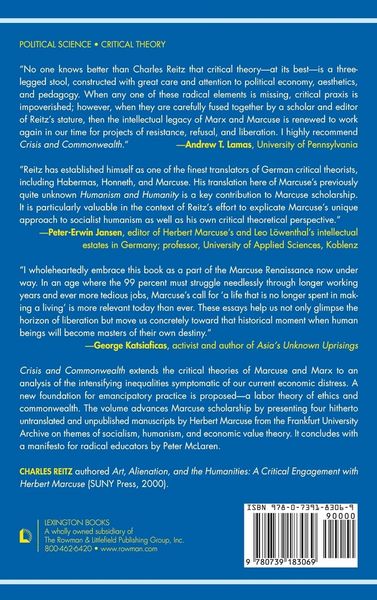
Crisis and Commonwealth: Marcuse, Marx, McLaren advances Marcuse scholarship by presenting four hitherto untranslated and unpublished manuscripts by Herbert Marcuse from the Frankfurt University Archive on themes of economic value theory, socialism, and humanism. Contributors to this edited collection, notably Peter Marcuse, Henry Giroux, Peter McLaren, Zvi Tauber, Arnold L. Farr and editor, Charles Reitz, are deeply engaged with the foundational theories of Marcuse and Marx with regard to a future of freedom, equality, and justice. Douglas Dowd furnishes the critical historical context with regard to U.S. foreign and domestic policy, particularly its features of economic imperialism and militarism. Reitz draws these elements together to show that the writings by Herbert Marcuse and these formidable authors can ably assist a global movement toward intercultural commonwealth. The collection extends the critical theories of Marcuse and Marx to an analysis of the intensifying inequalities symptomatic of our current economic distress. It presents a collection of essays by radical scholars working in the public interest to develop a critical analysis of recent global economic dislocations. Reitz presents a new foundation for emancipatory practice-a labor theory of ethics and commonwealth, and the collection breaks new ground by constructing a critical theory of wealth and work. A central focus is building a new critical vision for labor, including academic labor. Lessons are drawn to inform transformative political action, as well as the practice of a critical, multicultural pedagogy, supporting a new manifesto for radical educators contributed by Peter McLaren. The collection is intended especially to appeal to contemporary interests of college students and teachers in several interrelated social science disciplines: sociology, social problems, economics, ethics, business ethics, labor education, history, political philosophy, multicultural education, and critical pedagogy.
Kundinnen und Kunden meinen
Verfassen Sie die erste Bewertung zu diesem Artikel
Helfen Sie anderen Kund*innen durch Ihre Meinung