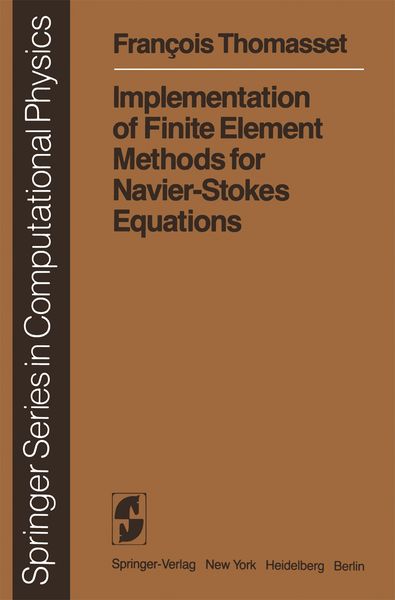
• Produktbild: Implementation of Finite Element Methods for Navier-Stokes Equations
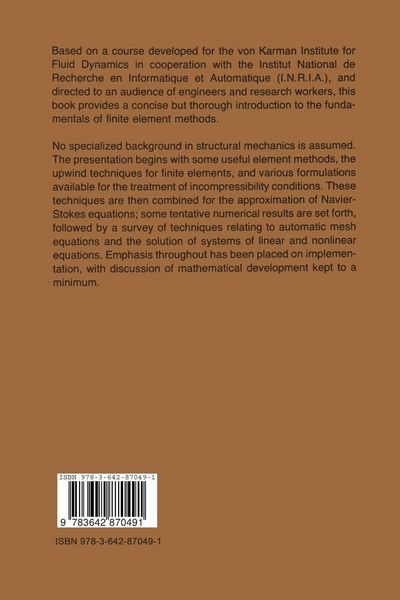
  • Produktbild: Implementation of Finite Element Methods for Navier-Stokes Equations

Implementation of Finite Element Methods for Navier-Stokes Equations

Aus der Reihe Scientific Computation

Fr. 72.90

inkl. gesetzl. MwSt., Versandkostenfrei


Beschreibung

Produktdetails

Einband

Taschenbuch

Erscheinungsdatum

12.12.2012

Verlag

Springer Berlin

Seitenzahl

164

Maße (L/B/H)

23.5/15.5/1 cm

Gewicht

271 g

Auflage

Softcover reprint of the original 1st ed. 1981

Sprache

Englisch

ISBN

978-3-642-87049-1

Beschreibung

Produktdetails

Einband

Taschenbuch

Erscheinungsdatum

12.12.2012

Verlag

Springer Berlin

Seitenzahl

164

Maße (L/B/H)

23.5/15.5/1 cm

Gewicht

271 g

Auflage

Softcover reprint of the original 1st ed. 1981

Sprache

Englisch

ISBN

978-3-642-87049-1

Herstelleradresse

Springer-Verlag KG
Sachsenplatz 4-6
1201 Wien
AT

Email: GPSR Kontakt

Noch keine Bewertungen vorhanden

Verfassen Sie die erste Bewertung zu diesem Artikel

Helfen Sie anderen Kundinnen und Kunden durch Ihre Meinung.

Kundinnen und Kunden meinen

Bewertungen (0)

  • Produktbild: Implementation of Finite Element Methods for Navier-Stokes Equations
  • Produktbild: Implementation of Finite Element Methods for Navier-Stokes Equations
  • Notations.- 1. Elliptic Equations of Order 2: Some Standard Finite Element Methods.- 1.1. A 1-Dimensional Model Problem: The Basic Notions.- 1.2. A 2-Dimensional Problem.- 1.3. The Finite Element Equations.- 1.4. Standard Examples of Finite Element Methods.- 1.4.1. Example 1: The P1-Triangle (Courant’s Triangle).- 1.4.2. Example 2: The P2-Triangle.- 1.4.3. Example 3: The Q1-Quadrangle.- 1.4.4. Example 4: The Q2-Quadrangle.- 1.4.5. A Variational Crime: The P1 Nonconforming Element.- 1.5. Mixed Formulation and Mixed Finite Element Methods for Elliptic Equations.- 1.5.1. The One Dimensional Problem.- 1.5.2. A Two Dimensional Problem.- 2. Upwind Finite Element Schemes.- 2.1. Upwind Finite Differences.- 2.2. Modified Weighted Residual (MWR).- 2.3. Reduced Integration of the Advection Term.- 2.4. Computation of Directional Derivatives at the Nodes.- 2.5. Discontinuous Finite Elements and Mixed Interpolation.- 2.6. The Method of Characteristics in Finite Elements.- 2.7. Peturbation of the Advective Term: Bredif (1980).- 2.8. Some Numerical Tests and Further Comments.- 2.8.1. One Dimensional Stationary Advection Equation (56).- 2.8.2. Two Dimensional Stationary Advection Equation.- 2.8.3. Time Dependent Advection.- 3. Numerical Solution of Stokes Equations.- 3.1. Introduction.- 3.2. Velocity—Pressure Formulations: Discontinuous Approximations of the Pressure.- 3.2.1. uh: P1 Nonconforming Triangle (
    1-4-5); ph: Piecewise Constant.- 3.2.2. uh: P2 Triangle ph: P0 (Piecewise Constant).- 3.2.3. uh: “P2+bubble” Triangle (or Modified P2); ph: Discontinuous P1.- 3.2.4. uh: Q2 Quadrangle; ph: Q1 Discontinuous.- 3.2.5. Numerical Solution by Penalty Methods.- 3.2.6. Numerical Results and Further Comments.- 3.3. Velocity—Pressure Formulations: Continuous Approximation of the Pressure and Velocity.- 3.3.1. Introduction.- 3.3.2. Examples and Error Estimates.- 3.3.3. Decomposition of the Stokes Problem.- 3.4. Vorticity—Pressure—Velocity Formulations: Discontinuous Approximations of Pressure and Velocity.- 3.5. Vorticity Stream-Function Formulation: Decompositions of the Biharmonic Problem.- 4. Navier-Stokes Equations: Accuracy Assessments and Numerical Results.- 4.1. Remarks on the Formulation.- 4.2. A review of the Different Methods.- 4.2.1 Velocity—Pressure Formulations: Discontinuous Approximations of the Pressure.- 4.2.2. Velocity—Pressure Formulations: Continuous Approximations of the Pressure.- 4.2.3. Vorticity—Pressure—Velocity Formulations: Discontinuous Approximations of Pressure and Velocity.- 4.2.4. Vorticity Stream-Function Formulation.- 4.3. Some Numerical Tests.- 4.3.1. The Square Wall Driven Cavity Flow.- 4.3.2. An Engineering Problem: Unsteady 2-D Flow Around and In an Air-Intake.- 5. Computational Problems and Bookkeeping.- 5.1. Mesh Generation.- 5.2. Solution of the Nonlinear Problems.- 5.2.1. Successive Approximations (or Linearization) with Under Relaxation.- 5.2.2. Newton-Raphson Algorithm.- 5.2.3. Conjugate Gradient Method (with Scaling) for Nonlinear Problems.- 5.2.4. A Splitting Technique for the Transient Problem.- 5.3. Iterative and Direct Solvers of Linear Equations.- 5.3.1. Successive Over Relaxation.- 5.3.2. Cholesky Factorizations.- 5.3.3. Out of Core Factorizations.- 5.3.4. Preconditioned Conjugate Gradient.- Appendix 2. Numerical Illustration.- Three Dimensional Case.- References.