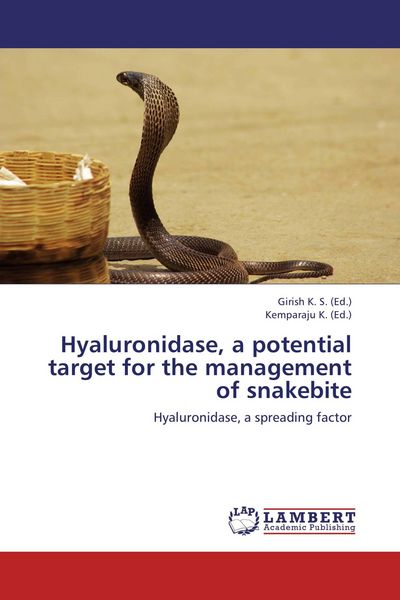
Hyaluronidase, a potential target for the management of snakebite Hyaluronidase, a spreading factor
-
- Englisch ausgewählt
Fr. 95.90
inkl. gesetzl. MwSt.,
Beschreibung
Produktdetails
Einband
Taschenbuch
Erscheinungsdatum
25.07.2013
Herausgeber
Girish K. S. + weitereVerlag
LAP LAMBERT Academic PublishingSeitenzahl
168
Maße (L/B/H)
22/15/1.1 cm
Gewicht
268 g
Sprache
Englisch
ISBN
978-3-659-37808-9
The venom hyaluronidases are non-toxic and popularly known as 'spreading factors' as they facilitates the spreading of target specific toxins from the bitten site to the general circulation by degrading hyaluronic acid present in extracellular matrix of basement membrane surrounding the blood capillaries. Neutralization of venom hyaluronidases not only protect the tissues at bitten site but also increases the survival time of a victim/pray by limiting the easy diffusion of target specific toxins. Therefore, hyaluronidase inhibition is considered as rate limiting step in the better management of snakebite. It could be an effective therapeutic tool in cataract surgery and drug delivery. It can be used as a model enzyme to design potent inhibitors against pathological disorders related to ECM degradation. The present book describes the isolation, biochemical characterization and inhibition of snake venom hyaluronidase. The book provides elaborated information about the assay methods, end product analysis, demonstration of spreading property and ECM degradation. In addition, it provides first information about hyaluronidase isoforms and role of hyaluronidase in snake envenomation.
Kundinnen und Kunden meinen
Verfassen Sie die erste Bewertung zu diesem Artikel
Helfen Sie anderen Kund*innen durch Ihre Meinung