• Produktbild: Gnomes in the Fog
  • Produktbild: Gnomes in the Fog
Band 28

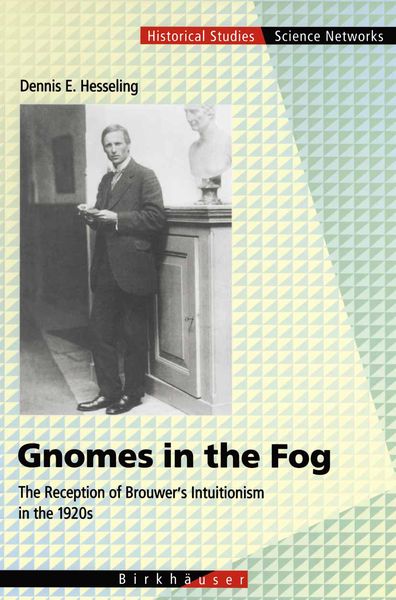
Gnomes in the Fog The Reception of Brouwer’s Intuitionism in the 1920s

Fr. 138.00

inkl. gesetzl. MwSt., Versandkostenfrei


Beschreibung

Produktdetails

Einband

Taschenbuch

Erscheinungsdatum

30.10.2012

Verlag

Springer Basel

Seitenzahl

448

Maße (L/B/H)

23.5/15.5/2.6 cm

Gewicht

724 g

Auflage

Softcover reprint of the original 1st ed. 2003

Sprache

Englisch

ISBN

978-3-0348-9394-7

Beschreibung

Rezension

"L.E.J. Brouwer is best known to many mathematicians for his seminal contributions to topology. He is also the founder of mathematical intuitionism, and a key player in the debate on foundations of mathematics that raged for a brief decade in the 1920s, and then subsided.
Gnomes in the Fog
tells the story of that important and influential episode in the history of mathematics, in fascinating and delicious detail.... [A]nyone with an interest in mathematics and its history and philosophy, should enjoy this book. Mathematicians (especially logicians) may find some surprises in the first chapter, on Brouwer's predecessors; philosophers and science study scholars should especially appreciate the final chapter on the cultural context of the debate.... One of the many treasures to be discovered in reading this book is the rich collection of original quotes in the many languages in which the debate took place, along with the author's translations."


—MAA Online

Produktdetails

Einband

Taschenbuch

Erscheinungsdatum

30.10.2012

Verlag

Springer Basel

Seitenzahl

448

Maße (L/B/H)

23.5/15.5/2.6 cm

Gewicht

724 g

Auflage

Softcover reprint of the original 1st ed. 2003

Sprache

Englisch

ISBN

978-3-0348-9394-7

Herstelleradresse

Springer-Verlag GmbH
Tiergartenstr. 17
69121 Heidelberg
DE

Email: GPSR Kontakt

Noch keine Bewertungen vorhanden

Verfassen Sie die erste Bewertung zu diesem Artikel

Helfen Sie anderen Kundinnen und Kunden durch Ihre Meinung.

Kundinnen und Kunden meinen

Bewertungen (0)

  • Produktbild: Gnomes in the Fog
  • Produktbild: Gnomes in the Fog
  • 1 Kronecker, the semi-intuitionists, Poincaré.- 1.1 Introduction.- 1.1.1 Mathematical prerequisites.- 1.2 Kronecker.- 1.2.1 Kronecker’s conflicts.- 1.2.2 Kronecker’s views.- 1.3 The French semi-intuitionists.- 1.3.1 The French semi-intuitionists’ main conflict.- 1.3.2 The French semi-intuitionists’ views.- 1.4 Poincaré.- 1.4.1 Poincaré’s conflicts.- 1.4.2 Poincaré’s views.- 1.5 Conclusion.- 2 The genesis of Brouwer’s intuitionism.- 2.1 Introduction.- 2.2 The early years.- 2.2.1 Brouwer’s youth.- 2.2.2 Brouwer’s profession of faith.- 2.2.3 Mannoury.- 2.2.4 Brouwer’s mysticism.- 2.3 The first act of intuitionism.- 2.3.1 Brouwer’s dissertation.- 2.3.2 The unreliability of the logical principles.- 2.4 Topology.- 2.5 Intuitionism and formalism.- 2.6 The second act of intuitionism.- 2.6.1 Intuitionistic set theory.- 2.6.2 Further development of intuitionistic mathematics.- 2.7 The Brouwer lectures.- 2.7.1 Berlin.- 2.7.2 Amsterdam.- 2.7.3 Vienna.- 2.8 The Mathematische Annalen and afterwards.- 2.9 Brouwer’s personality.- 2.10 Conclusion.- 3 Overview of the foundational debate.- 3.1 Introduction.- 3.2 Quantitative inquiry.- 3.2.1 The Fortschritte.- 3.2.2 ‘All’ public reactions to intuitionism.- 3.3 Qualitative inquiry.- 3.3.1 Themes.- 3.3.2 Tone.- 3.3.3 Currents and schools.- 3.3.4 People.- 3.3.5 Languages and media.- 3.4 Conclusion.- 4 Reactions: existence and constructivity.- 4.1 Introduction.- 4.1.1 Mathematical existence.- 4.1.2 A short history of constructivism.- 4.2 The beginning of the debate.- 4.2.1 Weyl’s Grundlagenkrise.- 4.2.2 Hilbert’s first reactions.- 4.2.3 Becker’s phenomenology.- 4.2.4 Fraenkel’s early commentaries.- 4.2.5 Baldus’ rector’s address.- 4.3 The debate widened.- 4.3.1 Existence in a central position.- 4.3.2 Existence as a minor subject.- 4.4 Later reactions.- 4.4.1 The Königsberg conference.- 4.4.2 Wittgenstein.- 4.4.3 Others.- 4.5 Conclusion.- 5 Reactions: logic and the excluded middle.- 5.1 Introduction.- 5.1.1 A short history of classical logic.- 5.2 The beginning of the debate.- 5.2.1 Weyl’s Grundlagenkrise.- 5.2.2 Hilbert’s first reactions.- 5.2.3 Addresses: Wolff, Finsler and Baldus.- 5.2.4 Fraenkel’s early commentaries.- 5.3 The debate widened.- 5.3.1 The excluded middle in a central position.- 5.3.2 The excluded middle as a minor subject.- 5.4 Later reactions.- 5.4.1 Glivenko, Heyting and Kolmogorov.- 5.4.2 Gödel.- 5.4.3 Barzin and Errera.- 5.5 Conclusion.- 6 The foundational crisis in its context.- 6.1 Introduction.- 6.2 Metaphors.- 6.2.1 Crisis and revolution.- 6.3 Philosophy.- 6.3.1 Lebensphilosophie.- 6.3.2 Mathematical and philosophical intuitionism: a comparison.- 6.3.3 Contemporaries’ remarks.- 6.3.4 Göttingen and Hilbert.- 6.3.5 Spengler.- 6.3.6 Summary.- 6.4 Physics.- 6.4.1 Theory of relativity.- 6.4.2 Quantum mechanics.- 6.5 Art.- 6.5.1 Constructivism.- 6.6 Politics.- 6.6.1 Mathematics and the rise of the Third Reich.- 6.6.2 Bieberbach’s racial interpretation of the foundational debate.- 6.7 Moderne and Gegenmoderne.- 6.8 Conclusion.- Conclusion.- A Chronology of the debate.- B Public reactions to Brouwer’s intuitionism.- C Logical notations.- Dankwoord/ Acknowledgements.