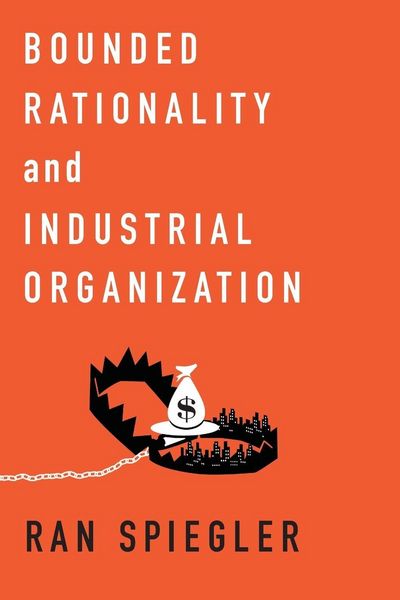

• Produktbild: Bounded Rationality and Industrial Organization
  • Produktbild: Bounded Rationality and Industrial Organization

Bounded Rationality and Industrial Organization

Fr. 39.90

inkl. gesetzl. MwSt., Versandkostenfrei


Beschreibung

Produktdetails

Einband

Taschenbuch

Erscheinungsdatum

01.02.2014

Verlag

Oxford Academic

Seitenzahl

240

Maße (L/B/H)

23.4/15.6/1.4 cm

Gewicht

340 g

Sprache

Englisch

ISBN

978-0-19-933426-1

Beschreibung

Produktdetails

Einband

Taschenbuch

Erscheinungsdatum

01.02.2014

Verlag

Oxford Academic

Seitenzahl

240

Maße (L/B/H)

23.4/15.6/1.4 cm

Gewicht

340 g

Sprache

Englisch

ISBN

978-0-19-933426-1

Herstelleradresse

Libri GmbH
Europaallee 1
36244 Bad Hersfeld
DE

Email: gpsr@libri.de

Noch keine Bewertungen vorhanden

Verfassen Sie die erste Bewertung zu diesem Artikel

Helfen Sie anderen Kundinnen und Kunden durch Ihre Meinung.

Kundinnen und Kunden meinen

Bewertungen (0)

  • Produktbild: Bounded Rationality and Industrial Organization
  • Produktbild: Bounded Rationality and Industrial Organization
    • 1 Introduction

    • 1.1 Bibliographic Notes

    • I Anticipating Future Preferences

    • 2 Dynamically Inconsistent Preferences I: Unconstrained Contracting

    • 2.1 The Multi-Selves Model

    • 2.1.1 Naivety

    • 2.2 Monopoly Pricing

    • 2.2.1 Optimal Price Schemes for Sophisticated Consumers

    • 2.2.2 Optimal Price Schemes for Naive Consumers

    • 2.2.3 Screening the Consumer's Type

    • 2.3 Competitive Pricing

    • 2.4 Welfare Analysis

    • 2.5 Educating Naive Consumers

    • 2.6 The Interpretation of Naivety

    • 2.7 Two Applications

    • 2.8 Other Topics

    • 2.8.1 The (?, ?) Model

    • 2.8.2 Preference Heterogeneity

    • 2.9 Summary

    • 2.10 Bibliographic Notes

    • 3 Dynamically Inconsistent Preferences II: Constrained Contracting

    • 3.1 Two-Part Tariffs

    • 3.1.1 Departure from Marginal-Cost Pricing

    • 3.1.2 Welfare Analysis

    • 3.2 Destabilization of Commitment Devices: Renegotiation and Spot Market

    • Competition

    • 3.3 Self-Control

    • 3.3.1 Implications for Monopoly Pricing

    • 3.3.2 Do Self-Control Costs Hamper Competition?

    • 3.4 Summary

    • 3.5 Bibliographic Notes

    • 4 Dynamically Inconsistent Preferences III: Partial Naivety

    • 4.1 Magnitude Naivety

    • 4.1.1 Monopoly Pricing

    • 4.1.2 Are More Sophisticated Consumers Always Better Off?

    • 4.2 Frequency Naivety

    • 4.2.1 First-Best Monopoly Pricing

    • 4.2.2 Second-Best Monopoly Pricing

    • 4.2.3 Does Competition Curb Exploitation?

    • 4.3 Summary

    • 4.4 Bibliographic Notes

    • 5 Biased Beliefs without Dynamic Inconsistency

    • 5.1 Monopoly Pricing with Over-Optimistic Consumers

    • 5.1.1 Comparison with Related Models

    • 5.2 Overconfidence: Three-Part Tariffs

    • 5.3 Unforeseen Contingencies: Add-On Pricing

    • 5.4 A Summary Exercise: Insurance Markets with Biased Consumers

    • 5.4.1 Equilibrium Analysis when Subjective Beliefs are Observable

    • 5.4.2 Equilibrium Analysis when Subjective Beliefs are Private Information

    • 5.5 Summary

    • 5.6 Bibliographic notes

    • A Appendix to Part I: A Decision-Theoretic Perspective

    • A.1 The Multi-Selves Model

    • A.2 Self-Control Preferences

    • A.3 The Relation between Self-Control Preferences and the Multi-Selves Model

    • A.4 Other Classes of Temptation-Driven Preferences

    • A.5 Bibliographic Notes

    • II Responding to Market Complexity

    • 6 Sampling-Based Reasoning: Price Competition and Product Differentiation

    • 6.1 A Sampling-Based Choice Procedure

    • 6.2 Price Competition and Technology Adoption

    • 6.2.1 Nash Equilibrium

    • 6.2.2 Welfare Analysis

    • 6.3 Spurious Product Differentiation

    • 6.3.1 Nash Equilibrium

    • 6.3.2 Product Complexity as a Differentiation Device

    • 6.4 Can the Market Educate Consumers?

    • 6.5 Summary

    • 6.6 Bibliographic Notes

    • 7 Sampling-Based Reasoning: Obfuscation

    • 7.1 A Model of Competitive Obfuscation

    • 7.1.1 Nash Equilibrium

    • 7.1.2 Welfare Analysis

    • 7.2 Production Inefficiencies

    • 7.3 Multi-Dimensional Prices

    • 7.4 A Market Intervention: Introducing \Simple" Options

    • 7.5 Summary

    • 7.6 Bibliographic Notes

    • 8 Coarse Reasoning

    • 8.1 A Modeling Framework

    • 8.2 Complex Price Patterns as a Discrimination Device

    • 8.2.1 "DeBruijn" Price Sequences

    • 8.2.2 Conditions for Profitability of Complex Price Patterns

    • 8.3 Limited Understanding of Adverse Selection

    • 8.3.1 A Buyer-Seller Example

    • 8.3.2 A Benchmark: A Bayesian-Rational Buyer

    • 8.3.3 A \Coarse" Buyer

    • 8.3.4 Action-Dependent Feedback

    • 8.4 Summary

    • 8.5 Bibliographic Notes

    • III Reference Dependence

    • 9 Loss Aversion

    • 9.1 Expected Price as a Reference Point: Monopoly Pricing

    • 9.1.1 Reduced Price Variability

    • 9.1.2 Impact on Expected Prices

    • 9.2 Price Uniformity in a Duopoly Setting: \Kinked" Demand

    • 9.3 Expected Consumption as a Reference Point: An \Attachment Effect"

    • 9.3.1 Personal Equilibrium

    • 9.3.2 Price Randomization

    • 9.4 Discussion

    • 9.4.1 Actual Prices as Reference Points

    • 9.4.2 Pleasant Surprises

    • 9.5 Summary

    • 9.6 Bibliographic Notes

    • 10 Inertia I: Price Competition

    • 10.1 Price Competition under Consumer Inertia

    • 10.2 Price-Frame Competition

    • 10.2.1 Nash Equilibrium

    • 10.2.2 Equilibrium Properties

    • 10.2.3 Two Market Interventions

    • 10.3 Consumer Switching

    • 10.4 Asymmetric Default Assignment

    • 10.5 A Few General Remarks

    • 10.5.1 More than Two Frames

    • 10.5.2 Revealed Preferences

    • 10.6 Summary

    • 10.7 Bibliographic Notes

    • 11 Inertia II: Costly Marketing 261

    • 11.1 A Model of Competitive Marketing

    • 11.2 Nash Equilibrium

    • 11.3 The Effective Marketing Property

    • 11.4 Discussion

    • 11.5 Summary

    • 11.6 Bibliographic Notes

    • IV Discussion

    • 12 Recurring Themes

    • 12.1 Complex Pricing Strategies

    • 12.2 Spurious Variety

    • 12.3 Market Transactions as a Form of Speculative Trade

    • 12.4 How Effective are Competition and Consumer Protection Policies?

    • 12.5 Externalities between Rational and Boundedly Rational Consumers

    • 12.6 Conclusion

    • 13 But Can't we Get the Same Thing with a Standard Model?

    • 13.1 Rationalization via Modified Information

    • 13.2 Rationalization via Modified Preferences

    • 13.3 Rationalization via Endogenization

    • 13.4 Discussion

    • 13.5 Epilogue

    • 13.6 Bibliographic Notes

    • Bibliography

    • Index