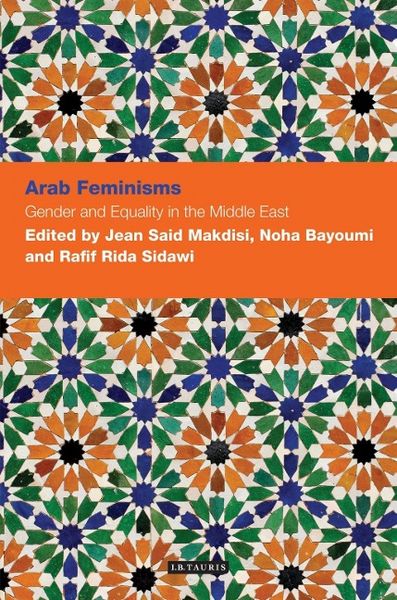
Produktbild: Arab Feminisms

Arab Feminisms Gender and Equality in the Middle East

Aus der Reihe Bloomsbury 3PL

Fr. 169.00

inkl. gesetzl. MwSt., Versandkostenfrei


Beschreibung

Produktdetails

Einband

Gebundene Ausgabe

Erscheinungsdatum

29.01.2014

Herausgeber

Jean Makdisi + weitere

Verlag

Bloomsbury USA

Seitenzahl

478

Maße (L/B/H)

23.4/15.6/2.7 cm

Gewicht

844 g

Sprache

Englisch

ISBN

978-1-78076-672-0

Beschreibung

Produktdetails

Einband

Gebundene Ausgabe

Erscheinungsdatum

29.01.2014

Herausgeber

Verlag

Bloomsbury USA

Seitenzahl

478

Maße (L/B/H)

23.4/15.6/2.7 cm

Gewicht

844 g

Sprache

Englisch

ISBN

978-1-78076-672-0

Herstelleradresse

Libri GmbH
Europaallee 1
36244 Bad Hersfeld
DE

Email: gpsr@libri.de

Kundinnen und Kunden meinen

0 Bewertungen

Informationen zu Bewertungen

Zur Abgabe einer Bewertung ist eine Anmeldung im Konto notwendig. Die Authentizität der Bewertungen wird von uns nicht überprüft. Wir behalten uns vor, Bewertungstexte, die unseren Richtlinien widersprechen, entsprechend zu kürzen oder zu löschen.

Die Bewertungen sind nach Format, Anzahl Sterne und Datum sortiert.

Verfassen Sie die erste Bewertung zu diesem Artikel

Helfen Sie anderen Kund*innen durch Ihre Meinung

Kundinnen und Kunden meinen

0 Bewertungen filtern

Die Leseprobe wird geladen.
  • Produktbild: Arab Feminisms
  • Introduction. Jean Said Makdisi, Noha Bayoumi & Rafif Sidawi. PART I: Variety in Understanding Feminist Concepts and Discourse Chapter 1: What Do Women Want? A Critical Mapping of Future Directions for Arab Feminisms. Mervat Hatem. Chapter 2: Gender Studies in the Arab World: Reflections and Questions on the Challenges of Discourses, Locations and History. Hoda Elsadda. Chapter 3: Recognition of Difference: Towards a More Effective Feminism. Najla Hamadeh. Chapter 4: Research Methods and Probing Feminist Thought. Nahawand el-Kadri Issa. Chapter 5: From Women's Rights to Feminism: The Urgent Need for an Arab Feminist Renaissance. Zeina Zaatari. Chapter 6: Feminist Discourse in the Arab Theatre. Watfa Hamadi. Chapter 7: Huqouq al Mar'a: Feminist Thought and the Language of the Arab Women's Movements. Jean Said Makdisi. Chapter 8: Femininity and Feminist Studies: Research, The Researcher, and Cultural Constrictions in Lebanon. Noha Bayoumi. Chapter 9: The Creative Arab Woman: Opposing the Stereotypical Image and Dismantling the Prevalent Discourse. Fawzia Abdullah Abu-Khaled. Chapter 10: Does Saudi Feminism Exist? Hatoon Ajwad el-Fassi. Chapter 11: Arab Feminism: Obstacles and Possibilities. Suad Zayed Al-Oraimi. Chapter 12: The Cultural Frameworks and Theoretical Boundaries of Arab Feminism. Kulthum Ghanem. Chapter 13: Feminism's Difference Problem. Joan W. Scott. Chapter 14: Feminism as Critique. Nivedita Menon. PART II: The Crisis of Feminism in the Context of War, Civil Conflict, and Military Occupation Chapter 15: Feminism Between Secularism and Islamism: The Case of Palestine. Islah Jad. Chapter 16: Palestinian Feminist Organisations in the Post-Oslo Era:The Binary Nature of Feminist Discourse. Eileen Kuttab. Chapter 17: Liberation Struggles: Reflections on The Palestinian Women's Movement. Amal Amireh. Chapter 18: Indigenising Feminist Knowledge: Palestinian Feminist Thought between the Physics of International Power and the Theology of Racist "Security". Nadera Shalhoub-Kevorkian. Chapter 19: The Developing Role of Colonial Feminists in Iraq. Haifa Zangana. Chapter 20: Women's Resistance and Struggle in Afghanistan and Diasporic Communities. Elaheh Rostami-Povey. Chapter 21: Women Struggling against the Legacy of Colonialism in East Asia. Mari Oka. Chapter 22: Conflicts and Wars: Women's Silent Discourse. Anicee Al Amine Merhi. Chapter 23: The Role of Feminist Movements in Establishing Peace and Improving The Condition of Women in Areas of Armed Conflict. Amira Yousef al-Badri. Chapter 24: Terrorizing Masculinities and Ambivalent Responses in Wajdi Mouawad's Scorched. Dina Georgis. Chapter 25: The Child Torn between War and the Adult World: In the Battlefields by Danielle Arbid. Dalia Said Mustafa. PART III: Islamic Feminism: Approaches and Visions Chapter 26: Sisters in Islam. Zainah Anwar. Chapter 27: Accounting for Affect: Kuwaiti Women Between Freedom and Apathy. Mai Al-Nakib. Chapter 28: Islamic Feminism in Egypt: Between Acceptance and Rejection. Hoda El-Saadi. Chapter 29: Islamic Feminism: A New Feminist Movement or a Strategy by Women for Acquiring Rights? Amal Grami. Chapter 30: Trends and Directions in Contemporary Islamic Feminist Research. Omaima Abou-Bakr. Chapter 31: Poststructuralist Theory and Women in the Middle East: Going in Circles? Marnia Lazreg. Chapter 32: Two Faces of the Revivalof Feminist Qur'anic Exegesis: 'A'ishaAbd al-Rahman and Amina Wadud. Husn Abboud. Chapter 33: Rokeya In The World: Feminism And Islam In 20th Century Bengal. Elora Shehabuddin. PART IV: Feminism in a Global Context Chapter 33: Tracing Dollars, Mapping Colonial Feminism: America Funds Women's 'Democracy' Training in Iraq. Shahrzad Mojab. Chapter 34: Gender in Modern Counterinsurgency. Laleh Khalili. Chpater 35: Reading Between the Lines: Sexual Politics and Publishing in the Age of Public Diplomacy. Vron Ware. Chapter 36: The Blind Traditional Subject and Suitcase Patriarchies. Kumkum Sangari. Chapter 37: Black Feminism and the World. Hazel Carby. Chapter 38: Between Feminism and Social Engineering: The Troubled Trajectory of International Gender Activism. Deniz Kandiyoti.