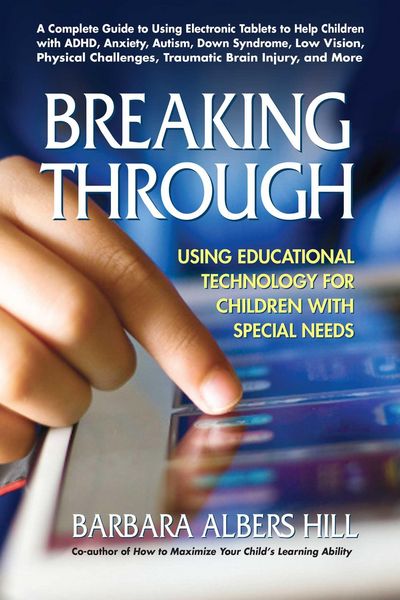
Breaking Through Using Educational Technology for Children with Special Needs
-
- Taschenbuch ausgewählt
- eBook
-
Sprache:Englisch
Fr. 25.90
inkl. gesetzl. MwSt.,
-
Kostenlose Lieferung ab Fr. 30 Einkaufswert
Schweiz & Liechtenstein:
Versandkostenfrei ab Fr. 30.00
Versandkosten bis Fr. 30.00: Fr. 3.50Andere Lieferländer
Fr. 18.00 unabhängig vom Warenwert
Beschreibung
Produktdetails
Einband
Taschenbuch
Erscheinungsdatum
01.04.2014
Verlag
Globe Pequot Publishing Group IncSeitenzahl
162
Maße (L/B/H)
22.9/15.2/0.9 cm
Gewicht
227 g
Sprache
Englisch
ISBN
978-0-7570-0395-0
While one-on-one therapy is certainly beneficial, for some children, the process of developing social skills, manual dexterity, and educational competency presents much more of a challenge. Fortunately, the introduction of new and easy-to-use technological devices has created a quiet revolution in the field of special education. It was only a decade ago that the iPad—a portable interactive Internet device—was introduced to the public. Apple’s marketing people correctly predicted the iPad’s popularity, but they did not expect how uniquely appealing this device would be to children with autism, attention issues, physical challenges, and a host of other learning disabilities. Today, numerous tablets offer programs that can break through the barriers caused by psychological and physical challenges. To understand how you can optimize the use of these devices and select the best programs available, best-selling author and special education expert Barbara Albers Hill has written Breaking Through: Using Today’s Tablet Technology with Special Needs Children.
The book is divided into two parts. Part One provides the basics of using this new technology. First, it explains the many dimensions available in these machines—animation, color, speech, music, reading, and games. Then, it examines how the interactive nature of these elements combine to capture the attention of children and draw them into any given activity. The book explores a range of individual learning differences—such as ADHD, autism spectrum disorder, cerebral palsy, low vision, Down syndrome, language impairment, and traumatic brain injury—and explains which type of programs are best suited for each challenge. Included are tips on adapting the device to a child’s specific condition, as well as practical safety advice. Part One concludes by discussing proven ways in which the programs can be integrated into home and school environments. Part Two provides a consumer’s guide to available devices, attachments and software programs, making the book eminently helpful to both teachers and parents.
If used correctly, the tablet is a devise that can help develop new pathways in the brain and facilitate learning, socialization, and motor skills. While we may call it a breakthrough in therapy, you may call it nothing short of a miracle.
Noch keine Bewertungen vorhanden
Verfassen Sie die erste Bewertung zu diesem Artikel
Helfen Sie anderen Kundinnen und Kunden durch Ihre Meinung.