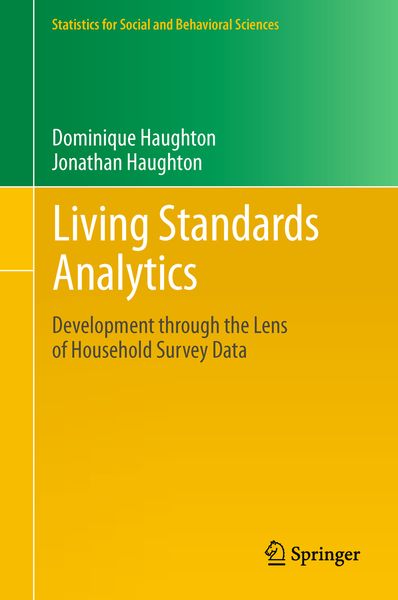
Produktbild: Living Standards Analytics

Living Standards Analytics Development through the Lens of Household Survey Data

Fr. 73.90

inkl. gesetzl. MwSt., Versandkostenfrei


Beschreibung

Produktdetails

Einband

Taschenbuch

Erscheinungsdatum

27.10.2013

Verlag

Springer Us

Seitenzahl

314

Maße (L/B/H)

23.5/15.5/1.9 cm

Gewicht

511 g

Auflage

2011

Sprache

Englisch

ISBN

978-1-4614-3000-1

Beschreibung

Rezension

Overall, the book is highly accessible and nicely produced. The authors characterise it as ‘a gateway book’, and I think that, for researchers in policy analysis and household survey work who learnt their trade some time ago, this is an apt description: The book provides an excellent introduction to some of the more recent developments. I shall certainly recommend it to colleagues in the public policy domain...It includes traditional staples such as linear regression and sampling, but also more recent and advanced tools such as the use of directed acyclic graphs in modelling causality, Kohonen networks to group data, Bayesian approaches, propensity score matching, and survival models. It also places considerable emphasis on the power of modern graphical methods – with the consequence that the book has some very attractive colour diagrams, such as bubble plots and cartograms, which certainly demonstrate the power of modern tools.

International Statistical Review, 81, 2, Review by David J. Hand

Produktdetails

Einband

Taschenbuch

Erscheinungsdatum

27.10.2013

Verlag

Springer Us

Seitenzahl

314

Maße (L/B/H)

23.5/15.5/1.9 cm

Gewicht

511 g

Auflage

2011

Sprache

Englisch

ISBN

978-1-4614-3000-1

Herstelleradresse

Springer-Verlag KG
Sachsenplatz 4-6
1201 Wien
AT

Email: GPSR Kontakt

Noch keine Bewertungen vorhanden

Verfassen Sie die erste Bewertung zu diesem Artikel

Helfen Sie anderen Kundinnen und Kunden durch Ihre Meinung.

Kundinnen und Kunden meinen

Bewertungen (0)

  • Produktbild: Living Standards Analytics
  • Introduction.- Graphical exploratory methods.- Sample size issues.- Beyond linear regression.- Adjustment for spatial correlation.- The issue of causality.- Non-homogeneity/mixtures.- Bayesian analysis.- Grouping methods.- Panel data issues.- Measures of poverty and inequality.- Bootstrap.- Fuzzy methods for poverty measures.- Combining data sets.