
• Produktbild: Few-Body Problems in Physics
  • Produktbild: Few-Body Problems in Physics
Band 6

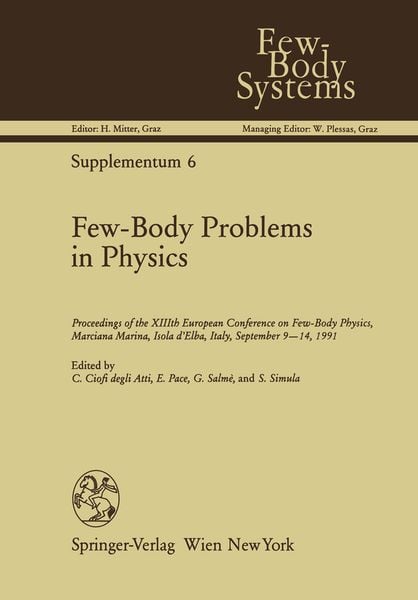
Few-Body Problems in Physics Proceedings of the XIIIth European Conference on Few-Body Physics, Marciana Marina, Isola d’Elba, Italy, September 9–14, 1991

Aus der Reihe Few-Body Systems

Fr. 72.90

inkl. gesetzl. MwSt., Versandkostenfrei


Beschreibung

Produktdetails

Einband

Taschenbuch

Erscheinungsdatum

14.02.2012

Herausgeber

Claudio Ciofi Degli Atti + weitere

Verlag

Springer Wien

Seitenzahl

635

Maße (L/B/H)

24.4/17/3.6 cm

Gewicht

1114 g

Auflage

Softcover reprint of the original 1st ed. 1992

Sprache

Englisch

ISBN

978-3-7091-7583-5

Beschreibung

Produktdetails

Einband

Taschenbuch

Erscheinungsdatum

14.02.2012

Herausgeber

Verlag

Springer Wien

Seitenzahl

635

Maße (L/B/H)

24.4/17/3.6 cm

Gewicht

1114 g

Auflage

Softcover reprint of the original 1st ed. 1992

Sprache

Englisch

ISBN

978-3-7091-7583-5

Herstelleradresse

Springer-Verlag KG
Sachsenplatz 4-6
1201 Wien
AT

Email: GPSR Kontakt

Noch keine Bewertungen vorhanden

Verfassen Sie die erste Bewertung zu diesem Artikel

Helfen Sie anderen Kundinnen und Kunden durch Ihre Meinung.

Kundinnen und Kunden meinen

Bewertungen (0)

  • Produktbild: Few-Body Problems in Physics
  • Produktbild: Few-Body Problems in Physics
  • Session 1 The Structure of Hadrons and Hadronic Interactions.- The Naive Quark Model and Beyond.- Algebraic Approach to Hadronic Structure.- Antiproton Reactions and Charm (With and Without Nuclei).- The Structure of Scalar and Vector Mesons.- Some Measurements for Determining Strangeness Matrix Elements in the Nucleon.- Discussion Session: The Structure of Hadrons.- A Covariant Model of Mesons That Decouples Confinement and Chiral Symmetry Breaking.- Compact Colorless Quark-Gluon Clusters in IAE Bag Model and Intermediate Structure of SU(3) Hadrons. Pion and Nucleon Electromagnetic Form Factors.- Hyperon Structure in the Soliton Approach.- Electroproduction of Strangeness in the Nucleon.- Session 2 The Quark and Meson-Nucleon Descriptions of Few-Body Systems.- A New Partial Wave Analysis and the Nucleon-Nucleon Interaction.- Uncertainties of Phase Shift Analyses and the Nucleon-Nucleon Interaction.- S-D Transition in the Nucleon-Nucleon System.- New Results on the ?NN System.- Multiquark Exotics.- Multiquark Spectra in Large Harmonic Oscillator Bases.- The Quark Model, Deuteron Form Factors and Nuclear Magnetic Moments.- Deuteron Form Factors from Meson-Theoretical Nucleon-Nucleon Interactions.- Discussion Session: Electro- and Photodisintegration of the Deuteron.- to the Discussion Session on Photo- and Electrodisintegration of the Deuteron.- Deuteron Threshold Electrodisintegration.- L/T Structure of the Electrodisintegration of the Deuteron.- Deuteron Electrodisintegration with Relativistic Corrections.- Deuteron Photodisintegration at Intermediate Energy and Quark Models.- Polarization Observables in Deuteron Electrodisintegration.- Three-Nucleon Potentials Due to ? and ? Exchange.- Three-Body Force Effects in Three-Nucleon Systems. What Was Achieved by the Study of Three-Nucleon Bound States?.- Discussion Session: Break-Up and Continuum States of Few-Nucleon Systems.- Break-Up and Continuum States of Few-Nucleon Systems.- Three-Nucleon Break-Up Processes.- Photo disintegration of 4He.- NN P-Wave Effects in Polarized Deuteron Capture on Hydrogen: An Exact Faddeev Calculation.- p-d Radiative Capture with Realistic Three-Nucleon Wave Functions.- Recent Advances in Three-Nucleon Continuum Studies.- Low Energy Scattering on Two-Body Bound State in Cartesian Coordinates.- Session 3 Discussion Session: Mesomolecular Problems and Muon Catalyzed Fusion.- p-d Capture Reactions in Muonic Molecules.- Muon Catalyzed Fusion (µCF) as a Method for Studying Few Nucleon Systems.- Effect of the Nuclear d-t Resonance on Muon Sticking in µ-Catalyzed Fusion.- Muonic Molecules of Light Nuclei.- Session 4 Response of Few-Body Systems to High Energy Probes.- Theoretical Description of Nucleon Structure Functions.- Discussion Session: The Spin Structure of the Nucleon.- The Spin Muon Collaboration Experiment.- Future Experiments to Measure the Spin Structure of the Nucleon.- Measurement of the Neutron Spin Structure Function—Test of the Bjorken Sum Rule.- The Role of Sea Polarisation and Gluons in Magnetic Moments and Resonance Excitation.- Discussion Session: Present Status and Future Perspectives in the Experimental Activity.- Summary of Sessions on Experimental Facilities.- MAMI Experimental Activity.- Nuclear Physics with 1 GeV Continuous Current Electron Beams..- Few-Body Experimental Program at CEBAF.- Few-Body Physics at TRIUMF and KAON.- News from SATURNE in Few-Body Systems.- The Few-Body Experimental Activity at the Saskatchewan Accelerator Laboratory.- Discussion Session: Present Status and Future Perspectives in the Experimental Activity.- The Many Facets of QCD at Low and Medium Energies: The Role of the Nucleus. European Collaboration for a Continuous Wave Electron Accelerator at 15–30 GeV.- Present and Future Few-Nucleon Studies with Cooler Beams at the Indiana University Cyclotron Facility.- Discussion Session: Electron Scattering by Few-Nucleon Systems.- The Scattering of Polarized Electrons from Polarized 3He: First Experiments and Implications for the Measurement of GEn.- Anomaly in the Transverse Response of 3He(e, e’p) Reaction for High Recoil Momentum.- Electromagnetic Studies of Few-Body Systems Using BLAST.- Studies of Inclusive Electron Scattering off the Lightest Nuclei.- Session 5 Theoretical Methods in Few-Body Problems.- Relativistic Approaches to the Few-Body Problem.- Front-Form Calculation of ?d ? np Reactions at High Energies.- Relativistic Two-Body Equations and Nuclear Interactions.- Discussion Session: New Approaches for Bound and Scattering States.- New Approaches for Bound and Scattering States.- New Applications of the Faddeev Approach to the Three-Body Coulomb Problem.- New Method for Solving Three-Dimensional Schrödinger Equation.- The Integrodifferential Equation Approach and Some Applications.- Study of the Bound States of Few-Nucleon Systems with Correlated Basis Functions.- Discussion Session: Few-Body Problems in Atomic and Molecular Physics: Dynamics and Reactions.- Discrete Analogs of Hyperspherical Harmonics and Their Use for the Quantum Mechanical Three-Body Problem.- Many-Body Coulomb Systems Above the Threshold for Total Break-Up.- Non-Relativistic Field Theory in Few-Body Atomic Physics.- Discussion Session: Few-Body Problems in Atomic and Molecular Physics: Bound States and Molecular Structure.- Green’s Functions for Molecules.- Bound States and Molecular Structure of Systems with Hyperons.- List of Participants.- Author Index.