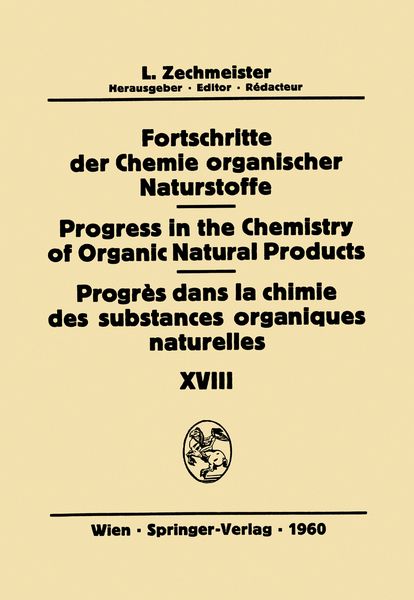
Produktbild: Fortschritte der Chemie organischer Naturstoffe / Progress in the Chemistry of Organic Natural Products / Progrés Dans la Chimie des Substances Organi
Band 18

Fortschritte der Chemie organischer Naturstoffe / Progress in the Chemistry of Organic Natural Products / Progrés Dans la Chimie des Substances Organi

Fr. 72.90

inkl. gesetzl. MwSt., Versandkostenfrei


Beschreibung

Produktdetails

Einband

Taschenbuch

Erscheinungsdatum

16.12.2011

Verlag

Springer Wien

Seitenzahl

600

Maße (L/B/H)

23.5/15.5/3.3 cm

Gewicht

914 g

Auflage

Softcover reprint of the original 1st ed. 1960

Sprache

Deutsch, Englisch, Französisch

ISBN

978-3-7091-7161-5

Beschreibung

Produktdetails

Einband

Taschenbuch

Erscheinungsdatum

16.12.2011

Verlag

Springer Wien

Seitenzahl

600

Maße (L/B/H)

23.5/15.5/3.3 cm

Gewicht

914 g

Auflage

Softcover reprint of the original 1st ed. 1960

Sprache

Deutsch, Englisch, Französisch

ISBN

978-3-7091-7161-5

Herstelleradresse

Springer-Verlag KG
Sachsenplatz 4-6
1201 Wien
AT

Email: GPSR Kontakt

Noch keine Bewertungen vorhanden

Verfassen Sie die erste Bewertung zu diesem Artikel

Helfen Sie anderen Kundinnen und Kunden durch Ihre Meinung.

Kundinnen und Kunden meinen

Bewertungen (0)

Weitere Artikel finden Sie in

  • Produktbild: Fortschritte der Chemie organischer Naturstoffe / Progress in the Chemistry of Organic Natural Products / Progrés Dans la Chimie des Substances Organi
  • / Contents / Table des matières.- Die Actinomycine.- I. Einleitung.- II. Gewinnung und Eigenschaften der Actinomycine.- 1. Trennung von Actinomycingemischen.- 2. Von Streptomyces-Arten produzierte Actinomycingemische.- Die Actinomycingemische C, X und I.- Actinomycingemisch Z.- Actinomycin bildende Streptomyces-Arten.- Identifizierung früher beschriebener Actinomycingemische.- Actinomycingemische der dirigierten Biosynthese.- 3. Nomenklatur der Actinomycine.- Nomenklatur nativer Actinomycingemische.- Nomenklatur reiner Actinomycine.- 4. Eigenschaften und Aminosäuregehalt reiner Actinomycine.- Physikalische Eigenschaften.- Chemische Eigenschaften.- Molekulargewicht.- Aminosäuregehalt.- III. Die Konstitution der Actinomycine.- 1. Die Konstitution des Chromophors.- Despeptido-actinomycin.- Konstitution des Despeptido-actinomycins.- Synthese des Despeptido-actinomycins.- Farbige Abbauprodukte der Säurehydrolyse.- Actinocinin.- Konstitution des Actinomycin-Chromophors.- Synthese des Actinomycin-Chromophors.- Reaktionen des Actinomycin-Chromophors.- 2. Die Konstitution des Peptidteils.- Actinomycin C3.- Actinomycin C1 (I1 X1, D).- Actinomycin C2.- Actinomycin X2.- Actinomycin X0?.- Actinomycin X0?.- 3. Struktur-Variationen des Peptidteils.- IV. Derivate der Actinomycine.- 1. Derivate, die durch Veränderung des Peptidteils entstehen.- 2. Derivate, die durch Veränderung des Chromophors entstehen.- Natürlich vorkommende Nitroverbindungen..- I. Chloramphenicol.- 1. Isolierung und Konstitutionsermittlung.- 2. Synthesen.- 3. Herstellung des Chloramphenicols auf biologischem Wege.- 4. Bestimmung des Chloramphenicols.- II. ?-Nitropropionsäure.- III. Aristolochiasäuren.- 1. Über ältere Arbeiten.- 2. Neuere Arbeiten zur Isolierung, Reindarstellung und Konstitutionsermittlung.- 3. Konstitution der Aristolochiasäure-I.- 4. Konstitution der Aristolochiasäure-II.- 5. Weiteres Vorkommen von Aristolochiasäuren und Isolierung und Charakterisierung von strukturell verwandten Naturstoffen.- Dérivés guanidiques biologiques..- I. Structure et formation.- 1. Structure.- 2. Nomenclature.- 3. Formation par voie chimique.- 4. Biogenèse.- a. Formation par amidination successive: cas de l’arginine.- b. Formation par transformation d’autres composés guanidiques.- c. Formation par transamidination.- II. Propriétés générales.- 1. Basicité.- 2. Formation des sels.- 3. Stabilité et hydrolyse.- 4. Cyclisation.- 5. Oxydation.- 6. Dégradation biochimique.- a. Déguanidylation.- b. Désamidination totale.- c. Dés-amidination partielle.- III. Méthodes générales d’analyse et de preparation.- 1. Réactions d’identification et de dosage.- a. Réaction au diacétyle.- b. Réaction à l’?-naphtol.- c. Réaction au nitroprussiate ferrique.- d. Réaction à la ninhydrine.- 2. Chromatographie sur papier et sur colonne. Electrophorèse.- IV. Répartition des dérivés guanidiques.- Conclusions.- Bibliographie.- Naturally Derived isoThiocyanates (Mustard Oils) and Their Parent Glucosides..- I. Introduction.- II. Historical Development.- III. Parent Glucosides.- 1. General Properties.- 2. Distribution in Plant Tissues.- 3. Detection, Isolation, Separation and Determination.- a. Paper Chromatography.- b. Isolation and Separation Methods.- c. Quantitative Determination.- 4. Chemical Structure.- a. Earlier Formulation.- b. Revised Structures.- c. Synthesis.- 5. Individual Glucosides.- IV. Enzymic Hydrolysis.- 1. Distribution of Myrosinase.- 2. Properties of Myrosinase.- V. Naturally Derived isoThiocyanates.- 1. General Properties.- 2. Detection, Isolation, Separation and Determination.- a. Chromatographic Methods.- b. Isolation.- c. Separation.- d. Quantitative Determination.- 3. Chemical Structure.- a. Saturated Alkyl isoThiocyanates.- b. Unsaturated Alkyl isoThiocyanates.- c. ?-Methylthioalkyl isoThiocyanates and Related Sulphoxides and Sulphones.- Stereochemistry.- d. Aromatic isoThiocyanates.- e. Hydroxy-substituted iso-Thiocyanates.- f. isoThiocyanates of Doubtful Structure.- VI. Botanical Distribution of isoThiocyanate Glucosides.- VII. Biological Properties of isoThiocyanates and Their Parent Glucosides.- VIII. Tables.- 1. Crystalline isoThiocyanate Glucosides, Known at the End of 1959.- 2. Crystalline isoThiocyanate Glucoside Tetraacetates, Known at the End of 1959.- 3. isoThiocyanate Glucosides with Established Side-chains, Known at the End of 1959.- 4. Molecular Rotations of Sulphoxide isoThiocyanates of Natural Origin, Some Derivatives and Related Compounds.- 5. The Occurrence of isoThiocyanates or Their Parent Glucosides in Species of the Family Cruciferae.- 6. The Occurrence of isoThiocyanates or Their Parent Glucosides in Families Other than Cruciferae.- References.- Die Farbstoffe im Gefieder der Vögel..- I. Einleitung.- II. Carotinoide (Lipochrome).- 1. Lutein (Xanthophyll).- 2. Kanarienxanthophyll.- 3. Zeaxanthin.- 4. Picofulvin.- 5. Astaxanthin bzw. Astacin.- 6. Rhodoxanthin.- 7. Rote Carotinoide unbekannter Struktur.- 8. Physiologische Grundlagen der Carotinoid-Ablagerung.- III. Die gelben und roten Federfarbstoffe der Papageien.- IV. Fluoreszierende, gelbe Federfarbstoffe.- 1. Bei Papageien.- 2. Bei anderen Arten.- V. Pyrrolfarbstoffe.- 1. Koproporphyrin.- 2. Turacin.- 3. Pyrrolfarbstoffe im Stoffwechsel der Vögel.- VI. Chemisch ungeklärte Federpigmente.- VII. Rückblick.- Cis-trans Isomeric Carotenoid Pigments..- I. Introduction.- Nomenclature.- Some Historical Remarks on Stereoisomerism of Polyenes.- II. Number and Types of cis Carotenoids. Steric Hindrance.- III. Some Properties of cis Carotenoids.- 1. Relative Stabilities.- Sterically Unhindered cis Forms.- Sterically Hindered cis Forms.- Polycis Forms.- 2. Melting Points.- 3. Rotatory Power.- 4. Relative Adsorption Affinities.- IV. Cis-trans Isomerism and UV Spectra.- 1. Some Remarks on the Spectra of all-trans Carotenoids.- 2. Spectral Effect of trans ? cis Isomerization in the Visible Region.- 3. Spectral Effect of trans ? cis Isomerization in the Near Ultraviolet Region: the cis-Peak.- 4. A Theoretical Interpretation of Spectral Phenomena, Especially of the cis-Peak Effect.- 5. Spectra at Extremely Low Temperatures.- V. Preparation of cis Carotinoids by Direct Rearrangement of the All-trans Form.- 1. Thermal Methods of cis-trans Isomerization.- (a) Spontaneous Rearrangement in Solution at Room Temperature.- (b) cis-trans Isomerization in Refluxed Solutions.- (c) cis-trans Isomerization by Melting Crystals.- 2. Photochemical cis-trans Isomerization in the Absence of Catalysts.- 3. cis-trans Isomerization by Iodine Catalysis, in Light.- 4. cis-trans Isomerization by Acid Catalysis.- 5. cis-trans Isomerization by Contact with Active Surfaces.- 6. cis-trans Isomerization via Boron Trifluoride Complexes.- 7. Bio-stereoisomerization.- VI. Preparation of cis Carotenoids by Total Synthesis.- VII. Naturally Occurring cis and Polypcis Carotenoids.- 1. Mono- and Dicis Carotenoids.- 2. Polycis Carotenoids.- Prolycopene.- Further Polycis Lycopenes.- Proneuro-sporene (Protetrahydrolycopene, Neoneurosporene P).- Pro-?-carotene.- VIII. Some General Remarks on Configurational Assignments.- 1. Stereoisomeric Types.- 2. Number and Location of cis Double Bonds.- 3. Configuration and Infrared Spectrum.- IX. Configurational Assignments in Certain Stereoisomeric Sets.- 1. Stereoisomeric Sets with Two Hydroaromatic Terminal Groups.- ?-Carotene Set.- Cryptoxanthin Set.- Zeaxanthin Set.- Isozeaxanthin Set.- Echinenone Set.- Can-thaxanthin Set.- ?-Carotene Monoepoxide Set.- ?-Carotene Diepoxide Set.- 3,4-Dehydro-?-carotene and 3,4,3?,4?-Bisdehydro-?-carotene Sets.- 16,16?-Homo-?-caxotene Set.- 13,13?-Bis-desmethyl-?-carotene Set.- retro-Dehydrocarotene Set.- ?-Carotene Set.- ?-Cryptoxanthin (Physoxanthin) Set.- Lutein Set.- Trollixanthin Set.- 3,4-Dehydro-?-carotene Set.- Taraxanthin Set.- 2. Stereoisomeric Sets with One Hydroaromatic and One Aliphatic Terminal Group.- ?-Carotene Set.- Gazaniaxanthin Set.- Celaxanthin Set.- Capsanthin Set.- Torularhodin Set.- 3. Stereoisomeric Sets with Two Aliphatic Terminal Groups.- Lycopene Set.- Neurosporene Set.- Phytofluene Set.- Rhodoviolascin (Sprilloxanthin) Set.- Capsorubin Set.- Fucoxanthin Set.- 4. Stereoisomeric Sets with Two Aromatic Terminal Groups.- 1,18-Diphenyl-3,7,12,16-tetramethyl-octadecanonaene Set.- Renieratene and Isorenieratene Sets.- 1,3,7,12,16,18-Hexaphenyl-octadecanonaene Set.- “Naphthyl-carotene” Set.- X. Lower-molecular Weight Carötenoid-carboxylic Acids: Bixin and Crocetin.- Bixin Set.- Crocetin Set.- XI. Cis-trans Isomerism and Provitamin a Effect of Carotenoids..- References.- The Gibberellins..- I. Introduction.- II. The Chemistry of the Gibberellins.- 1. General Remarks.- 2. Nomenclature.- 3. The Chemistry of Gibberellic Acid.- A. Structure of Gibberene.- B. Structure of Gibberic Acid.- (a) Gibberic Acid.- (b) epiGibberic Acid.- C. Structure and Stereochemistry of allo Gibberic Acid.- (a) allo Gibberic Acid.- (b) Absolute Configuration.- (c) epiallo Gibberic Acid.- D. Structure and Stereochemistry of Gibberellic Acid.- (a) Gibberellic Acid.- (b) Epimerisation at Position 2 in Gibbanes.- (c) Rearrangement of Gibb-3-ene 1 ? 4a Lactones.- (d) Absolute Configuration.- (e) Miscellaneous Reactions of Ring A.- 4. Biogenesis of the Gibberellins.- III. Occurrence of Gibberellins in Higher Plants.- IV. Effects on Plant Growth and Development.- 1. Stem Growth.- A. Day-neutral Annuals, etc.- B. Herbaceous Plants Sensitive to Vernalisation or Photoperiod.- C. Photoperiod-controlled Growth of Woody Plants.- D. Cell-extension or Cell-multiplication?.- E. Mode of Action Studies: Interactions with Auxins.- F. Mode of Action Studies: Interactions with Light.- G. Other Interactions.- 2. Leaf Growth.- 3. Root Growth.- A. Root Extension.- B. Root Initiation on Stem Cuttings.- C. Development of Root-nodules on Leguminous Plants.- 4. Flowering.- A. Rosette Plants Requiring Vernalisation or Long-days.- B. Caulescent Plants Induced to Flower by Vernalisation or Long-day Photoperiods.- C. Short-day Plants.- D. Discussion.- 5. Fertilisation and Fruit Growth.- A. Pollen Growth.- B. Parthenocarpy.- C. Fruit-swelling.- 6. Seed Germination.- A. Breaking of Dormancy.- B. Acceleration of Germination.- 7. Effects on Lower Plants.- 8. Discussion.- A. Hormonal Interactions.- B. The Rôle of the Gibberellins as Plant Hormones.- V. Detection and Estimation of Gibberellins.- 1. Bioassay.- 2. Chemical and Physical Methods.- References.- Selected Subjects in Sedimentation Analysis, with Some Applications to Biochemistry..- Glossary of Terms.- I. Basic Theory.- 1. Charge Effects.- a) Diffusion.- b) Sedimentation.- 2. The Theory of Sedimentation Analysis.- a) Conservation of Mass. The Continuity Equation.- b) The Flow Equations.- 3. Velocity Equation for Two-Component, Incompressible Systems and Its Uses.- 4. The Differential Equation of the Ultracentn fuge and Its Solutions. Two Components.- II. The Sedimentation Velocity Experiment and the Determination of Molecular Weight. (Two-Component, Idealized Systems.).- 1. Definition and Evaluation of the Sedimentation Coefficient.- 2. Molecular Weights from Sedimentation and Diffusion.- 3. Molecular Weight Determination by Combination of Sedimentation Coefficient and Intrinsic Viscosity.- III. Heterogeneity and the Form of the Boundary Gradient Curve.- 1. Boundary Spreading: Negligible Diffusion, Constant Sedimentation Coefficient.- 2. Boundary Spreading: Appreciable Diffusion, Constant Sedimentation Coefficient.- 3. Boundary Spreading: Sharpening Effects of Concentration Dependence of Sedimentation Coefficient.- 4. The Johnston-Ogston Effect.- 5. Protein-Protein Interactions.- a) Monomer-Polymer Equilibria.- b) Bimolecular Associations.- c) Interconversion of Isomers.- IV. Three-Component Systems.- 1. Solvation.- 2. Sedimentation Equilibrium in a Density Gradient.- References.- Structure and Immunological Specificity of Polysaccharides..- I. Introduction.- II. Chemistry of Capsular Polysaccharides of Pneumococcus and O-Poly-saccharides of Salmonella.- III. Cross-reactions of Antipneumococcal Sera.- IV. Cross-reactions in Anti-Salmonella Sera.- V. Cross-reactions in Anti-Mycoplasma mycoides Serum.- VI. Conclusion.- VII. Tables.- 1. Specific Capsular Polysaccharides of Pneumococcus and Polysaccharides of Cross-reacting Microorganisms.- 2. Polysaccharides which Precipitate Antipneumococcal and Other Sera to Strongly Moderately.- 3. Cross-reactions of Polysaccharides of Microorganisms in Antipneumococcal and Other Antisera.- 4. Cross-reactions of Animal and Plant Polysaccharides in Antipneumococcal and Other Antisera.- References.- Namenverzeichnis. Index of Names. Index des Auteurs.- Sachverzeichnis. Index of Subjects. Index des Matières.