Gutscheinbedingungen

*Gültig bis 05.07.2026 auf (fast) alles. Ausgeschlossen sind Smartboxen, Zeitschriften, Tickets, Lebensmittel, Gaming-Elektroartikel, Tinte/Toner, Gutscheine, Geschenkkarten, Blumen und Abos | Einlösbar in allen Buchhandlungen von Orell Füssli, Barth Bücher, Buchladen Rapunzel, Papeterie Köhler, Schuler Orell Füssli, Stauffacher und ZAP unter Vorweisung des Gutscheins, auf www.orellfüssli.ch durch Eingabe des Gutscheincodes. Beim Service „eBooks verschenken“ und bei eBook-Käufen via eReader nicht einlösbar | Mindesteinkaufswert: Fr. 30.- | Nicht mit anderen Rabatten kumulierbar.

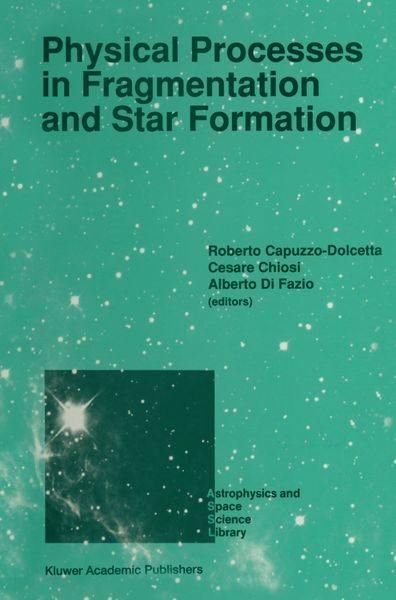
  • Produktbild: Physical Processes in Fragmentation and Star Formation
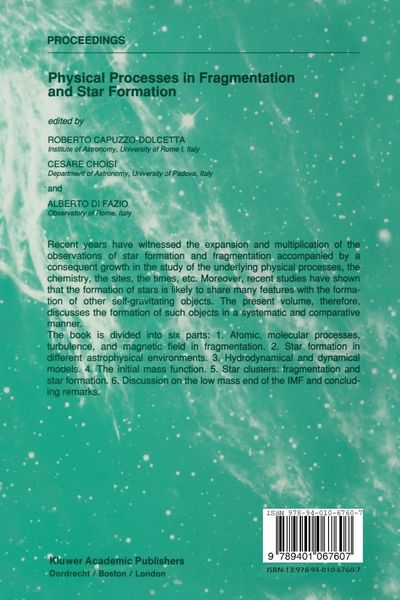
  • Produktbild: Physical Processes in Fragmentation and Star Formation
Band 162

Physical Processes in Fragmentation and Star Formation Proceedings of the Workshop on ‘Physical Processes in Fragmentation and Star Formation’, Held in Monteporzio Catone (Rome), Italy, June 5–11, 1989

Fr. 72.90

inkl. gesetzl. MwSt., Versandkostenfrei


Beschreibung

Produktdetails

Einband

Taschenbuch

Erscheinungsdatum

01.10.2011

Herausgeber

Roberto Capuzzo-Dolcetta + weitere

Verlag

Springer Netherland

Seitenzahl

492

Maße (L/B/H)

23.5/15.5/2.7 cm

Gewicht

739 g

Auflage

Softcover reprint of the original 1st ed. 1990

Sprache

Englisch

ISBN

978-94-010-6760-7

Beschreibung

Produktdetails

Einband

Taschenbuch

Erscheinungsdatum

01.10.2011

Herausgeber

Verlag

Springer Netherland

Seitenzahl

492

Maße (L/B/H)

23.5/15.5/2.7 cm

Gewicht

739 g

Auflage

Softcover reprint of the original 1st ed. 1990

Sprache

Englisch

ISBN

978-94-010-6760-7

Herstelleradresse

Springer-Verlag KG
Sachsenplatz 4-6
1201 Wien
AT

Email: GPSR Kontakt

Noch keine Bewertungen vorhanden

Verfassen Sie die erste Bewertung zu diesem Artikel

Helfen Sie anderen Kundinnen und Kunden durch Ihre Meinung.

Kundinnen und Kunden meinen

Bewertungen (0)

  • Produktbild: Physical Processes in Fragmentation and Star Formation
  • Produktbild: Physical Processes in Fragmentation and Star Formation
  • 1. Atomic, Molecular Processes, Turbulence, and Magnetic Field in Fragmentation.- Chemistry and star formation.- Molecular cloud chemistry with mixing.- Collapse and fragmentation of molecular clouds.- On the role of molecular hydrogen in the formation and evolution of blue compact dwarf galaxies and giant HII regions.- NLTE H2 cooling function and protogalactic evolution.- Radiative shocks and nonequilibrium chemistry in the early universe: Galaxy and primordial star formation.- The intergalactic medium: initial and boundary conditions for Galaxy and primeval star formation.- Supersonic turbulent fragmentation of giant molecular clouds.- Turbulence in the frame of the evolution of a self-gravitating protocloud.- Fragmentation and supersonic turbulence in self-gravitating gas clouds.- Fragmentation and collapse in magnetic molecular clouds: natural length scales and protostellar masses.- 2. Star Formation in Different Astrophysical Environments.- Perception of interstellar structure: facing complexity.- Interstellar gas cycling powered by star formation.- Star complex formation in differentially rotating superclouds.- Global star formation in the L1630 molecular cloud.- Observations of fragmentation.- Extrasolar planetary material.- Star formation and dissipation in galactic discs.- Star formation in star burst galaxies.- The new brilliant blue compact dwarf galaxy: a test on the early stages of galaxy evolution.- Star formation in elliptical galaxies.- Star formation in distant galaxies.- The early evolution of spheroidal star systems.- 3.Hydrodynamical and Dynamical Models.- Fragmentation of isothermal and non-isothermal protostellar clouds.- Protostellar core instabilities.- A multifluid hydrodynamical radiative model for the evolution of a spherical protogalaxy.- Thermal instabilities in the warm interstellar gas as a regulating mechanism of star formation.- Evolution of the first protostellar core.- Numerical hydrodynamics of cloud implosion.- 4. The Initial Mass Function.- A review on IMF theories.- Fragmentation theories and the IMF.- The initial mass function of very low mass stars and the significance of brown dwarfs.- Multimodality of star formation.- 5. Star Clusters: Fragmentation and Star Formation.- Formation of star clusters.- The initial mass functions of magellanic cloud star clusters.- Are there large variations among IMFs of LMC clusters?.- Star clusters in the Large Magellanic Cloud.- Formation and disruption of open clusters.- 6. Discussion on the low mass end of the imf and concluding remarks.- Discussion on the low mass end of the IMF.- Radio-observation perspectives and star formation.- Concluding remarks.- Key Word Index.