Gutscheinbedingungen

*Gültig bis 05.07.2026 auf (fast) alles. Ausgeschlossen sind Smartboxen, Zeitschriften, Tickets, Lebensmittel, Gaming-Elektroartikel, Tinte/Toner, Gutscheine, Geschenkkarten, Blumen und Abos | Einlösbar in allen Buchhandlungen von Orell Füssli, Barth Bücher, Buchladen Rapunzel, Papeterie Köhler, Schuler Orell Füssli, Stauffacher und ZAP unter Vorweisung des Gutscheins, auf www.orellfüssli.ch durch Eingabe des Gutscheincodes. Beim Service „eBooks verschenken“ und bei eBook-Käufen via eReader nicht einlösbar | Mindesteinkaufswert: Fr. 30.- | Nicht mit anderen Rabatten kumulierbar.

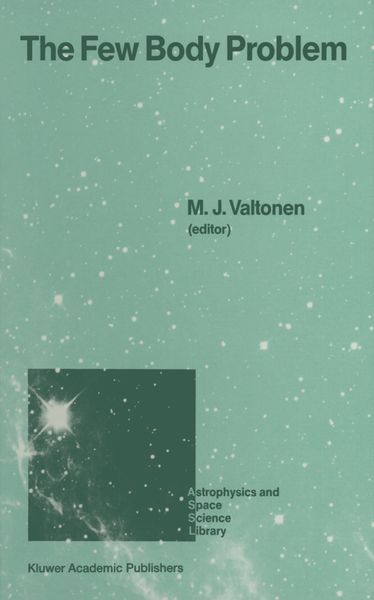
  • Produktbild: The Few Body Problem
  • Produktbild: The Few Body Problem
Band 140

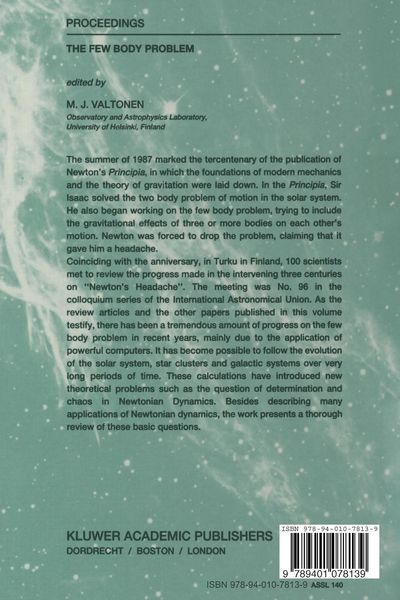
The Few Body Problem Proceedings of the 96th Colloquium of the International Astronomical Union Held in Turku, Finland, June 14–19, 1987

Fr. 241.00

inkl. gesetzl. MwSt., Versandkostenfrei


Beschreibung

Produktdetails

Einband

Taschenbuch

Erscheinungsdatum

21.12.2011

Herausgeber

M.J. Valtonen

Verlag

Springer Netherland

Seitenzahl

432

Maße (L/B/H)

23.5/15.5/2.5 cm

Gewicht

686 g

Auflage

Softcover reprint of the original 1st ed. 1988

Sprache

Englisch

ISBN

978-94-010-7813-9

Beschreibung

Produktdetails

Einband

Taschenbuch

Erscheinungsdatum

21.12.2011

Herausgeber

M.J. Valtonen

Verlag

Springer Netherland

Seitenzahl

432

Maße (L/B/H)

23.5/15.5/2.5 cm

Gewicht

686 g

Auflage

Softcover reprint of the original 1st ed. 1988

Sprache

Englisch

ISBN

978-94-010-7813-9

Herstelleradresse

Springer-Verlag KG
Sachsenplatz 4-6
1201 Wien
AT

Email: GPSR Kontakt

Noch keine Bewertungen vorhanden

Verfassen Sie die erste Bewertung zu diesem Artikel

Helfen Sie anderen Kundinnen und Kunden durch Ihre Meinung.

Kundinnen und Kunden meinen

Bewertungen (0)

  • Produktbild: The Few Body Problem
  • Produktbild: The Few Body Problem
  • Introductory remarks.- I. General theory.- Qualitative analysis in the few-body problem.- A classification of motion types in the general three-body problem.- Periodic orbits and stability.- The effect of perturbing potentials on Hill’s stable range in restricted three-body problem.- Fractal dimensions and integrability of Hamiltonian systems: a discretization method.- Non-integrability of three body problems with homogeneous potential.- On the existence of some configurations of relative equilibrium in the N-body problem.- Rotational motion of a rigid body in an orbit of the three body problem.- Possibility of exchange of a rectilinear three-body system with zero energy.- Escape in the three-body problem with two degrees of freedom — Rectilinear case and isosceles case —.- On a restricted five-body problem: An analysis with Computer Algebra.- A perturbative method for problems with two critical arguments.- Generalized Hamilton’s principle and its application.- Round table discussion on chaotic motions.- II. Solar system.- Asteroid families.- On the origin of 5/2 Kirkwood gap.- A possible source for highly inclined Apollo-Armor asteroids: the secular resonance ?16.- The 2/1 Jovian resonance in the elliptic problem.- Asteroids in the 1:3:2 commensurability.- The problem of evolution on orbital resonance.- Stability of the planetary triangular Lagrangian points.- Long-term orbital evolution studies of Aten-Apollo-Amor objects.- Long-term dynamics of the outer solar system Review of LONGSTOP project.- Secular variations of the semimajor axes of the planets.- Higher-order numerical secular planetary theory.- Numerical simulations of ring dynamics.- Dynamics of coorbital satellite rings.- Orbital energy transfer in exactly commensurate satellites.- Capture of comets as temporary satellites of Jupiter.- Influence of close encounters on the determination of cometary orbits.- Passage of the Sun through an interstellar nebula and the Oort cloud comets.- Motion of satellites — the choice of reference frames.- III. Stellar systems.- The scattering problem.- Influence of a hyperbolic flyby of a small mass on the orbital evolution of a massive binary.- Numerical investigation of the orbital evolution of a massive binary in the field of small masses.- Energy exchange in a parabolic three-body encounter.- The stellar problem of three bodies and applications.- The triple-escape function behaviour for small energy systems.- Dynamical evolution of double and triple subsystems in the N-body systems.- Multiple stars in the solar neighbourhood.- On the effects of unequal masses in the statistics of three- and four-body interactions.- Escapes from stellar systems.- The force distribution for close encounters.- Mass transferring binaries in hierarchical triples.- On some stability regions in the three-body problem.- Integration methods for small N-body systems.- A numerical experimenter’s view of the few-body problem.- Relaxation in small N-body systems.- Long-term evolution of cores of globular clusters after core collapse.- IV. Multiple galaxies.- The merger time of interacting galaxies.- Orbital decay in non-spherical galaxies.- Cluster influences on the internal dynamics of a galaxy.- Tidal stripping and accretion in collapsing clusters of galaxies.- Close approaches and coalescence in the triple systems of gravitating masses.- Tidal interaction of small satellite galaxies with spiral primaries.- Inelastic collisions in models of disk galaxies.- Influence of gas motion on star formation in the central region of a disk galaxy.- Numerical simulations of massive ejections from galactic nuclei.- Formation of bridges and tails in interacting galaxies.- Bar formation in interacting galaxies.- The polar ring galaxy NGC 4650A.- A computational method for galaxy interactions.- Some aspects of chaotic behavior in the Solar System.- Index of names.- Index of subjects.