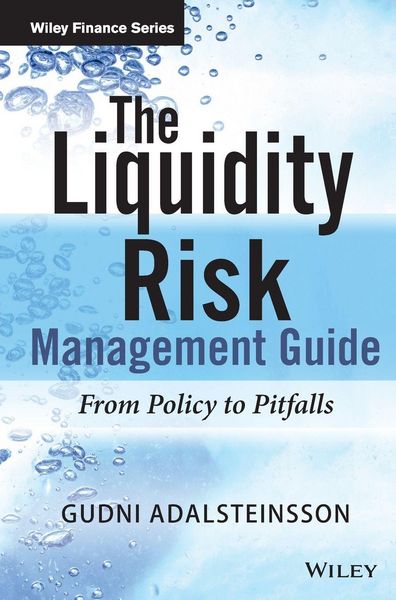
Produktbild: The Liquidity Risk Management Guide
Band 1

The Liquidity Risk Management Guide From Policy to Pitfalls

Aus der Reihe Wiley Finance Series

Fr. 113.00

inkl. gesetzl. MwSt., Versandkostenfrei


Beschreibung

Produktdetails

Einband

Gebundene Ausgabe

Erscheinungsdatum

06.06.2014

Verlag

John Wiley & Sons

Seitenzahl

216

Maße (L/B/H)

25.1/17.7/2.5 cm

Gewicht

551 g

Auflage

1. Auflage

Sprache

Englisch

ISBN

978-1-118-85800-4

Beschreibung

Produktdetails

Einband

Gebundene Ausgabe

Erscheinungsdatum

06.06.2014

Verlag

John Wiley & Sons

Seitenzahl

216

Maße (L/B/H)

25.1/17.7/2.5 cm

Gewicht

551 g

Auflage

1. Auflage

Sprache

Englisch

ISBN

978-1-118-85800-4

Herstelleradresse

Libri GmbH
Europaallee 1
36244 Bad Hersfeld
DE

Email: GPSR Kontakt

Noch keine Bewertungen vorhanden

Verfassen Sie die erste Bewertung zu diesem Artikel

Helfen Sie anderen Kundinnen und Kunden durch Ihre Meinung.

Kundinnen und Kunden meinen

Bewertungen (0)

Die Leseprobe wird geladen.
  • Produktbild: The Liquidity Risk Management Guide
  • Preface xi

    List of Figures xiii

    1 Introduction 1

    1.1 The importance of an overarching liquidity risk management framework 3

    1.2 The '6 Step Framework' 4

    1.3 The structure of the book 5

    1.4 Additional material - templates 6

    2 Primer in Banking 7

    2.1 Risk in banking 7

    2.1.1 Managing the risk 9

    2.1.2 The bank's balance sheet 11

    3 The ALM Function - The Framework on Top of Liquidity Management 13

    3.1 ALM within risk, finance and the businesses 14

    3.1.1 Centralization versus decentralization 14

    3.1.2 Accounting and ALM 15

    3.2 The asset-liability committee (ALCO) 16

    3.3 Areas covered by ALCO 17

    3.3.1 Interest rate risk management 18

    3.3.2 Liquidity risk management 18

    3.3.3 Capital reporting and management 19

    3.3.4 Setting or recommending risk limits 19

    3.4 Enhanced role of the ALM unit 20

    4 Liquidity - Background and Key Concepts 23

    4.1 Definitions and more definitions 23

    4.1.1 Liquidity - definition 23

    4.1.2 Liquidity risk 25

    4.2 The liquidity gap 26

    4.3 The timing factor of liquidity risk: tactical, structural and contingent 27

    4.4 It's all about the 'L' word 30

    4.5 Liquidity, solvency and capital 30

    4.6 Liquidity from a macroeconomic perspective - the singular case of contagion risk and asymmetric information 31

    5 The Appropriate Liquidity Framework - Introduction to the '6 Step Framework' 35

    5.1 Setting the stage - from policy to a practical framework 35

    5.2 The heightened regulatory focus on liquidity 36

    5.3 Recommended Liquidity risk management framework - The '6 Step Framework' 38

    6 Step I: Sources of Liquidity Risk 43

    6.1 The 10 sources of liquidity risk 45

    6.1.1 Wholesale funding risk 46

    6.1.2 Retail funding risk 50

    6.1.3 Intraday liquidity risk 57

    6.1.4 Intragroup liquidity risk 60

    6.1.5 Off-balance sheet liquidity risk 61

    6.1.6 Cross-currency liquidity risk 63

    6.1.7 Funding cost risk 63

    6.1.8 Asset risk 64

    6.1.9 Funding concentration Risk 65

    6.1.10 Correlation and contagion risk 66

    7 Step II: Risk Appetite 69

    7.1 The risk appetite statement 69

    7.1.1 Eggs, omelettes and a free lunch in the board room 69

    7.2 Drawing up a risk appetite statement 70

    7.2.1 Risk appetite set at the appropriate level 71

    7.2.2 Liquidity risk statement - tolerance limit approach 73

    7.2.3 Liquidity risk statement - survival time period or scenario-based approach 75

    7.3 The liquidity reserve 76

    7.3.1 A liquidity reserve or a liquidity buffer? 78

    7.3.2 How to review the risk appetite? 78

    8 Step III: Governance and High-Level Policy 81

    8.1 The role of the board of directors 82

    8.2 The role of senior management 83

    8.2.1 First down then up again 84

    8.3 High-level liquidity policies and strategies 84

    8.3.1 Additional material 85

    8.4 Liquidity policy 85

    8.5 Funding strategy 88

    8.5.1 Examination of the business strategy/plan requirements 88

    8.5.2 Assessment of funding sources and their attractiveness 90

    8.5.3 Medium and longer term funding plans 91

    8.6 Funds transfer pricing 95

    8.6.1 Funds transfer pricing in a nutshell 96

    8.6.2 The FTP principles and objectives 97

    8.6.3 Construction of an FTP model 98

    8.6.4 The FTP method in two steps 99

    8.6.5 The pooled (average) cost method 103

    8.6.6 The matched funding method 104

    8.6.7 Funds transfer pricing in application 105

    9 Step IV: The Quantitative Framework 111

    9.1 Different ways to measure liquidity 111

    9.1.1 Balance sheet analysis 112

    9.1.2 Cash flow analysis 115

    10 Step V: Stress Testing and the Contingency Funding Plan 123

    10.1 Stress testing - the heart of the liquidity framework 123

    10.1.1 How banks perform their stress tests 124

    10.1.2 Where stress tests failed during the financial crises 124

    10.1.3 The principles of stress testing 125

    10.1.4 Stress testing within the '6 Step Framework' 126

    10.1.5 Picking the model 126

    10.1.6 The limitation of VaR for liquidity risk stress testing 127

    10.1.7 The deterministic 'what if' approach 127

    10.1.8 Setting of the deterministic scenario 128

    10.1.9 Choice of severity 129

    10.1.10 Choice of time horizon 132

    10.1.11 Scenario stress testing, step by step 133

    10.1.12 Define the scenarios 134

    10.1.13 Playing out the scenario 135

    10.1.14 Analysing the outcome 141

    10.2 Final note on scenario stress testing 145

    10.2.1 Reverse stress testing 146

    10.3 Contingency funding plan (CFP) - the SPADE of the liquidity framework 146

    10.3.1 The regulatory requirement 148

    10.3.2 Why banks need a CFP 148

    10.3.3 The CFP process 149

    10.3.4 Spotting the risk - triggers and early warning indicators 150

    10.3.5 Assessing the risk and alert level - the boy who cried wolf 153

    10.3.6 Decisions and action plans 155

    10.3.7 Execution 160

    11 Step VI: Reporting and Management Information 169

    11.1 Internal controls and internal audit processes 171

    12 Basel III: The New Global Framework 173

    12.1 Basel III - beyond the buzzwords 173

    12.1.1 The basel committee on banking supervision (BCBS) 173

    12.1.2 Short summary of the regulatory framework leading up to basel III 173

    12.1.3 Basel III 174

    12.1.4 Capital requirements directive (CRD) and the single rulebook 176

    12.2 The basel III liquidity ratios 177

    12.3 The liquidity coverage ratio (LCR) 178

    12.3.1 Challenges the LCR Will Bring to the liquidity framework 180

    12.3.2 The basel III definitions and stress assumptions 181

    12.3.3 LCR common disclosure template 183

    12.4 The net stable funding ratio (NSFR) 185

    Bibliography 187

    Index