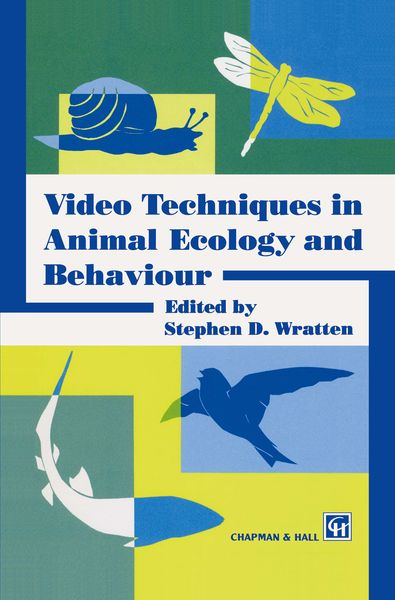
• Produktbild: Video Techniques in Animal Ecology and Behaviour
  • Produktbild: Video Techniques in Animal Ecology and Behaviour

Video Techniques in Animal Ecology and Behaviour

Fr. 191.00

inkl. gesetzl. MwSt., Versandkostenfrei


Beschreibung

Produktdetails

Einband

Taschenbuch

Erscheinungsdatum

21.09.2012

Verlag

Springer Netherland

Seitenzahl

211

Maße (L/B/H)

23.5/15.5/1.3 cm

Gewicht

353 g

Auflage

Softcover reprint of the original 1st ed. 1994

Sprache

Englisch

ISBN

978-94-010-4301-4

Beschreibung

Rezension

`
...an essential reference handbook for postgraduate students and researchers in higher education and industry who are involved in studies of reproductive and foraging behaviour and of the feeding and dispersal in vertebrates and invertebrates.
'

Ethology, Ecology and Evolution

`
A practical sourcebook devoted to the applications of video techniques in the study of movement in organisms in the field and laboratory. It describes in detail systems used for exploring the behavior and ecology of animals as diverse as protozoa, molluscs, mites, predatory and flying insects, as well as domestic, wild, and farm vertebrates.
'

SciTech Book News (April 1994)

`
The final judgement on a book like this is whether it motivates one to run right out and buy a video camera and associated computer equipment or not. Given the resources, we would do so (in the mean time, we recommend borrowing time on a colleague's system). ...If you are new to applications of video technology and think that you may have a good situation for an application, then a first look at a couple of the chapters in this book is an excellent way to examine the practical difficulties that you may have.
'

Acta Oecologica

Produktdetails

Einband

Taschenbuch

Erscheinungsdatum

21.09.2012

Verlag

Springer Netherland

Seitenzahl

211

Maße (L/B/H)

23.5/15.5/1.3 cm

Gewicht

353 g

Auflage

Softcover reprint of the original 1st ed. 1994

Sprache

Englisch

ISBN

978-94-010-4301-4

Herstelleradresse

Springer-Verlag GmbH
Tiergartenstr. 17
69121 Heidelberg
DE

Email: ProductSafety@springernature.com

Kundinnen und Kunden meinen

0 Bewertungen

Informationen zu Bewertungen

Zur Abgabe einer Bewertung ist eine Anmeldung im Konto notwendig. Die Authentizität der Bewertungen wird von uns nicht überprüft. Wir behalten uns vor, Bewertungstexte, die unseren Richtlinien widersprechen, entsprechend zu kürzen oder zu löschen.

Die Bewertungen sind nach Format, Anzahl Sterne und Datum sortiert.

Verfassen Sie die erste Bewertung zu diesem Artikel

Helfen Sie anderen Kund*innen durch Ihre Meinung

Kundinnen und Kunden meinen

0 Bewertungen filtern

  • Produktbild: Video Techniques in Animal Ecology and Behaviour
  • Produktbild: Video Techniques in Animal Ecology and Behaviour
  • 1 Flying insects in the field.- 1.1 Introduction.- 1.2 Types of application.- 1.3 Factors affecting the visibility of airborne insects.- 1.4 Artificial illumination.- 1.5 Observational configurations.- 1.6 Target identification.- 1.7 Summary.- References.- 2 Flying insects in the laboratory.- 2.1 Equipment.- 2.2 Optimizing images.- 2.3 Analysing videos.- 2.4 Specialized flight chambers.- 2.5 Summary.- References.- 3 Parasites and predators.- 3.1 Applications of video technology to parasitoid and predator ecology.- 3.2 Lighting.- 3.3 Arenas.- 3.4 Data extraction from video.- 3.5 MicroMeasure — video analysis software.- 3.6 MicroMeasure in use.- 3.7 Other video analyses of predation.- References.- 4 Terrestrial molluscs.- 4.1 Practical advantages and problems of time-lapse.- 4.2 Recording equipment and techniques.- 4.3 Uses of video technology.- 4.4 Conclusions.- References.- 5 Marine video.- 5.1 Introduction.- 5.2 Problems special to underwater cameras.- 5.3 A basic system and its development for special purposes.- 5.4 Radio links for remote cameras.- 5.5 Video recording.- 5.6 Working in the dark.- 5.7 Work with TV at great depths.- 5.8 Self-propelled camera-carrying vehicles.- 5.9 Use of cameras to measure length.- 5.10 Conclusions.- References.- 6 Wild birds.- 6.1 Introduction.- 6.2 Breeding failures of red kites in Wales.- 6.3 Feeding ecology of nesting cirl buntings.- 6.4 Discussion.- References.- 7 Farm animals.- 7.1 Introduction.- 7.2 How comparable are data gained by direct observation and video recording?.- 7.3 An overview of farm animal behaviour studies using VCR.- 7.4 Identification and marking techniques.- 7.5 Camera and recording techniques.- 7.6 Playback and data extraction techniques.- 7.7 General complications.- 7.8 The future of VCR in farm animalethology.- References.- 8 Companion animals.- 8.1 Introduction.- 8.2 Home ranges and territories.- 8.3 Social behaviour.- 8.4 Feeding behaviour.- 8.5 Behavioural development.- 8.6 Interactions with man.- 8.7 General considerations.- References.- 9 Video and microorganisms.- 9.1 Need for video in microbiology.- 9.2 Advantages and disadvantages of video recording.- 9.3 Video applications in behaviour analysis of fast-swimming microorganisms.- 9.4 Detailed single cell tracking and motility analysis.- 9.5 Video recording of rapid organellar motion.- 9.6 Video recording of slowly moving microorganisms.- 9.7 Some new video techniques.- References.