
The Economic and Environmental Impacts of Agbiotech A Global Perspective
-
- Hardcover
- Taschenbuch ausgewählt
-
Sprache:Englisch
Fr. 138.00
inkl. gesetzl. MwSt.,
Beschreibung
Produktdetails
Einband
Taschenbuch
Erscheinungsdatum
16.09.2012
Herausgeber
Nicholas KalaitzandonakesVerlag
Springer UsSeitenzahl
338
Maße (L/B/H)
25.4/17.8/2 cm
Gewicht
663 g
Auflage
Softcover reprint of the original 1st ed. 2003
Sprache
Englisch
ISBN
978-1-4613-4954-9
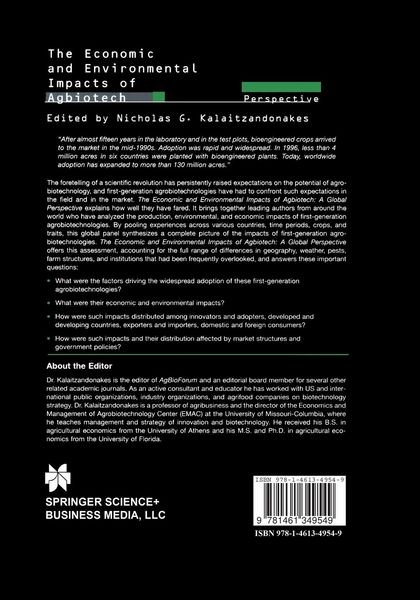
After almost fifteen years in the laboratory and in the test plots, bioengineered crops arrived to the market in the mid-1990s. Adoption was rapid and wide spread. In 1996, less than 4 million acres in six countries were planted with bioengineered crops. By 2001, worldwide adoption had expanded to more than 115 million acres. Important questions quickly followed. What were the factors driving the widespread adoption and rapid diffusion of these first-generation agrobiotech nologies? What were their economic and environmental impacts? How were such impacts distributed among large and small producers, innovators and adopters, developed and developing countries, exporters and importers, domestic and foreign consumers? How were such impacts and their distribu tion affected by market structure and government policies? A growing body of literature has provided valuable answers to some of these questions. However, an assessment that accounts for the full range of differences in geography, weather, pests, farm structures, and institutions had not been completed. It brings together leading This book provides just such an assessment. authors from around the world who have analyzed the production, environ mental, and economic impacts of first-generation crop biotechnologies. By pooling experiences across various countries, time periods, crops, and traits, this global panel is able to synthesize a complete picture of the impacts of first-generation crop biotechnologies.
Kundinnen und Kunden meinen
Verfassen Sie die erste Bewertung zu diesem Artikel
Helfen Sie anderen Kund*innen durch Ihre Meinung