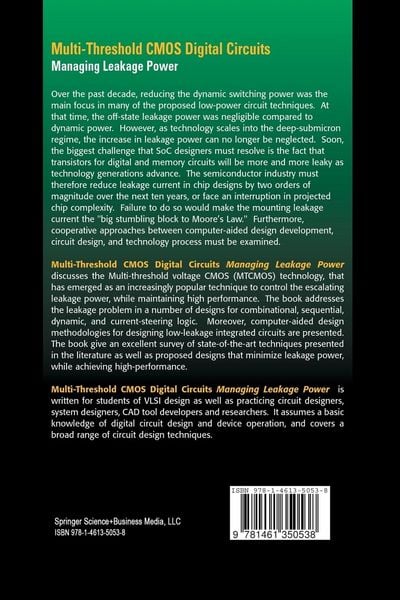
• Produktbild: Multi-Threshold CMOS Digital Circuits
  • Produktbild: Multi-Threshold CMOS Digital Circuits

Multi-Threshold CMOS Digital Circuits Managing Leakage Power

Fr. 138.00

inkl. gesetzl. MwSt., Versandkostenfrei


Beschreibung

Produktdetails

Einband

Taschenbuch

Erscheinungsdatum

23.10.2012

Verlag

Springer Us

Seitenzahl

216

Maße (L/B/H)

23.5/15.5/1.4 cm

Gewicht

376 g

Auflage

Softcover reprint of the original 1st ed. 2003

Sprache

Englisch

ISBN

978-1-4613-5053-8

Beschreibung

Rezension

From the reviews:


"This book is written for students of VLSI design and practicing circuit designers and shows how the MTCMOS technology can be used to reduce power dissipation. … The text covers a wide range of circuit design techniques. … Each chapter contains a brief introduction that serves as a quick background, summary that explains the contributions contained therein, and a set of additional references provided for further reading." (A. V. Chashkin, Zentralblatt MATH, Vol. 1041 (16), 2004)

Produktdetails

Einband

Taschenbuch

Erscheinungsdatum

23.10.2012

Verlag

Springer Us

Seitenzahl

216

Maße (L/B/H)

23.5/15.5/1.4 cm

Gewicht

376 g

Auflage

Softcover reprint of the original 1st ed. 2003

Sprache

Englisch

ISBN

978-1-4613-5053-8

Herstelleradresse

Springer-Verlag GmbH
Tiergartenstr. 17
69121 Heidelberg
DE

Email: ProductSafety@springernature.com

Kundinnen und Kunden meinen

0 Bewertungen

Informationen zu Bewertungen

Zur Abgabe einer Bewertung ist eine Anmeldung im Konto notwendig. Die Authentizität der Bewertungen wird von uns nicht überprüft. Wir behalten uns vor, Bewertungstexte, die unseren Richtlinien widersprechen, entsprechend zu kürzen oder zu löschen.

Die Bewertungen sind nach Format, Anzahl Sterne und Datum sortiert.

Verfassen Sie die erste Bewertung zu diesem Artikel

Helfen Sie anderen Kund*innen durch Ihre Meinung

Kundinnen und Kunden meinen

0 Bewertungen filtern

  • Produktbild: Multi-Threshold CMOS Digital Circuits
  • Produktbild: Multi-Threshold CMOS Digital Circuits
  • 1. Introduction.- References.- 2. Leakage Power: Challenges and Solutions.- 2.1 Introduction.- 2.2 Power Dissipation in CMOS Digital Circuits.- 2.3 Impact of Technology Scaling on Leakage Power.- 2.4 (Vdd-Vth) Design Space.- 2.5 Total Power Management.- 2.6 Leakage Power Control Circuit Techniques.- 2.7 Chapter Summary.- References.- 3. Embedded Mtcmos Combinational Circuits.- 3.1 Introduction.- 3.2 Basic Concept.- 3.3 The Power Minimization Problem.- 3.4 Algorithms.- 3.5 Choosing the High-Vth Value.- 3.6 Chapter Summary.- References.- 4. Mtcmos Combinational Circuits Using Sleep Transistors.- 4.1 Introduction.- 4.2 MTCMOS Design: Overview.- 4.3 Variable Breakpoint Switch Level Simulator [1].- 4.4 Hierarchical Sizing Based on Mutually Exclusive Discharge Patterns.- 4.5 Designing High-Vth Sleep Transistors, the Average Current Method [6].- 4.6 Drawbacks of Techniques.- 4.7 Distributed Sleep Transistors [9] [10].- 4.8 Clustering Techniques.- 4.9 Hybrid Heuristic Techniques.- 4.10 Virtual Ground Bounce.- 4.11 Results: Taking ground bounce into account.- 4.12 Power Management of Sleep Transistors.- 4.13 Chapter Summary.- References.- 5. Mtcmos Sequential Circuits.- 5.1 Introduction.- 5.2 MTCMOS Latch Circuit.- 5.3 MTCMOS Balloon Circuit.- 5.4 Intermittent Power Supply Scheme.- 5.5 Auto-Backgate-Controlled MTCMOS.- 5.6 Virtual Rails Clamp (VRC) Circuit.- 5.7 Leakage Sneak Paths in MTCMOS Sequential Circuits.- 5.8 Interfacing MTCMOS and CMOS blocks.- 5.9 Impact of the High-Vth and Low-Vth values on MTCMOS Sequential Circuit Design.- 5.10 Leakage Feedback Gates.- 5.11 Chapter Summary.- References.- 6. Mtcmos Dynamic Circuits.- 6.1 Introduction.- 6.2 Clock-Delayed Domino Logic: Overview.- 6.3 HS-Domino Logic.- 6.4 MTCMOS CD-Domino Logic: Analysis and Overview.- 6.5 MTCMOS HS-Domino (MHS-Domino) Logic.- 6.6 Domino Dual Cascode Voltage Switch Logic (DDCVSL).- 6.7 Chapter Summary.- References.- 7. Mtcmos Current-Steering Circuits.- 7.1 MOS Current Mode Logic: Overview.- 7.2 Introduction.- 7.3 Minimum Supply Voltage: First Constraint.- 7.4 Saturation Assurance: Second Constraint and the Proposed MTCMOS Design.- 7.5 A 2.5 Gbit/s 1:8 Demultiplexer in MTCMOS MCML.- 7.6 Impact of Using MTCMOS Technology Over MCML Parameters.- 7.7 Chapter Summary.- References.