• Produktbild: Introduction to Surfactant Analysis
  • Produktbild: Introduction to Surfactant Analysis

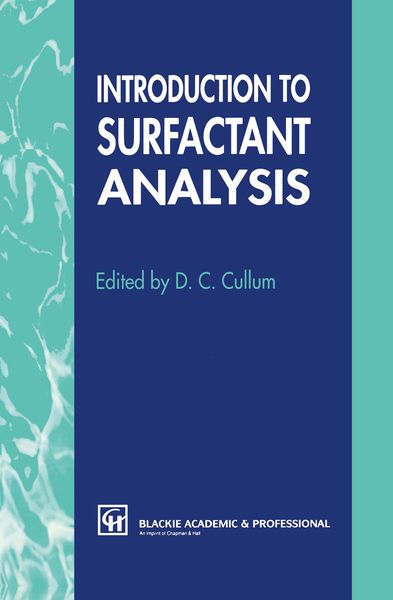
Introduction to Surfactant Analysis

Fr. 241.00

inkl. gesetzl. MwSt., Versandkostenfrei


Beschreibung

Produktdetails

Einband

Taschenbuch

Erscheinungsdatum

21.09.2012

Herausgeber

D.C. Cullum

Verlag

Springer Netherland

Seitenzahl

352

Maße (L/B/H)

23.5/15.5/2.1 cm

Gewicht

550 g

Auflage

Softcover reprint of the original 1st ed. 1994

Sprache

Englisch

ISBN

978-94-010-4574-2

Beschreibung

Rezension

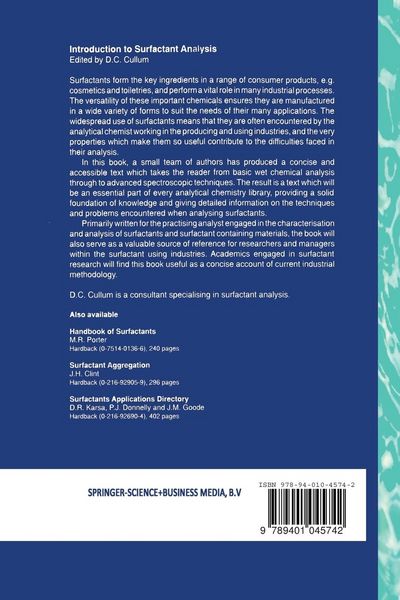
Experienced analysts in this field will find information and guidance in this book that they may not have known or may have forgotten....a thorough coverage of modern surfactant anaylsis. It would be a very useful addition to the library of any laboratory doing surfactant analysis |o Inform |d September 1994; This book will provide both the novice and experienced chemist with a clear, well-structured introduction to surfactant analysis. The text achieves a good balance between the theoretical aspects of the chemistry and sound practical instruction. The recommended techniques are often accompanied by useful advice obviously derived from extensive experience...an excellent introduction to the field... - Analytica Chimica Acta

Produktdetails

Einband

Taschenbuch

Erscheinungsdatum

21.09.2012

Herausgeber

D.C. Cullum

Verlag

Springer Netherland

Seitenzahl

352

Maße (L/B/H)

23.5/15.5/2.1 cm

Gewicht

550 g

Auflage

Softcover reprint of the original 1st ed. 1994

Sprache

Englisch

ISBN

978-94-010-4574-2

Herstelleradresse

Springer-Verlag GmbH
Tiergartenstr. 17
69121 Heidelberg
DE

Email: ProductSafety@springernature.com

Kundinnen und Kunden meinen

0 Bewertungen

Informationen zu Bewertungen

Zur Abgabe einer Bewertung ist eine Anmeldung im Konto notwendig. Die Authentizität der Bewertungen wird von uns nicht überprüft. Wir behalten uns vor, Bewertungstexte, die unseren Richtlinien widersprechen, entsprechend zu kürzen oder zu löschen.

Die Bewertungen sind nach Format, Anzahl Sterne und Datum sortiert.

Verfassen Sie die erste Bewertung zu diesem Artikel

Helfen Sie anderen Kund*innen durch Ihre Meinung

Kundinnen und Kunden meinen

0 Bewertungen filtern

  • Produktbild: Introduction to Surfactant Analysis
  • Produktbild: Introduction to Surfactant Analysis
  • 1 Introduction.- 1.1 Why analyse surfactants?.- 1.2 Sampling.- 1.3 Features peculiar to surfactant analysis.- 1.4 Calculations.- 1.5 Accuracy and precision.- 1.6 Analysis of competitors’ products.- 1.7 National and international standards.- References.- 2 Surfactant types; classification, identification, separation.- 2.1 Definitions.- 2.2 Common types of surfactants of all four classes.- 2.3 Classification of surfactants using indicators.- 2.4 Classification by acid and alkaline hydrolysis.- 2.5 Elemental analysis.- 2.6 Spectroscopic identification.- 2.7 Separation/extraction techniques.- 3 Basic techniques.- 3.1 Introduction.- 3.2 Extraction of surfactants.- 3.3 Acid-base titration.- 3.4 Potentiometrie titration.- 3.5 Methods for esters, amines, alcohols and unsaturated fatty materials.- 3.6 Two-phase titration of ionic surfactants with surfactants of opposite charge.- 3.7 Potentiometrie titration with surfactants of opposite charge using a surfactant-sensitive electrode.- 3.8 Direct potentiometry: calculation of results.- 3.9 Open-column chromatography.- References.- 4 Ion exchange.- 4.1 Introduction.- 4.2 What is ion exchange?.- 4.3 Ion-exchange media.- 4.4 Properties of ion-exchange resins.- 4.5 Guidelines on using ion-exchange resins.- 4.6 Practical applications of ion exchange.- 4.7 Analysis of column effluents.- References.- 5 Analysis of anionics.- 5.1 Introduction.- 5.2 General methods.- 5.3 Alkyl, alkylether and alkylphenylether sulphates.- 5.4 Monoalkanolamide and ethoxylated monoalkanolamide sulphates.- 5.5 Mono- and diglyceride sulphates.- 5.6 Alkylbenzene sulphonates.- 5.7 Alkane sulphonates.- 5.8 Alpha-olefin sulphonates.- 5.9 Oil-soluble sulphonates.- 5.10 Acyl isethionates.- 5.11 Fatty ester ?-sulphonates.- 5.12 Mono- and dialkylsulphosuccinates.-5.13 Sulphonated amides.- 5.14 Carboxylates.- 5.15 Alkyl and alkyether phosphates.- References.- 6 Analysis of nonionics.- 6.1 Introduction.- 6.2 Ethoxylated alcohols, alkylphenols and fatty acids.- 6.3 Block copolymers of ethylene and propylene oxide.- 6.4 Esters of polyhydroxy compounds and ethoxylated derivatives.- 6.5 Alkylpolyglycosides.- 6.6 Alkanolamides and ethoxylated alkanolamides.- 6.6.5 Determination of free ethanolamine, ester amine and free fatty acid or glycerol.- 6.6.6 Determination of ethanolamide, amide ester and methyl ester or glycerides.- References.- 7 Analysis of cationics and amphoterics.- 7.1 Introduction.- 7.2 Quaternary ammonium salts.- 7.3 Carboxybetaines.- 7.4 Amphoterics with weakly basic nitrogen.- 7.5 Sulphobetaines.- 7.6 Amines.- 7.7 Fatty diamines: determination.- 7.8 Ethoxylated amines and diamines.- 7.9 Amine oxides 189 References.- 8 Analysis of mixtures without separation.- 8.1 Introduction.- 8.2 Mixtures of anionics.- 8.3 Mixtures of nonionics.- 8.4 Mixtures of cationics and amphoterics.- 8.5 Mixtures of anionics and cationics.- 8.6 Mixtures with more than one component in each class.- References.- 9 Chromatographic analysis of surfactants.- 9.1 Introduction.- 9.2 Gas chromatography.- 9.3 High performance liquid chromatography.- 9.4 Thin layer chromatography.- 9.5 Other techniques.- 9.6 Summary.- 9.7 References.- 10 Infrared spectroscopy.- 10.1 What infrared spectroscopy offers the analyst.- 10.2 Theory.- 10.3 The infrared spectrometer.- 10.4 Sample presentation.- 10.5 Data manipulations.- 10.6 Examples and applications.- 10.7 Multicomponent analysis.- 10.8 Buying a spectrometer.- 10.9 Further information.- References.- 11 Nuclear magnetic resonance (NMR) spectroscopy.- 11.1 Introduction.- 11.2 Theory of NMR.- 11.3 The NMR spectrometer.- 11.4 The NMR sample.- 11.5 The NMR spectrum.- 11.6 Applications of NMR to surfactant analysis.- 11.6.6 Analysis of alkyl phosphate mixtures by 31P-NMR.- 12 Mass spectrometry.- 12.1 Introduction.- 12.2 Sample introduction.- 12.3 Methods of ionization.- 12.4 Mass analysis.- 12.5 Detection, sensitivity and data processing.- 12.6 Applications.- 12.6.6 FAB/LSIMS of amphoteric surfactants.- 12.6.7 EI MS of anionic surfactants.- References.- Appendix I List of ISO Standards relating to surfactant analysis.- Appendix II List of relevant ASTM Methods.