
Band 141
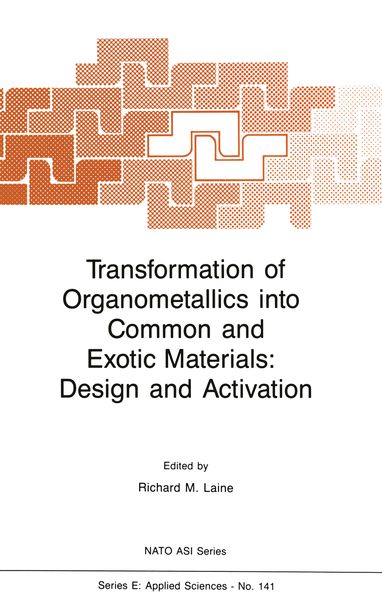
Transformation of Organometallics into Common and Exotic Materials: Design and Activation
Aus der Reihe
NATO Science Series E:
-
- Hardcover
- Taschenbuch ausgewählt
-
Sprache:Englisch
Fr. 72.90
inkl. gesetzl. MwSt.,
Beschreibung
Produktdetails
Einband
Taschenbuch
Erscheinungsdatum
27.09.2011
Herausgeber
R.M. LaineVerlag
Springer NetherlandSeitenzahl
312
Maße (L/B/H)
23.5/15.5/1.7 cm
Gewicht
476 g
Auflage
Softcover reprint of the original 1st ed. 1988
Sprache
Englisch
ISBN
978-94-010-7122-2
The design, -synthesis, and selective pyrolytic conversion of organo metallic precursdrs to materials of high purity or specific morphology (for electronic or optical applications), high strength and/or high-temperature stability (for structural or refractory applications) represents a poten tial area of extreme growth at the overlap of chemistry and materials science (materials chemistry). Research in this area is likely to have considerable impact at both the academic and societal levels because it will require development of scientific expertise in areas currently not well understood. Examples include: (1) The thermodynamics of molecular rearrangements in organometallic molecules at temperatures above 200°C; (2) The electronic properties of amorphous ceramic materials; (3) The phys icochemical properties of ceramic molecular composites; and (4) The optical properties of multicomponent glasses made by sol-gel processing. The opportunity to establish the scientific principles needed to pursue useful research goals in "materials chemistry" requires communica tion between chemists, ceramists, metallurgists, and physicists. To date, there have been few opportunities to create an environment where such communication might occur. The objective of this NATO Advanced Research Workshop was to promote discussions between experts in the varibus disci plines aligned with "materials chemistry. " These discussions were intended to identify the scope and potential rewards of research efforts in the development of: Custom-designed precursors to common and exotic materials, methods of selectively transforming these precursors in high yield to the desired material, and methods of characterizing the final products.
Kundinnen und Kunden meinen
Verfassen Sie die erste Bewertung zu diesem Artikel
Helfen Sie anderen Kund*innen durch Ihre Meinung