
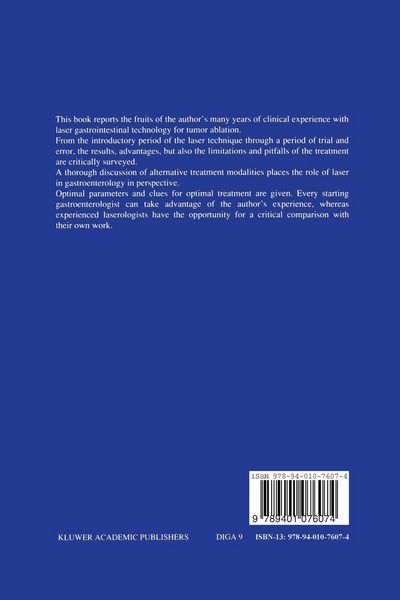
• Produktbild: The Role of Laser in Gastroenterology
  • Produktbild: The Role of Laser in Gastroenterology
Band 9

The Role of Laser in Gastroenterology Analysis of Eight years’ experience

Fr. 241.00

inkl. gesetzl. MwSt., Versandkostenfrei


Beschreibung

Produktdetails

Einband

Taschenbuch

Erscheinungsdatum

02.10.2011

Herausgeber

E.M.H. Mathus-Vliegen

Verlag

Springer Netherland

Seitenzahl

210

Maße (L/B/H)

23.5/15.5/1.3 cm

Auflage

Softcover reprint of the original 1st ed. 1989

Sprache

Englisch

ISBN

978-94-010-7607-4

Beschreibung

Rezension

`
This book is thoroughly readable, well got-up, and furnished with tables and colourful illustrations and highly recommended as a survey for those involved in the treatment of patients suffering from gasto-intestinal afflictions. It will also prove to be extremely useful as a reference work.
'

S.H. Yap, Dutch Magazine on Medicine,
1990, March, p. 783

Produktdetails

Einband

Taschenbuch

Erscheinungsdatum

02.10.2011

Herausgeber

E.M.H. Mathus-Vliegen

Verlag

Springer Netherland

Seitenzahl

210

Maße (L/B/H)

23.5/15.5/1.3 cm

Auflage

Softcover reprint of the original 1st ed. 1989

Sprache

Englisch

ISBN

978-94-010-7607-4

Herstelleradresse

Springer-Verlag KG
Sachsenplatz 4-6
1201 Wien
AT

Email: ProductSafety@springernature.com

Kundinnen und Kunden meinen

0 Bewertungen

Informationen zu Bewertungen

Zur Abgabe einer Bewertung ist eine Anmeldung im Konto notwendig. Die Authentizität der Bewertungen wird von uns nicht überprüft. Wir behalten uns vor, Bewertungstexte, die unseren Richtlinien widersprechen, entsprechend zu kürzen oder zu löschen.

Die Bewertungen sind nach Format, Anzahl Sterne und Datum sortiert.

Verfassen Sie die erste Bewertung zu diesem Artikel

Helfen Sie anderen Kund*innen durch Ihre Meinung

Kundinnen und Kunden meinen

0 Bewertungen filtern

  • Produktbild: The Role of Laser in Gastroenterology
  • Produktbild: The Role of Laser in Gastroenterology
  • and purpose of the study.- 1 General aspects of laser.- 1.1. The properties of laser.- 1.1.1. Thermal action of laser.- 1.2. Types of laser.- 1.3. Clinical application of laser.- 1.3.1. Parameters of effective haemostasis.- 1.3.2. Endoscopic modalities and laser treatment for haemostasis.- 1.4. New developments in laser application.- 1.5. Conclusion.- 2 Application of laser energy in gastroenterology.- 2.1. Laser treatment in acute bleeding.- 2.2. Laser treatment of variceal bleeding.- 2.3. Laser treatment of non-variceal bleeding.- 2.3.1. Divergent selection criteria.- 2.3.2. Parameters for optimal haemostasis and optimal safety.- 2.4. Results of laser treatment.- 2.4.1. Haemostasis with the argon laser.- 2.4.2. Haemostasis with the Nd:YAG laser.- 2.4.3. Overall considerations.- 2.5. Comparison of laser with other endoscopic modalities in haemostasis.- 2.5.1. Experimental studies.- 2.5.2. Clinical studies.- 2.6. Conclusion and proposition for treatment of acute bleeding.- 3 Technical prerequisites, safety considerations and treatment settings in Amsterdam.- 3.1. Technical prerequisites.- 3.1.1. Laser equipment.- 3.1.2. Endoscopes.- 3.1.3. Auxilliary instruments.- 3.2. Safety considerations.- 3.3. Laser settings and treatment procedure.- 3.3.1. Mucosal vascular abnormalities as potentially bleeding lesions.- 3.3.2. Tumour treatment.- 3.4. Technical problems.- 3.5. Conclusion.- I: Haemostasis.- 4 Mucosal vascular abnormalities as potentially bleeding lesions in gastroenterology.- 4.1. Classification of vascular lesions.- 4.2. Mucosal vascular abnormalities.- 4.2.1. Pathology.- 4.2.2. Aetiology and pathogenesis.- 4.3. A ngiodysplasia.- 4.3.1. Symptomatology and associated diseases.- 4.3.2. Diagnosis.- 4.4. Telangiectasia.- 4.5. Treatment of mucosal vascular abnormalities.- 4.5.1. Surgery.- 4.5.2. Endoscopic treatment.- 4.5.3. Treatment in the presence of associated valvular heart disease.- 5. Laser treatment of mucosal vascular abnormalities as potentially bleeding lesions.- 5.1. Design of the study.- 5.1.1. Patients and methods.- 5.1.2. Treatment and technique.- 5.1.3. Evaluation of the results.- 5.2. Results of the study: descriptive part.- 5.2.1. Demographic data.- 5.2.2. Diagnostic and investigational data.- 5.3. Results of the study: laser treatment.- 5.3.1. Angiodysplasia.- 5.3.2. Telangiectasia.- 5.3.3. Haemangioma.- 5.4. Results of the study: outcome without laser intervention.- 5.5. Discussion.- 5.6. Conclusion.- II: Tumour Ablation.- 6 Laser treatment of colorectal adenomas.- 6.1. Introduction.- 6.1.1. Adenomas of the colon.- 6.1.2. Familial polyposis col.- 6.2. Prospective study of patients with colorectal adenomas and rectal stump polyps between 1979 and 1987.- 6.2.1. Preliminary results (1979–1984).- 6.2.2. Patients and methods (1979–1987).- 6.3. Results.- 6.3.1. Group 1, 150 patients with colorectal adenoma.- 6.3.2. Group 2, 30 patients with familial polyposis col.- 6.4. Follow-up observations.- 6.4.1. Effect of laser treatment after short and long exposure.- 6.4.2. Patients with malignant degeneration.- 6.5. Discussion.- 6.6. Conclusion.- 7. Palliation of gastro-oesophageal cancer.- 7.1. Introduction.- 7.2. Surgical treatment.- 7.2.1. Oesophageal cancer.- 7.2.2. Gastric cancer.- 7.3. Radiotherapy and chemotherapy.- 7.3.1. Oesophageal cancer.- 7.3.2. Gastric cancer.- 7.4. Endoscopic procedures.- 7.5. Conclusion.- 8 Laser photoablation in the palliation of gastro-oesophageal cancer.- 8.1. Design of the study.- 8.1.1. Patients and methods.- 8.1.2. Patient preparation and treatment.- 8.2. Evaluation of the results.- 8.3. Results.- 8.3.1. Demographic data.- 8.3.2. Treatment data.- 8.3.3. Adverse effects of laser treatment.- 8.4. Discussion.- 8.5 Conclusion.- 9. Treatment modalities in colorectal cancer.- 9.1. Introduction.- 9.2. Operative treatment: general surgery.- 9.2.1. Elective surgery.- 9.2.2. Emergency surgery.- 9.2.3. Palliative surgery.- 9.3. Operative treatment: local surgery.- 9.4. Radiotherapy.- 9.5. Chemotherapy.- 9.6. Laser photocoagulation.- 10. Laser photocoagulation in the palliation of colorectal cancer.- 10.1. Design of the study.- 10.1.1. Patients and methods.- 10.1.2. Patient preparation and treatment.- 10.2. Evaluation of results.- 10.3. Results.- 10.3.1. Demographic data.- 10.3.2. Treatment data.- 10.3.3. Adverse effects of laser treatment.- 10.4. Discussion.- 10.5. Conclusion.- 11. Laser photoablation of early gastrointestinal cancer.- 11.1. Introduction.- 11.2. Design of the study.- 11.3. Evaluation of the results.- 11.4. Results.- 11.4.1. Early gastric cancer.- 11.4.2. Early colonic cancer.- 11.5. Discussion.- 11.6. Conclusion.- 12. Laser photocoagulation in the small intestine.- 12.1. Design of the study.- 12.1.1. Patients, methods and technique.- 12.1.2. Evaluation of the results.- 12.2. Results.- 12.3. Discussion.- Appendix I.- Questionnaire on Nd:YAG laser treatment of mucosal vascular abnormalities.- Appendix II.- Questionnaire on Nd:YAG laser treatment of gastro-oesophageal cancer.- Appendix III.- Questionnaire on Nd:YAG laser treatment of colorectal cancer.- Appendix IV.- Data of patients unfit for laser treatment of angiodysplasia.- Summary.- Samenvatting.- References.