• Produktbild: Chemical Principles of Synthetic Fibre Dyeing
  • Produktbild: Chemical Principles of Synthetic Fibre Dyeing

Chemical Principles of Synthetic Fibre Dyeing

Fr. 201.00

inkl. gesetzl. MwSt., Versandkostenfrei


Beschreibung

Produktdetails

Einband

Taschenbuch

Erscheinungsdatum

18.09.2012

Verlag

Springer Netherland

Seitenzahl

223

Maße (L/B/H)

23.5/15.5/1.3 cm

Gewicht

385 g

Auflage

Softcover reprint of the original 1st ed. 1995

Sprache

Englisch

ISBN

978-94-010-4263-5

Beschreibung

Rezension

The author has written an easy, well-referenced survey...The book will be well received in universities and colleges. It provides the information and detail required by students doing research in industry and in academic institutes. - Chemistry and Industry

Produktdetails

Einband

Taschenbuch

Erscheinungsdatum

18.09.2012

Verlag

Springer Netherland

Seitenzahl

223

Maße (L/B/H)

23.5/15.5/1.3 cm

Gewicht

385 g

Auflage

Softcover reprint of the original 1st ed. 1995

Sprache

Englisch

ISBN

978-94-010-4263-5

Herstelleradresse

Springer-Verlag GmbH
Tiergartenstr. 17
69121 Heidelberg
DE

Email: ProductSafety@springernature.com

Kundinnen und Kunden meinen

0 Bewertungen

Informationen zu Bewertungen

Zur Abgabe einer Bewertung ist eine Anmeldung im Konto notwendig. Die Authentizität der Bewertungen wird von uns nicht überprüft. Wir behalten uns vor, Bewertungstexte, die unseren Richtlinien widersprechen, entsprechend zu kürzen oder zu löschen.

Die Bewertungen sind nach Format, Anzahl Sterne und Datum sortiert.

Verfassen Sie die erste Bewertung zu diesem Artikel

Helfen Sie anderen Kund*innen durch Ihre Meinung

Kundinnen und Kunden meinen

0 Bewertungen filtern

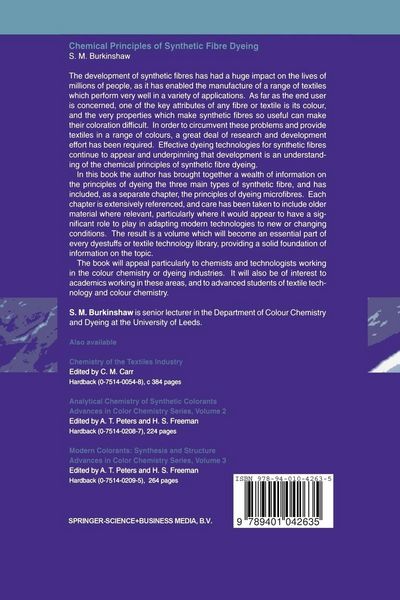
  • Produktbild: Chemical Principles of Synthetic Fibre Dyeing
  • Produktbild: Chemical Principles of Synthetic Fibre Dyeing
  • 1. Polyester.- 1.1. Introduction.- 1.2. Disperse dyes.- 1.2.1. Aqueous phase transfer.- 1.2.2. Thermodynamics of dyeing.- 1.2.3. Kinetics of dyeing.- 1.2.4. Effect of crystal form of the dye on dye adsorption.- 1.2.5. Effect of particle size and distribution on dye adsorption.- 1.2.6. Effect of dispersing agents on dye adsorption.- 1.2.7. Effect of levelling agents on dye adsorption.- 1.2.8. Effect of temperature on dye adsorption.- 1.2.9. Isomorphism.- 1.2.10. Oligomers.- 1.2.11. Carrier dyeing.- 1.2.12. Solvent-assisted dyeing.- 1.2.13. Solvent dyeing.- 1.2.14. High-temperature dyeing.- 1.2.15. Thermofixation.- 1.2.16. Afterclearing.- 1.3. Azoic colorants.- 1.4. Vat dyes.- References.- 2. Nylon.- 2.1. Introduction.- 2.2. Anionic dyes.- 2.2.1. Barré effects.- 2.2.2. Acid dyes.- 2.2.3. Mordant dyes.- 2.2.4. Direct dyes.- 2.2.5. Reactive dyes.- 2.3. Cationic dyes.- 2.4. Non-ionic dyes.- 2.4.1. Disperse dyes.- 2.4.2. Disperse reactive dyes.- 2.4.3. Azoic colorants.- 2.4.4. Vat dyes.- References.- 3. Acrylic.- 3.1. Introduction.- 3.2. Cationic dyes.- 3.2.1. Thermodynamics of dye adsorption.- 3.2.2. Kinetics of dye adsorption.- 3.2.3. Effect of pH on dye adsorption.- 3.2.4. Effect of electrolyte on dye adsorption.- 3.2.5. Effect of temperature on dye adsorption.- 3.2.6. Effect of water on PAN fibres.- 3.2.7. Carrier dyeing.- 3.2.8. Retarding agents.- 3.2.9. Dye—fibre characteristics.- 3.2.10. Migrating cationic dyes.- 3.2.11. Gel dyeing.- 3.3. Disperse dyes.- 3.3.1. Thermodynamics of dyeing.- 3.3.2. Kinetics of dyeing.- 3.3.3. General considerations.- References.- 4. Microfibres.- 4.1. Introduction.- 4.1.1. General considerations.- 4.1.2. Microfibre production.- 4.2. Polyester microfibres.- 4.2.1. Mass-reduced polyester fibres.- 4.3. Polyamide micro fibres.- References.- Dye Index.