• Produktbild: Chemistry of Tin
  • Produktbild: Chemistry of Tin

Chemistry of Tin

Fr. 359.00

inkl. gesetzl. MwSt., Versandkostenfrei


Beschreibung

Produktdetails

Einband

Taschenbuch

Erscheinungsdatum

27.09.2012

Herausgeber

P.J. Smith

Verlag

Springer Netherland

Seitenzahl

578

Maße (L/B/H)

22.9/15.2/3.2 cm

Gewicht

851 g

Auflage

Second Edition 1998

Sprache

Englisch

ISBN

978-94-010-6072-1

Beschreibung

Rezension

about the first edition:

`
Chemistry of Tin
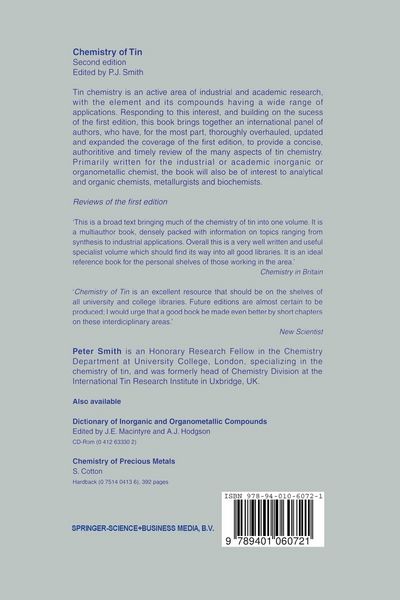
is an excellent resource that should be on the shelves of all university and college libraries... Future editions are almost certain to be produced; I would urge that a good book be made even better by short chapters on these interdisciplinary areas.
'

New Scientist

`
This is a broad text bringing much of the chemistry of tin into one volume. It is a multiauthor book, densely packed with information on topics ranging from synthesis to industrial applications. Overall, this is a very well written and useful specialist volume which should find its way into all good libraries. It is an ideal reference book for the personal shelves of those working in the area.
'

Chemistry in Britain

Produktdetails

Einband

Taschenbuch

Erscheinungsdatum

27.09.2012

Herausgeber

P.J. Smith

Verlag

Springer Netherland

Seitenzahl

578

Maße (L/B/H)

22.9/15.2/3.2 cm

Gewicht

851 g

Auflage

Second Edition 1998

Sprache

Englisch

ISBN

978-94-010-6072-1

Herstelleradresse

Springer-Verlag GmbH
Tiergartenstr. 17
69121 Heidelberg
DE

Email: ProductSafety@springernature.com

Kundinnen und Kunden meinen

0 Bewertungen

Informationen zu Bewertungen

Zur Abgabe einer Bewertung ist eine Anmeldung im Konto notwendig. Die Authentizität der Bewertungen wird von uns nicht überprüft. Wir behalten uns vor, Bewertungstexte, die unseren Richtlinien widersprechen, entsprechend zu kürzen oder zu löschen.

Die Bewertungen sind nach Format, Anzahl Sterne und Datum sortiert.

Verfassen Sie die erste Bewertung zu diesem Artikel

Helfen Sie anderen Kund*innen durch Ihre Meinung

Kundinnen und Kunden meinen

0 Bewertungen filtern

  • Produktbild: Chemistry of Tin
  • Produktbild: Chemistry of Tin
  • 1 Tin-the element.- 1.1 From earliest times.- 1.2 Occurrence.- 1.3 Physical properties of metallic tin.- 1.4 Chemical reactions.- References.- 2 Compounds of tin: general trends.- 2.1 Electronegativity values, ionization potentials and elemental radii.- 2.2 Enthalpies of formation and bond energy data.- 2.3 Multiple bond formation.- 2.4 Structure and bonding in bivalent compounds.- 2.5 Structural behaviour of tetravalent tin compounds.- 2.6 Mixed-valence compounds.- 2.7 Compounds with metal-metal bonds.- 2.8 Theoretical studies of reaction pathways.- References.- 3 The inorganic chemistry of tin.- 3.1 Tin(II) chemistry.- 3.2 Tin(IV) chemistry.- 3.3 Mixed-valence tin compounds.- References.- 4 Formation and cleavage of the tin-carbon bond.- 4.1 Preparation of tin(IV)—carbon bonds.- 4.2 Cleavage of carbon-tin bonds.- References.- 5 Organometallic compounds of tetravalent tin.- 5.1 Introduction.- 5.2 Introducing reactivity: synthetic precursors to functionalized organotin(IV) compounds.- 5.3 Construction and reactivity of Sn-element bonds.- 5.4 Structural variations.- References.- 6 Organometallic compounds of bivalent tin.- 6.1 Introduction and review articles.- 6.2 ?-Bonded compounds.- 6.3 ?-Bonded complexes.- References.- 7 Tin-metal bonded compounds.- 7.1 Tin—alkali metal compounds.- 7.2 Tin—Group 2 metal compounds.- 7.3 Scandium, yttrium, lanthanides and actinides.- 7.4 Titanium, zirconium and hafnium.- 7.5 Vanadium, niobium and tantalum.- 7.6 Chromium, molybdenum and tungsten.- 7.7 Manganese, technetium and rhenium.- 7.8 Iron, ruthenium and osmium.- 7.9 Cobalt, rhodium and iridium.- 7.10 Nickel, palladium and platinum.- 7.11 Copper, silver and gold.- 7.12 Zinc, cadmium and mercury.- 7.13 Boron, aluminium, indium and thallium.- 7.14 Antimony and bismuth.- 7.15Silicon, germanium and lead.- 7.16 Tin—tin bonded compounds.- 7.17 Structure and bonding.- References.- 8 Radical chemistry of tin.- 8.1 Introduction.- 8.2 Organotin radicals.- 8.3 Homolytic reactions at the ligands in organotin compounds.- 8.4 Homolytic reactions at the tin centre.- 8.5 Organotin radical ions.- References.- 9 The uses of organotin compounds in organic synthesis.- 9.1 Applications of tin-hydrogen bonded compounds.- 9.2 Applications of tin—carbon bonded compounds.- 9.3 Applications oftin—heteroatom bonded compounds.- References.- 10 Recent studies on the mode of biological action of di- and trialkyltin compounds.- 10.1 Introduction.- 10.2 Neurotoxicity.- 10.3 Immunotoxicity.- 10.4 Cellular and biochemical aspects of the activity manifestation.- 10.5 Conclusion.- Abbreviations.- References.- 11 Health and safety aspects of tin chemicals.- 11.1 Introduction.- 11.2 Inorganic tin compounds.- 11.3 Organotin compounds.- 11.4 Manufacturers of tin chemicals.- Acknowledgements.- References.- 12 Industrial uses of tin chemicals.- 12.1 Introduction.- 12.2 The plastics industry.- 12.3 Glass and ceramics.- 12.4 Electroplating.- 12.5 Biocidal applications.- 12.6 Heterogeneous catalysts.- 12.7 Pharmaceuticals.- 12.8 Fire prevention.- 12.9 Miscellaneous uses.- References.- 13 Solid state NMR spectroscopy of tin compounds.- 13.1 Introduction.- 13.2 The early period (1978-1985).- 13.3 Compounds with four tin-carbon bonds.- 13.4 Organotin halides.- 13.5 Compounds with tin-oxygen bonds.- 13.6 Compounds with Sn-S, Sn-Se and Sn-Te bonds.- 13.7 Compounds with Sn-B and Sn-N bonds.- 13.8 Coordination complexes derived from R2SnCl2.- 13.9 Miscellaneous organotin compounds.- 13.10 Other measurements.- 13.11 13C measurements.- 13.12 Inorganic tin compounds.- References.- 14119mSn Mössbauer studies on tin compounds.- 14.1 Introduction.- 14.2 Hyperfine interactions and parameters.- 14.3 Instrumentation and experimental procedures.- 14.4 Treatment of spectral data.- 14.5 Isomer shift: fingerprint criteria.- 14.6 Nuclear quadrupole splitting: fingerprint criteria.- 14.7 Structure and bonding.- 14.8 Dynamics of Mössbauer nuclei.- 14.9 Applications to materials, and environmental interactions.- 14.10 Applications to tin industry.- References.- 15 The analysis of organotin compounds from the natural environment.- 15.1 Introduction.- 15.2 Analysis of inorganic tin compounds.- 15.3 Analysis of organotin compounds.- 15.4 Conclusion.- Abbreviations.- References.