
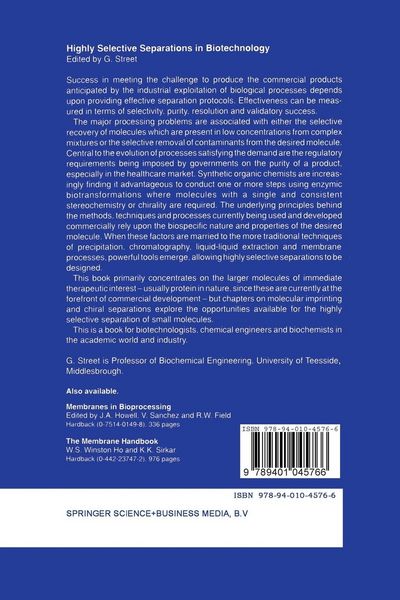
• Produktbild: Highly Selective Separations in Biotechnology
  • Produktbild: Highly Selective Separations in Biotechnology

Highly Selective Separations in Biotechnology

Fr. 241.00

inkl. gesetzl. MwSt., Versandkostenfrei


Beschreibung

Produktdetails

Einband

Taschenbuch

Erscheinungsdatum

25.09.2012

Herausgeber

G. Street

Verlag

Springer Netherland

Seitenzahl

231

Maße (L/B/H)

23.5/15.5/1.4 cm

Gewicht

382 g

Auflage

Softcover reprint of the original 1st ed. 1994

Sprache

Englisch

ISBN

978-94-010-4576-6

Beschreibung

Rezension

Each chapter is well written, and provides a sound background understanding together with useful practical details and user experience ... It is a good source of ideas and solutions that will enable many to develop their own highly selective bioseparations. - The Genetic Engineer and Biotechnologist; This is a well put-together and presented book - highly practical in nature...Four stars. - Australian Biotechnology Association

Produktdetails

Einband

Taschenbuch

Erscheinungsdatum

25.09.2012

Herausgeber

G. Street

Verlag

Springer Netherland

Seitenzahl

231

Maße (L/B/H)

23.5/15.5/1.4 cm

Gewicht

382 g

Auflage

Softcover reprint of the original 1st ed. 1994

Sprache

Englisch

ISBN

978-94-010-4576-6

Herstelleradresse

Springer-Verlag GmbH
Tiergartenstr. 17
69121 Heidelberg
DE

Email: ProductSafety@springernature.com

Kundinnen und Kunden meinen

0 Bewertungen

Informationen zu Bewertungen

Zur Abgabe einer Bewertung ist eine Anmeldung im Konto notwendig. Die Authentizität der Bewertungen wird von uns nicht überprüft. Wir behalten uns vor, Bewertungstexte, die unseren Richtlinien widersprechen, entsprechend zu kürzen oder zu löschen.

Die Bewertungen sind nach Format, Anzahl Sterne und Datum sortiert.

Verfassen Sie die erste Bewertung zu diesem Artikel

Helfen Sie anderen Kund*innen durch Ihre Meinung

Kundinnen und Kunden meinen

0 Bewertungen filtern

  • Produktbild: Highly Selective Separations in Biotechnology
  • Produktbild: Highly Selective Separations in Biotechnology
  • 1 Overview.- References.- 2 Affinity precipitation.- 2.1 Introduction.- 2.2 Various formats of affinity precipitation.- 2.3 Heterobifunctional ligands.- 2.4 Use of macro affinity ligands.- 2.5 Practical applications of affinity precipitation.- 2.6 Affinity precipitation by heterobifunctional ligands.- 2.7 Comparison of affinity precipitation with other affinity techniques.- 2.8 Conclusions.- References.- 3 Membrane-based affinity separation processes.- 3.1 Introduction.- 3.2 Chemical and physical feature of the membrane matrix.- 3.3 Purification protocol.- 3.4 Ligand coupling.- 3.5. Stability of active membranes.- 3.6 Reuse of ligand coupled membranes.- 3.7 Storage of ligand coupled membranes in buffer.- 3.8 Ligand leaching.- 3.9 Efficiency of ligand coupling.- 3.10 Effect of flow rates on affinity purification of IgG.- 3.11 Exhaustive purification of antibodies.- 3.12 Effect of sample recirculation on yields.- 3.13 Purification of IgG from ascites fluid and serum.- 3.14 Efficiency in product recovery.- 3.15 Applications.- 3.16 Scale-up.- 3.17 Discussion.- References.- 4 Affinity partitioning.- 4.1 Introduction.- 4.2 Two-phase systems.- 4.3 General ways of steering the partitioning.- 4.4 Affinity partitioning.- 4.5 Large-scale extractions.- 4.6 Use of two-phase systems in bioreactors.- 4.7 Non-protein partitioning.- 4.8 Alternative types of affinity ligands.- 4.9 Counter-current distribution.- 4.10 Conclusions.- References.- 5 The use of reverse micelles for the separation of proteins.- 5.1 Introduction.- 5.2 Description of reverse micelles.- 5.3 The reverse micellar extraction method.- 5.4 Protein distribution between an aqueous and a conjugated reverse micellar phase.- 5.5 Mass transfer of protein extraction.- 5.6 Process development.- 5.7 Examples of reverse micellarapplications for protein separation.- 5.8 Conclusions.- References.- 6 The chemistry and engineering of affinity chromatography.- 6.1 Introduction.- 6.2 The role of AC in protein purification.- 6.3 Affinity packings.- 6.4 Characterization of AC packings.- 6.5 Modelling and design of affinity chromatography columns.- 6.6 Notation.- References.- 7 Protein fusions as an aid to purification.- 7.1 Introduction.- 7.2 Choice of host organism.- 7.3 Induction of expression.- 7.4 Solubilisation of recombinant proteins.- 7.5 Vectors.- 7.6 Affinity purification.- 7.7 Thrombin cleavage of fusion proteins.- 7.8 General discussion.- References.- 8 Chiral separations.- 8.1 Introduction.- 8.2 Some stereochemical terms.- 8.3 Chirality and biological systems.- 8.4 Methods available for chiral separation.- 8.5 Conclusion.- References.- 9 Molecular imprinting—a versatile technique for the preparation of separation materials of predetermined selectivity.- 9.1 Introduction.- 9.2 Preparation of molecular imprints.- 9.3 Recognition in molecularly imprinted polymers.- 9.4 Application.- 9.5 Conclusions.- References.