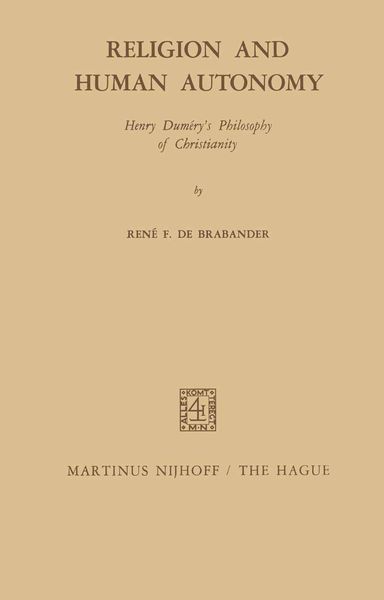
Produktbild: Religion and Human Autonomy

Religion and Human Autonomy Henry Duméry’s Philosophy of Christianity

Fr. 73.90

inkl. gesetzl. MwSt., Versandkostenfrei


Beschreibung

Produktdetails

Einband

Taschenbuch

Erscheinungsdatum

05.11.2011

Verlag

Springer Netherland

Seitenzahl

200

Maße (L/B/H)

24.4/15.6/1.2 cm

Gewicht

336 g

Auflage

Softcover reprint of the original 1st ed. 1972

Sprache

Englisch

ISBN

978-94-010-2832-5

Beschreibung

Produktdetails

Einband

Taschenbuch

Erscheinungsdatum

05.11.2011

Verlag

Springer Netherland

Seitenzahl

200

Maße (L/B/H)

24.4/15.6/1.2 cm

Gewicht

336 g

Auflage

Softcover reprint of the original 1st ed. 1972

Sprache

Englisch

ISBN

978-94-010-2832-5

Herstelleradresse

Springer-Verlag GmbH
Tiergartenstr. 17
69121 Heidelberg
DE

Email: ProductSafety@springernature.com

Kundinnen und Kunden meinen

0 Bewertungen

Informationen zu Bewertungen

Zur Abgabe einer Bewertung ist eine Anmeldung im Konto notwendig. Die Authentizität der Bewertungen wird von uns nicht überprüft. Wir behalten uns vor, Bewertungstexte, die unseren Richtlinien widersprechen, entsprechend zu kürzen oder zu löschen.

Die Bewertungen sind nach Format, Anzahl Sterne und Datum sortiert.

Verfassen Sie die erste Bewertung zu diesem Artikel

Helfen Sie anderen Kund*innen durch Ihre Meinung

Kundinnen und Kunden meinen

0 Bewertungen filtern

  • Produktbild: Religion and Human Autonomy
  • I Freedom and Religion.- Section I: Posing the problem.- Section II: Duméry’s appraisal of Sartre’s position on God and freedom.- Section III: Duméry’s critique of Sartre’s position on God and freedom.- II Search for a Method to be Used in the Philosophical Study of Religion.- Section I: Method of explication and method of confrontation.- a) Stating the problem.- b) The method of explication.- c) The method of confrontation.- Section II: Blondel’s method of immanence and the philosophical study of religion.- a) Introducing the framework of the Blondelian thought.- b) The problem of the supernatural and the method of immanence.- c) How the principle of immanence can provide a method for the philosophical study of religion which escapes the pitfalls of immanentism and dualism.- Section III: Husserl’s method of comprehension and Duméry’s method of discrimination.- a) The method of Husserl and the service it renders to the phenomenology of religion.- b) Objections against Husserlés phenomenological method.- c) Duméryés method of discrimination: reflective and critical analysis.- III Duméry’s Religious Philosophy. The Spirit as Constitutive Exigency of the Absolute.- Section I: Transition from method to doctrine.- Section II: The irreducible relation of the spirit with God.- a) The God of living religion.- b) Plotinian translation and completion of Husserl’s reductions.- c) Nature of the relation between the Absolute One and the spirit.- Section III: The spirit as creator of the world of determinations. The theory of the Act-Law.- a) The spirit as correlation of freedom and order.- b) Description of the relation between the act-law and the psyche: freedom and determinism, eternity and time.- c) Empirical consciousness and its universe: inverted expressions and projections of the system of spirits.- IV Duméry’s Philosophy of Religion: Critique of the Categories and Schemes which Express the Spirit’s Constitutive Exigency of the Transordinal One.- Section I: The scheme of transcendence and the category of the Absolute.- a) Scope of the reflective critique in general and of the critique of the attributes in particular.- b) Henological redemption of the scheme of transcendence and the category of the absolute.- c) Henology and negative theology.- Section II: Interpretation of the category of grace and the scheme of the supernatural.- a) Is there a philosophical problem of grace and how can philosophy deal with it?.- b) Discriminative critique of the different schemes of the category of grace.- c) Philosophical critique of the categories of grace and the supernatural.- Section III: Category of faith, factual and doctrinal schemes.- a) Descriptive phenomenology of the Judaeo-Christian religion.- b) The Jesus-fact assumed by the hierogenic consciousness of the early Christian community.- c) The four means of expression of hierogenic consciousness.- d) Projective mentality and truth of Christianity.- Epilogue: Human Autonomy and Finitude.