• Produktbild: Multiservice Loss Models for Broadband Telecommunication Networks
  • Produktbild: Multiservice Loss Models for Broadband Telecommunication Networks

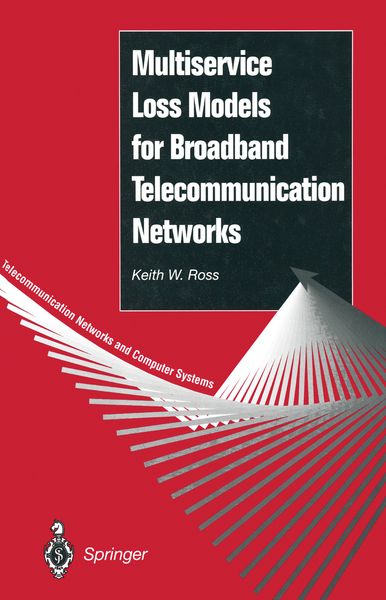
Multiservice Loss Models for Broadband Telecommunication Networks

Fr. 137.00

inkl. gesetzl. MwSt., Versandkostenfrei


Beschreibung

Produktdetails

Einband

Taschenbuch

Erscheinungsdatum

08.12.2011

Verlag

Springer London

Seitenzahl

343

Maße (L/B/H)

23.5/15.5/2 cm

Gewicht

546 g

Auflage

Softcover reprint of the original 1st ed. 1995

Sprache

Englisch

ISBN

978-1-4471-2128-2

Beschreibung

Produktdetails

Einband

Taschenbuch

Erscheinungsdatum

08.12.2011

Verlag

Springer London

Seitenzahl

343

Maße (L/B/H)

23.5/15.5/2 cm

Gewicht

546 g

Auflage

Softcover reprint of the original 1st ed. 1995

Sprache

Englisch

ISBN

978-1-4471-2128-2

Herstelleradresse

Springer-Verlag KG
Sachsenplatz 4-6
1201 Wien
AT

Email: GPSR Kontakt

Noch keine Bewertungen vorhanden

Verfassen Sie die erste Bewertung zu diesem Artikel

Helfen Sie anderen Kundinnen und Kunden durch Ihre Meinung.

Kundinnen und Kunden meinen

Bewertungen (0)

  • Produktbild: Multiservice Loss Models for Broadband Telecommunication Networks
  • Produktbild: Multiservice Loss Models for Broadband Telecommunication Networks
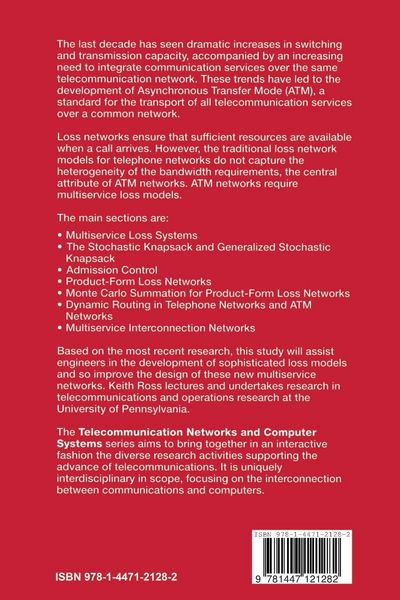
  • 1 Multiservice Loss Systems.- 1.1 The Erlang Loss System.- 1.2 Loss Networks with Fixed Routing.- 1.3 Loss Networks with Dynamic Routing.- 1.4 The ATM Multiplexer.- 1.5 ATM Networks.- 1.6 Multiservice Interconnection Networks.- 2 The Stochastic Knapsack.- 2.1 The Model and Notation.- 2.2 Performance Evaluation.- 2.3 Virtual Channel Establishment for ATM Multiplexers.- 2.4 Contiguous Slot Assignment.- 2.5 Stochastic Comparisons.- 2.6 Monotonicity Properties for the Stochastic Knapsack.- 2.7 Asymptotic Analysis of the Stochastic Knapsack.- 2.8 The Stochastic Knapsack with Continuous Sizes.- 2.9 Bibliographical Notes.- 2.10 Summary of Notation.- 3 The Generalized Stochastic Knapsack.- 3.1 Preliminaries.- 3.2 A Recursive Algorithm.- 3.3 A Convolution Algorithm.- 3.4 Calculating Blocking Probabilities*.- 3.5 Refined Convolution Algorithms*.- 3.6 Monotonicity Properties.- 3.7 ATM with Burst Multiplexing.- 3.8 Circuit-Switched Access Networks.- 3.9 Sharing Memory*.- 3.10 Objects with Continuous Sizes*.- 3.11 Bibliographical Remarks.- 3.12 Summary of Notation.- 4 Admission Control.- 4.1 Admission Policies.- 4.2 Optimization Concepts.- 4.3 Optimal Complete Partitioning Policies.- 4.4 Optimal Coordinate Convex Policies.- 4.5 Markov Decision Processes.- 4.6 Optimal Admission to Broadband Multiplexers.- 4.7 Service Separation for ATM.- 4.8 Bibliographical Notes.- 4.9 Summary of Notation.- 5 Product-Form Loss Networks.- 5.1 The Model.- 5.2 Basic Properties.- 5.3 Algorithms for Generalized Access Networks.- 5.4 Algorithms for Hierarchical Access Networks.- 5.5 The Reduced Load Approximation for Single-Service Networks.- 5.6 The Reduced Load Approximation for Multiservice Networks.- 5.7 Implied Costs.- 5.8 Asymptotic Analysis.- 5.9 Loss Models for ATM Networks.- 5.10 ATM Networks: Route Separation.- 5.11 ATM Networks: Multiplexing Across Routes.- 5.12 Continuous Bandwidths*.- 5.13 Cellular Networks and Wavelength-Division Multiplexing Networks*.- 5.14 Bibliographical Notes.- 5.15 Summary of Notation.- 6 Monte Carlo Summation for Product-Form Loss Networks.- 6.1 The Theory of Monte Carlo Summation.- 6.2 Numerical Examples.- 6.3 Estimates for Revenue Sensitivity.- 6.4 Loss Network Analyzer: A Software Package.- 6.5 Bibliographical Notes.- 6.6 Summary of Notation.- 7 Dynamic Routing in Telephone Networks.- 7.1 An Overview of Contemporary Routing Techniques.- 7.2 Bounds on Average Revenue.- 7.3 Reduced Load Approximation for Dynamic Routing.- 7.4 Symmetric Networks.- 7.5 Computational Effort of Reduced Load Approximation.- 7.6 Computational Examples for the Reduced Load Approximation.- 7.7 Bibliographical Notes.- 7.8 Summary of Notation.- 8 Dynamic Routing in ATM Networks.- 8.1 ATM Routing Concepts.- 8.2 Static-Service, Dynamic-Route Separation.- 8.3 Static-Service Separation, Multiplexing Across Routes.- 8.4 Dynamic-Service, Dynamic-Route Separation.- 8.5 Dynamic-Service Separation, Multiplexing Across Routes.- 8.6 The Reduced Load Approximation for Multiservice Networks with Dynamic Routing.- 8.7 Bibliographical Notes.- 9 Multiservice Interconnection Networks.- 9.1 Model Description.- 9.2 Three-Stage Clos Networks.- 9.3 Cantor Networks.- 9.4 Rearrangeable Interconnection Networks.- 9.5 Bibliographical Notes.- 9.6 Summary of Notation.