
• Produktbild: Design and Implementation of Computer-Based Information Systems
  • Produktbild: Design and Implementation of Computer-Based Information Systems
Band 1

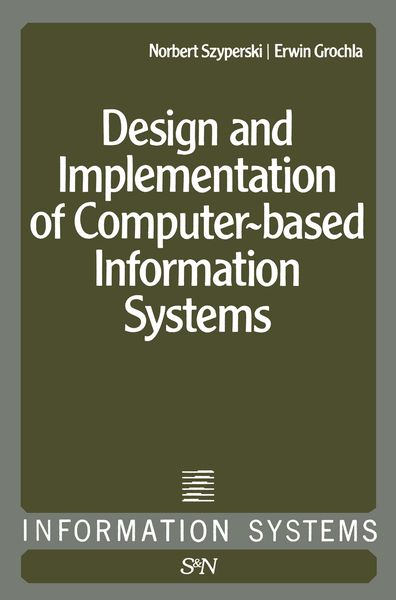
Design and Implementation of Computer-Based Information Systems

Aus der Reihe Information Systems

Fr. 73.90

inkl. gesetzl. MwSt., Versandkostenfrei


Beschreibung

Produktdetails

Einband

Taschenbuch

Erscheinungsdatum

13.10.2011

Herausgeber

N. Szyperski + weitere

Verlag

Springer Netherland

Seitenzahl

368

Maße (L/B/H)

23.5/15.5/2.1 cm

Gewicht

587 g

Auflage

Softcover reprint of the original 1st edition 1979

Sprache

Englisch

ISBN

978-94-009-9570-3

Beschreibung

Produktdetails

Einband

Taschenbuch

Erscheinungsdatum

13.10.2011

Herausgeber

Verlag

Springer Netherland

Seitenzahl

368

Maße (L/B/H)

23.5/15.5/2.1 cm

Gewicht

587 g

Auflage

Softcover reprint of the original 1st edition 1979

Sprache

Englisch

ISBN

978-94-009-9570-3

Herstelleradresse

Springer-Verlag KG
Sachsenplatz 4-6
1201 Wien
AT

Email: ProductSafety@springernature.com

Kundinnen und Kunden meinen

0 Bewertungen

Informationen zu Bewertungen

Zur Abgabe einer Bewertung ist eine Anmeldung im Konto notwendig. Die Authentizität der Bewertungen wird von uns nicht überprüft. Wir behalten uns vor, Bewertungstexte, die unseren Richtlinien widersprechen, entsprechend zu kürzen oder zu löschen.

Die Bewertungen sind nach Format, Anzahl Sterne und Datum sortiert.

Verfassen Sie die erste Bewertung zu diesem Artikel

Helfen Sie anderen Kund*innen durch Ihre Meinung

Kundinnen und Kunden meinen

0 Bewertungen filtern

  • Produktbild: Design and Implementation of Computer-Based Information Systems
  • Produktbild: Design and Implementation of Computer-Based Information Systems
  • A. Basic Considerations on Design and Implementation of Computer-based Information Systems.- I. Introduction.- 1. State of the Art of Implementation Research on Computer-based Information Systems.- 1. Introduction.- 2. Basic Notes on the Implementation Game.- 3. Contributions from Research to System Design and Implementation.- 4. Some Preliminary Remarks on Consequences for Implementation Research.- 2. Evaluating the Quality of Information Systems.- 1. Introduction.- 2. Conceptual and Operational Issues.- 3. A Survey of the Research Literature.- 4. Conclusion.- II. Technical Aspects of Systems Design and Implementation.- 3. The Modeling Process: Steps Versus Components.- I. The Topic.- 2. The Role of the Model.- 3. The Plea for the Assemblage-of-Components Concept.- 4. The Components of the Modeling Process.- 5. Modeling, an Art or a Science?.- 4. Implementation of Planning Models: Presentation of the APIS Approach.- 1. Introduction.- 2. Diagnosis of Problem Areas.- 3. Consequences in the APIS Project.- 4. APIS Results.- 5. Conclusion.- III. Organizational Aspects of Systems Design and Implementation.- 5. Basic Considerations in Organizational and Human Aspects in Systems Design: the State of the Art of Implementation Research.- 1. Introduction.- 2. Approaches to Implementation Research.- 3. Research Designs.- 4. Three Examples.- 5. Future Research.- 6. A Design-Oriented Approach in Implementation Research: The Project PORGI.- 1. Statement of the Problem.- 2. Research Design of Project PORGI.- 3. PORGI-Implementation Handbook: The Concept.- B. Working Group: Technical Aspects of Systems Design and Implementation.- I. Selection of Planning Methods.- 7. The Feasibility of Linear Planning Models in Business Administration.- 1. Survey.- 2. Methods and Tools for Planning.- 3. Implementation of the Planning System.- 4. Problems of Evolution.- 5. Feasibility Problems.- 6. Future Development.- 8. Application Areas for Planning Software.- 1. The Purpose of Planning Software.- 2. Categories of Planning Software.- 3. Features of Planning Languages.- 4. The Planning Languages PLATO, PS1, ITS/73, ITS/DMS.- 5. Various Applications of a Planning Language.- II. Modeling Methodology.- 9. A Data-Centered, User-Evolutionary Approach to the Development of Planning Support Systems.- 1. Development Strategies and Design Approaches.- 2. Detailed Considerations in the Data-Centered Design Approach.- 3. A User-Evolutionary Approach to Planning Model Development.- 4. Conclusion.- 10. Implementation and Design Problems of Corporate Simulation and Planning Systems.- 1. Introduction.- 2. Languages, Systems, and Operation.- 3. Organization, Task Structure, and Planning Process.- 4. Personal and Behavioural Aspects.- 5. Conclusions.- 11. An Information System on Planning Models: A General Concept.- 1. Objectives, Necessity, Goals.- 2. Problematic Nature of Models: Definition, Process of Model Design.- 3. Descriptive Characteristics of Models.- 4. System Organization and Operation.- 5. Special Model Files Prototypes—Present Work.- III. Tools for Model Implementation.- 12. Interactive Modelling: Problems in Design and Practical Use.- 1. Interactive Modelling: A Way of Getting Better Answers More Quickly.- 2. A Framework for a Reasonable Use of the Interactive Approach.- 3. Modelling Process and Planning Functions: When to Recommend Direct Communication with the Computer.- 4. Planners and Analysts: What Must Be Their Abilities?.- 5. Software Tools.- 6. Conclusion.- 13. User-Oriented Programming Languages—Tendencies of Development.- 1. Introduction.- 2. Features of Planning Languages.- 3. Generations of Planning Languages.- 4. Tendencies of Development.- 5. Final Remarks.- 14. On Designing LP Interface Structures.- 1. Concepts and Notations.- 2. LP Matrix as a Relation.- 3. The Case Model.- 4. The LP-Matrix Definition.- 5. Computer Implementation.- C. Working Group: Organizational Aspects of Systems Design and Implementation.- I. Participative System Design.- 15. Consensus Systems Design: An Evaluation of this Approach.- 1. Introduction.- 2. Participative Systems Design: Its Rationale.- 3. Participative Systems Design: Different Approaches.- 4. Procedures for Consensus Design.- 5. Problems of Using a Consensus Design Approach.- 6. Advantages of Using a Consensus Design Approach.- 7. Training, Monitoring and Development.- 8. Conclusions.- 16. Concepts and Experiences with Participative Design Approaches.- 1. A Practical Example.- 2. Why Participation?.- 3. Socio-Technique in the Hands of Computer Specialists.- 4. The Activities of the Unions.- 5. Some Consequences of Taking the Participation Problem Seriously in Connection With the System Design Process.- 6. Summary.- 17. High Level Languages—A Basis for Participative Design.- 1. Introduction.- 2. The Setting.- 3. Role Centered Systems Design.- 4. The Nature of Change.- 5. Role Maps.- 6. The Accounting Map.- 7. Applying the Model to Systems Design.- 8. The Solution.- 9. A Language Design.- 10. Conclusion.- II. Evaluation of Systems.- 18. Effectiveness Measurement of Computer-Based Information Systems through Cost-Benefit Analysis: Empirical Research and Perspectives.- 1. Problem Definition and Initial Situation.- 2. Pilot Study on System Investments.- 3. Analytical Study for Evaluating System Investments.- 4. First Formulation of Hypotheses and Further Research.- 5. Summary.- 19. User and Specialist Evaluations in System Development.- 1. Processes of Goal Definition and Evaluation to Start System Development.- 2. Definitions of and Relationships between Effectiveness and Efficiency of CBIS-Development.- 3. Different Levels of Goal Definition and Evaluation.- 4. Examples of Goals Belonging to Different Levels.- 5. Organizational Consequences of Differentiation and Integration of Goal-Levels.- 20. The Evaluation of an Information System Implementation.- 1. Introduction.- 2. Activity Analysis.- 3. Possibility Analysis.- 4. Utility Analysis.- III. Instruments and Tools for Organizational Implementation.- 21. Early Diagnosis of Implementation Failure: A Plan For Research.- 1. Overview.- 2. The Concept of Early Warning.- 3. Is Early Diagnosis Possible: Theoretical and Empirical Clues.- 4. A Program of Research.- 5. Phase 1.- 6. Preliminary Results, Discussion, and Conclusion.- 22. Concepts and Experience with the PORGITmplementation Handbook.- 1. PORGI-Tmplementation Handbook: The Concept.- 2. Practical Application of PORGI-Tools.- 3. Implications and Limitations of the PORGI-Approach.- D. Review.- Challenges and Consequences for Future Research on Implementation.- 1. Introduction.- 2. Actual Challenges in Information Systems Implementation.- 3. Consequences for Future Research.- List of Participants.