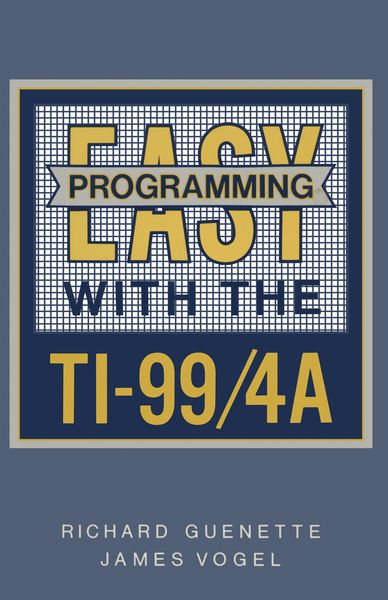
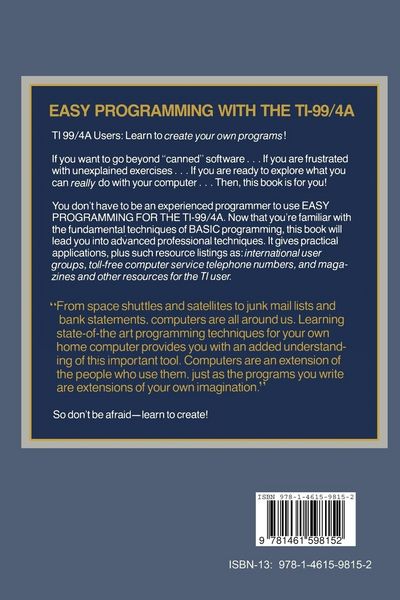
• Produktbild: Easy Programming with the TI-99/4A
  • Produktbild: Easy Programming with the TI-99/4A

Easy Programming with the TI-99/4A

Fr. 72.90

inkl. gesetzl. MwSt., Versandkostenfrei


Beschreibung

Produktdetails

Einband

Taschenbuch

Erscheinungsdatum

17.02.2012

Verlag

Birkhäuser Boston

Seitenzahl

188

Maße (L/B/H)

23.5/15.5/1.2 cm

Gewicht

312 g

Auflage

Softcover reprint of the original 1st ed. 1984

Sprache

Englisch

ISBN

978-1-4615-9815-2

Beschreibung

Produktdetails

Einband

Taschenbuch

Erscheinungsdatum

17.02.2012

Verlag

Birkhäuser Boston

Seitenzahl

188

Maße (L/B/H)

23.5/15.5/1.2 cm

Gewicht

312 g

Auflage

Softcover reprint of the original 1st ed. 1984

Sprache

Englisch

ISBN

978-1-4615-9815-2

Herstelleradresse

Springer Nature c/o IBS
Benzstrasse 21
48619 Heek
DE

Email: Tanja.Keller@springer.com

Kundinnen und Kunden meinen

0 Bewertungen

Informationen zu Bewertungen

Zur Abgabe einer Bewertung ist eine Anmeldung im Konto notwendig. Die Authentizität der Bewertungen wird von uns nicht überprüft. Wir behalten uns vor, Bewertungstexte, die unseren Richtlinien widersprechen, entsprechend zu kürzen oder zu löschen.

Die Bewertungen sind nach Format, Anzahl Sterne und Datum sortiert.

Verfassen Sie die erste Bewertung zu diesem Artikel

Helfen Sie anderen Kund*innen durch Ihre Meinung

Kundinnen und Kunden meinen

0 Bewertungen filtern

  • Produktbild: Easy Programming with the TI-99/4A
  • Produktbild: Easy Programming with the TI-99/4A
  • 1 Microcomputers in Brief.- Of Bits and Bytes.- Storing Information.- Elementary Computer Architecture.- Computer Languages.- 2 Cassette Deck Notes.- Cassette Decks.- Cassette Interface Cable.- Loading and Saving Programs.- 3 Keyboard Guide.- Enter Key.- Shift and Alpha Lock.- Special Symbols.- Mathematical Operators.- Control Keys.- Function Keys.- Automatic Repetition.- Using the Screen Editor.- 4 Introducing TI BASIC.- Commands, Functions, and Statements.- Immediate Mode.- Using the PRINT Command.- CALL Commands.- Command Mode Calculator.- Variables.- Functions.- Math Functions.- TAB Function.- Statement and Program Lines.- GOTO.- 5 Tools for Building Programs.- Line Numbering.- RESEQUENCE.- Editing Programs.- LIST.- Edit Mode.- Starting and Stopping Programs.- Diamond Track.- RUN.- CONtinue.- BREAK and UNBREAK.- END and STOP.- REMark Statements.- 6 Working with Numbers.- Order of Arithmetic Operations.- Relational Expressions.- 7 Variables.- Numeric Variables.- Naming Numeric Variables.- String Variables.- The Role of Variables in Programming.- 8 Using PRINT.- The PRINT System.- Quotation Marks.- Print Separators.- The TAB Function.- The Sick Rose.- 9 Branching Statements.- The Unconditional Branchers.- GOTO.- GOSUBroutine.- Conditional Branching Statements.- ON-GOTO.- ON-GOSUB.- IF-THEN-ELSE.- 10 Data Anyone?.- INPUT.- The READ/DATA Statements.- Setting Up a Data Bank.- Checking Variable Status.- Multiple-Variable READ/DATA Statements.- RESTORE.- Using Counters To Manipulate Data.- Using Data Flags.- 11 The FOR-NEXT Loop.- Entering Data with FOR-NEXT Loops.- Defining Loops With STEP.- Nested Loops.- 12 Debugging Programs.- Error Messages.- TRACE and UNTRACE.- PRINT Debug.- 13 Numeric Functions.- INTeger.- RANDOMIZE and the Random Number Function — (RND(X)).- Other Numeric Functions.- ABS(X).- ATN(X).- COS(X).- SIN(X).- TAN(X).- EXP(X).- LOG(X).- SQR(X).- SGN(X).- User-Defined Functions.- 14 Computer Sound and Music.- The Sound Chip.- CALLing Sound.- Noise Settings.- Negative Duration Values.- Programming a Song for One Voice.- RESTORE for Repeats.- A Song for Three Voices.- Sound Effects.- 15 BASIC Graphics.- The Screen.- BASIC Graphics Statements.- CALL CHAR.- CALL CLEAR.- CALL HCHAR and CALL VCHAR.- CALL COLOR.- CALL SCREEN.- The RANDOM Character Generator.- Combining Characters in Space: White Knight.- Combining Characters in Time: Running Man.- 16 Interacting with Your Computer: Keyboard and Joystick.- CALL KEYboard.- Key-Unit.- Return Variable.- Status Variable.- Mazemaker.- CALL JOYSTick.- Joystick Mazemaker.- 17 Arrays.- Subscripted Variables and Simple Arrays.- Using READ/DATA To Load Arrays.- OPTION BASE 1 and the DIM Statements.- Two-Dimensional Arrays.- 18 String Functions.- ASCII Value—ASC.- Character—CHR$.- Value—VAL.- String Number—STR$.- Length—LEN.- Position—POS.- String Segment—SEG$.- 19 More Graphics.- FOR-NEXT Looping.- CALLing COLOR.- Strings and String Functions.- Using PRINT.- Using SEGment and LENgth String Functions.- Printing Text with HCHAR.- Using Arrays in Graphics.- 20 Live Time on the Keyboard.- Links in a Chain.- 21 Your Home Computer as a Terminal.- 22 System Options.- Extended BASIC.- Speech Synthesizer.- Peripheral Expansion Box.- RS232 Card.- Disk Drive Controller Card.- 32K Memory Expansion Card.- P-CodeCard.- Disk Drives.- Printers.- Telephone Modems.- The Fully Configured System.- Alternatives to the Peripheral Expansion Box System.- Word Processing.- Microsoft Multiplan™.- UCSD p-System™.- LOGO.- Machine Language.- FORTH.- Voice Recognition.- Winchester Hard Disk.- 23 Resource List.