
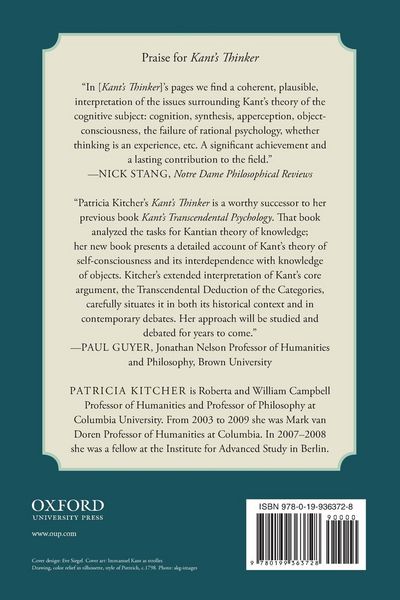
• Produktbild: Kant's Thinker
  • Produktbild: Kant's Thinker

Kant's Thinker

Fr. 73.90

inkl. gesetzl. MwSt., Versandkostenfrei


Beschreibung

Produktdetails

Einband

Taschenbuch

Erscheinungsdatum

01.02.2014

Verlag

Oxford University Press

Seitenzahl

328

Maße (L/B/H)

23.4/15.6/1.9 cm

Gewicht

499 g

Sprache

Englisch

ISBN

978-0-19-936372-8

Beschreibung

Produktdetails

Einband

Taschenbuch

Erscheinungsdatum

01.02.2014

Verlag

Oxford University Press

Seitenzahl

328

Maße (L/B/H)

23.4/15.6/1.9 cm

Gewicht

499 g

Sprache

Englisch

ISBN

978-0-19-936372-8

Herstelleradresse

Produktsicherheitsverantwortliche/r
Europaallee 1
36244 Bad Hersfeld
DE

Email: gpsr@libri.de

Noch keine Bewertungen vorhanden

Verfassen Sie die erste Bewertung zu diesem Artikel

Helfen Sie anderen Kundinnen und Kunden durch Ihre Meinung.

Kundinnen und Kunden meinen

Bewertungen (0)

Die Leseprobe wird geladen.
  • Produktbild: Kant's Thinker
  • Produktbild: Kant's Thinker
    • 1. Overview

    • 1. Introduction

    • 2. Interpretive Framework

    • 3. Preview

    • 4. Current Work on Kant's 'I-Think'

    • Part I: Background

    • 2. Locke's Internal Sense and Kant's Changing Views

    • 1. Locke's Influence

    • 2. Locke's Complex Theory of Internal Sense

    • 3. Kant's Varied Reactions

    • 4. 'Inner Sense' in relation to Kantian 'Apperception'

    • 5. Kant's Use of 'Inner Sense'

    • 3. Personal Identity and Its Problems

    • 1. Locke's Problem

    • 2. Leibniz's Criticisms and Additions

    • 3. Kant and Hume

    • 4. Tetens (and Hume)

    • 4. Rationalist Metaphysics of Mind

    • 1. The Role of Rationalism

    • 2. Leibniz's Elegant 'I-theory'

    • 3. Faculties, Powers and Substances

    • 4. Rational Psychology

    • 5. Consciousness, Self-Consciousness and Cognition

    • 1. Introduction

    • 2. Locke's 'Reflection' and Leibniz's 'Apperception'

    • 3. Self-consciousness and Object cognition

    • 4. Self-Consciousness through Self-Feeling

    • 5. Summary

    • 6. Strands of Argument in the Duisburg Nachla?

    • 1. Introduction

    • 2. Kant's Objection to the Inaugural Dissertation

    • 3. Principles of Appearance and Thought in the Duisburg NachlaB Notion of Apperception?

    • 4. What is the Duisburg Nachla?'s Notion of 'Apperception?

    • 5. From the Duisburg NachlaB to the Critique

    • Part II: Theory

    • 7. A Transcendental Deduction for A Priori Concepts

    • 1. Kant's Goal

    • 2. Clues to the Nature of the Argument

    • 3. The First Premise of the Transcendental Deduction

    • 4. Apriority and Activity

    • 5. A 'Transcendental' Deduction

    • 8. Synthesis: Why and How?

    • 1. Problems to be Solved

    • 2. Kant's Definition

    • 3. Synthesis and Objective Reference

    • 4. Five Syntheses and Their Relations

    • 9. Arguing for Apperception

    • 1. Introduction

    • 2. 'I-Think' as the 'Cogito'; The One-step Deduction from Judgment

    • 3. What Kind of Cognition Is at Issue in the Transcendental Deduction?

    • 4. What is the Principle of Apperception?

    • 5. The Apperceptive Synthesis of Recognition in a Concept

    • 6.Combination and Self-Consciousness in the B Deduction

    • 7. Arguing from the Unity of Apperception to the Necessary Applicability of Categories to Intuitions

    • 8. Transcendental Apperception, Empirical Apperception and 'Mineness'

    • 9. Summary

    • 10. The Power of Apperception

    • 1. Introduction

    • 2. What is the Power/Faculty of Apperception?

    • 3. Does the Faculty of Apperception Endure? Is it the 'Inner Principle' of a Substance?

    • 4. Does the Power of Apperception Initiate Causal Chains or Provide Impressions of Necessary Connection?

    • 5. 'Is it an Experience That I think?'

    • 6. Root Powers, Scientific Ideals and the Ground of Appearances

    • 11. 'I-Think' as the Destroyer of Rational Psychology

    • 1. Understanding Kant's Criticisms

    • 2. Kant's Earlier and Later Treatments of Rational Psychology

    • 3. 'I-Think' as the Vehicle of the Categories

    • 4. 'I-Think' as Analytically Contained in the Concept of Thought

    • 5. Does the Analysis of Cognition Imply the Existence of a Thinker?

    • 6. Why Can't Thinkers Know Themselves as Such?

    • Part III: Evaluation

    • 12. Is Kant's Theory Consistent?

    • 1. The Old Objection

    • 2. The Most Problematic Passage (A251-52)

    • 3. The Confusion about the Causes of Sensations

    • 4. A Second Look at the Most Problematic Passage

    • 5. Criticizing Rationalist Confusions

    • 6. What Kant's Epistemology and Metaphysics Imply

    • 13. The Normativity Objection

    • 1. Psychologism or Noumenalism?

    • 2. Scrutinizing Sensations and Adding 'Transcendental Content'

    • 3. Forming Concepts and Acquiring the I-Representation

    • 4. Making A Priori Principles Explicit and Testing Instances

    • 5. Normativity and the I-rule

    • Appendix to Chapter 13: Longuenesse on Concept Formation

    • 14. Is Kant's Thinker (as Such) a Free and Responsible Agent?

    • 1. Introduction

    • 2. Texts Linking Theoretical and Practical Reason

    • 3. Autonomy and Accountability

    • 4. Intellectual Accountability

    • 15. Kant our Contemporary

    • 1. Supporting and Showing Relevance

    • 2. Transcendental Arguments

    • 3. Must Rational Cognition involve Self-consciousness?

    • 4. A Second Hard Problem of Consciousness?

    • 5. Other 'I's