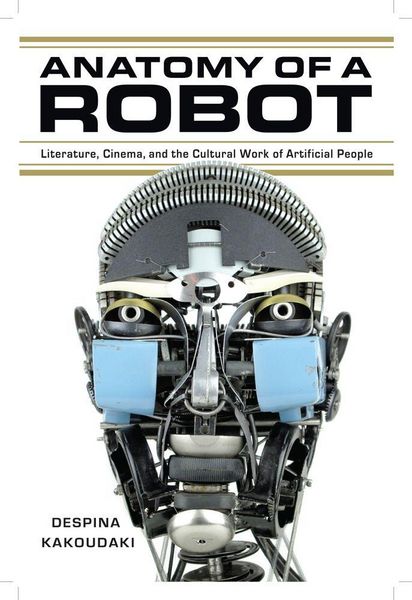
Anatomy of a Robot Literature, Cinema, and the Cultural Work of Artificial People
-
- Hardcover
- Taschenbuch ausgewählt
-
Sprache:Englisch
Fr. 53.90
inkl. gesetzl. MwSt.,
Beschreibung
Produktdetails
Einband
Taschenbuch
Erscheinungsdatum
07.07.2014
Verlag
Rutgers University PressSeitenzahl
272
Maße (L/B/H)
22.8/15.1/2.2 cm
Gewicht
448 g
Sprache
Englisch
ISBN
978-0-8135-6215-5
Why do we find artificial people fascinating? Drawing from a rich fictional and cinematic tradition, Anatomy of a Robot explores the political and textual implications of our perennial projections of humanity onto figures such as robots, androids, cyborgs, and automata. In an engaging, sophisticated, and accessible presentation, Despina Kakoudaki argues that, in their narrative and cultural deployment, artificial people demarcate what it means to be human. They perform this function by offering us a non-human version of ourselves as a site of investigation. Artificial people teach us that being human, being a person or a self, is a constant process and often a matter of legal, philosophical, and political struggle.
By analyzing a wide range of literary texts and films (including episodes from Twilight Zone, the fiction of Philip K. Dick, Kazuo Ishiguro’s novel Never Let Me Go, Metropolis, The Golem, Frankenstein, The Terminator, Iron Man, Blade Runner, and I, Robot), and going back to alchemy and to Aristotle’s Physics and De Anima, she tracks four foundational narrative elements in this centuries-old discourse- the fantasy of the artificial birth, the fantasy of the mechanical body, the tendency to represent artificial people as slaves, and the interpretation of artificiality as an existential trope. What unifies these investigations is the return of all four elements to the question of what constitutes the human.
This focused approach to the topic of the artificial, constructed, or mechanical person allows us to reconsider the creation of artificial life. By focusing on their historical provenance and textual versatility, Kakoudaki elucidates artificial people’s main cultural function, which is the political and existential negotiation of what it means to be a person.
Kundinnen und Kunden meinen
Verfassen Sie die erste Bewertung zu diesem Artikel
Helfen Sie anderen Kund*innen durch Ihre Meinung