• Produktbild: Restoring Lands - Coordinating Science, Politics and Action
  • Produktbild: Restoring Lands - Coordinating Science, Politics and Action

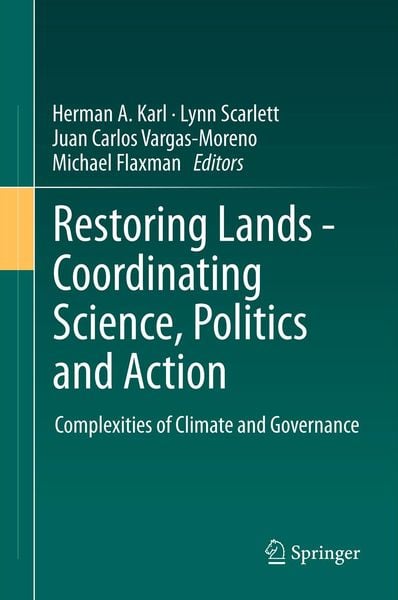
Restoring Lands - Coordinating Science, Politics and Action Complexities of Climate and Governance

Fr. 192.00

inkl. gesetzl. MwSt., Versandkostenfrei


Beschreibung

Produktdetails

Einband

Taschenbuch

Erscheinungsdatum

13.04.2014

Herausgeber

Herman Karl + weitere

Verlag

Springer Netherland

Seitenzahl

540

Maße (L/B/H)

23.5/15.5/3 cm

Gewicht

842 g

Auflage

2012

Sprache

Englisch

ISBN

978-94-017-8520-4

Beschreibung

Rezension

This book by Karl et al., Restoring and Sustaining Lands Coordinating Science, Politics and Communities for Action , is a must read for those who are attempting to conduct policy-relevant research on sustainability of lands and water resources. It provides clear perspectives about the challenges that scientists face in addressing climate change and other complex societal issues. This is a book that should be recommended to students are interested in contributing to interdisciplinary and participatory research programs that address sustainable resources management.

James Jones, Distinguished Professor, University of Florida, Department of Agriculture and Biological Engineering

This book collects the first-person accounts of diverse practitioners who have taken action on what they know in efforts to manage ecosystems in harmony with social and economic systems. The outcomes of these empirical tests of knowledge both the achievements and the disappointments illuminate barriers between disciplines, agencies, and different kinds of expertise as well as paths for overcoming them in advancing common interests. For scientists in particular, this book is a valuable source of insight for rethinking their roles in society and revitalizing their sciences and service to society accordingly.

-Ronald D. Brunner

Professor Emeritus and Policy Scientist

University of Colorado, Boulder

Author (with Amanda H. Lynch), Adaptive Governance and Climate Change , and (with others) Adaptive Governance: Integrating Science, Policy, and Decision Making

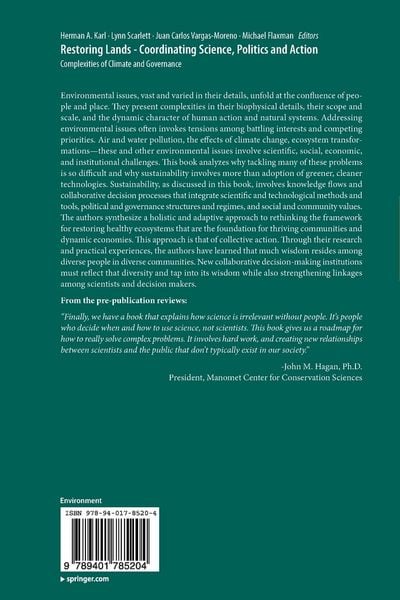
Finally, we have a book that explains how science is irrelevant without people. It s people who decide when and how to use science, not scientists. This book gives us a roadmap for how to really solve complex problems. It involves hard work, and creating new relationships between scientists and the public that don t typically exist in our society.

-John M. Hagan, Ph.D.

President, Manomet Center for Conservation Sciences

This book presents adaptive governance as a new policy frame. It is full of insights into how relationships between scientists, policy-makers, and stakeholders change as they try to manage natural resources and address complex problems like climate change. The reflections that are brought together in this book are a welcome tonic to anyone who has felt the potential and the frustrations of trying to work across the boundaries that separate disciplines and set science apart from society.

-Maarten Hajer

Director, PBL Netherlands Environmental Assessment Agency

Professor of Public Policy

University of Amsterdam

Author of Strong Stories. How the Dutch are Reinventing Spatial Planning

The overall compilation of this book goes to the core of a problem of academic separation from the critical social issues of our day by conducting research only in disciplinary silos. These silos are important for developing foundational basic work, but the task of bringing that work to the world of practical relevance requires a multi-disciplinary approach and an engagement with practitioners and citizens that the norms of academia formally resist. This book provides just such a multi-disciplinary synthesis and engagement with the real world.

-Andrew J. Hoffman

Holcim (US) Professor of Sustainable Enterprise

Erb Institute for Global Sustainable Enterprise

University of Michigan

Author of From Heresy to Dogma: An Institutional History of Corporate Environmentalism , Memo to the CEO: Climate Change, What s Your Business Strategy? (with John Woody), and editor of Oxford Handbook on Business and the Natural Environment (with Pratima Bansal)

Restoring and Sustaining Lands Coordinating Science, Politics and Communities for Action illustrates the frustrations and triumphs associated with trying to manage our lands in the 21 st century with the vision and humanity called for by Thoreau and Leopold in the 19 th and early 20 th centuries. The editors and autho

Portrait

Herman Karl is a U.S. Geological Survey Research Scientist and Visiting Lecturer in the Department of Urban Studies and Planning; he co-directs the MIT-USGS Science Impact Collaborative (MUSIC). During his thirty-year career at USGS, Dr. Karl has developed and led many projects to collect scientific information to inform policy decisions. He was a chief scientist of the EEZ-Scan project. EEZ-Scan project teams mapped the entire U.S. Exclusive Economic Zone and provided data in planning for environmental and resource management of this zone. He received the U.S. Department of the Interior Superior Service Award for his leadership of the EEZ-Scan project. He initiated and led the Gulf of the Farallones project, which conducted research on the effects of radioactive waste dumped off the San Francisco Bay area. The book summarizing this research won the Association of Earth Science Editors Award for Outstanding Publication of 2003 and two other national awards. His work was used in testimony to Congress. Dr. Karl was one of several chief scientists directing research gathering information on DDT-contaminated sediment offshore the southern California coast. This research was in support of the Montrose Case, the single largest environmental lawsuit at the time. Dr. Karl was one of the government expert witnesses in this case; the government won the lawsuit. For several years, he was part of the instructor core in the U.S. Bureau of Land Management Community Based Ecosystem Steward course. The course was given at the request of land managers at sites of some of the most contentious environmental issues in the Nation, such as the spotted owl/timber harvest controversy. USGS located Dr. Karl at MIT to continue to develop ways to more effectively utilize science to inform policy. Before coming to MIT, he was Chief Scientist of the USGS Western Geographic Science Center.

Produktdetails

Einband

Taschenbuch

Erscheinungsdatum

13.04.2014

Herausgeber

Verlag

Springer Netherland

Seitenzahl

540

Maße (L/B/H)

23.5/15.5/3 cm

Gewicht

842 g

Auflage

2012

Sprache

Englisch

ISBN

978-94-017-8520-4

Herstelleradresse


Kundinnen und Kunden meinen

0 Bewertungen

Informationen zu Bewertungen

Zur Abgabe einer Bewertung ist eine Anmeldung im Konto notwendig. Die Authentizität der Bewertungen wird von uns nicht überprüft. Wir behalten uns vor, Bewertungstexte, die unseren Richtlinien widersprechen, entsprechend zu kürzen oder zu löschen.

Die Bewertungen sind nach Format, Anzahl Sterne und Datum sortiert.

Verfassen Sie die erste Bewertung zu diesem Artikel

Helfen Sie anderen Kund*innen durch Ihre Meinung

Kundinnen und Kunden meinen

0 Bewertungen filtern

  • Produktbild: Restoring Lands - Coordinating Science, Politics and Action
  • Produktbild: Restoring Lands - Coordinating Science, Politics and Action
  • Acknowledgements.- Preface.- Introduction: Chapter 1 Restoring and Sustaining Lands—Coordinating Science, Politics, and Communities for Action, by  Karl, Scarlett, Vargas-Moreno, and Flaxman.- Section One—Science, Technology, and Engineering (Tools and Methods):  Chapter 2 Section Introduction, by  Flaxman and Vargas-Moreno.- Chapter 3: Participatory Climate Change Scenario and Simulation Modeling: Exploring Future Conservation Challenges in the Greater Everglades Landscape, by Vargas-Moreno and Flaxman.- Chapter 4 Using "Spatial Resilience Planning" to Test Climate-Adaptive Conservation Strategies, by  Flaxman and Vargas-Moreno.- Chapter 5: Cities and Integrated Water Planning: Complexities of Climate Change, by Kirshen and others.-

    Chapter 6 Collaborative Modeling: Institutional Complexities, by Barreteau and others; Chapter 7 Challenge of Integrating Natural and Social Sciences to Better Inform Decisions: A Novel Proposal Review Process, by Matso.- Section Two—Politics and Policy (Governance and Frameworks): Chapter 8 Section Introduction, by Scarlett; Chapter 9 Transcending Boundaries: The Emergence of Conservation Networks, by  Scarlett.- Chapter 10 Managing the Science-Policy Interface in a Complex and Contentious World, by Beratan and Karl.- Chapter 11 Deliberative Democratic Governance to Foster Sustainability, by Merad.- Chapter 12 Values in Natural Resource Management and Policy, by Mattson and others.- Chapter 13 Flow in the Everglades: The Game Inside the Game, by Light.- Chapter 14 Framing an Uncertain Climate: Adaptation and Water Management Practice in the Netherlands, by Hogendorn, Laws, and Petersen.- Chapter 15 Adapting to Changing Climate: Exploring the Role of the Neighborhood, by Karl and others.- Section Three—People and Action (Implementation and Stewardship): Chapter 16 Section Introduction, by Karl.- Chapter 17 Community-based Ecological Stewardship—A Concept for Productive Harmony on the Public Lands of the Western United States, by McVicker.- Chapter 18 Thoughts on How to Implement Citizen Based Ecosystem Stewardship from 32 Years in Governance, by Whitley.- Chapter 19 Climate Change and the Language of Geographic Place, by Kent and Preister.- Chapter 20 Tomales Bay Watershed Council: Model of Collective Action, by Pileggi and others.- Chapter 21 Outcomes of social-ecological experiments in near-shore marine environments: cognitive interpretation of the impact of changes in fishing gear type on ecosystem form and function, by Curtin and Hammitt.- Synthesis: Chapter 22 Synthesis: Developing the institutions to coordinate science, politics, and communities for action to restore and sustain lands, by Karl, Scarlett, Vargas-Moreno, Flaxman.