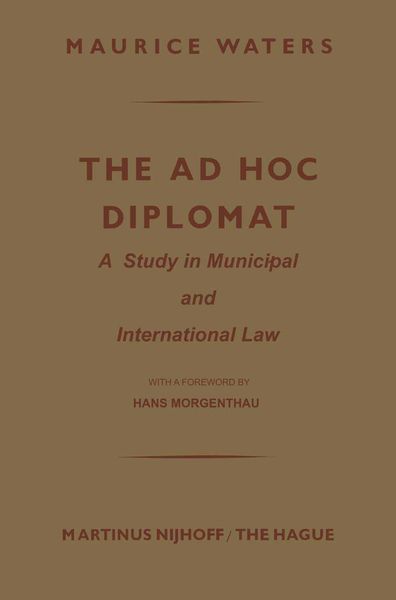

• Produktbild: The Ad Hoc Diplomat: A Study in Municipal and International Law
  • Produktbild: The Ad Hoc Diplomat: A Study in Municipal and International Law

The Ad Hoc Diplomat: A Study in Municipal and International Law

Fr. 72.90

inkl. gesetzl. MwSt., Versandkostenfrei


Beschreibung

Produktdetails

Einband

Taschenbuch

Erscheinungsdatum

01.01.1963

Herausgeber

Hans Morgenthau

Verlag

Springer Netherland

Seitenzahl

233

Maße (L/B/H)

23.5/15.5/1.5 cm

Gewicht

400 g

Auflage

Softcover reprint of the original 1st ed. 1963

Sprache

Englisch

ISBN

978-94-015-0346-4

Beschreibung

Produktdetails

Einband

Taschenbuch

Erscheinungsdatum

01.01.1963

Herausgeber

Hans Morgenthau

Verlag

Springer Netherland

Seitenzahl

233

Maße (L/B/H)

23.5/15.5/1.5 cm

Gewicht

400 g

Auflage

Softcover reprint of the original 1st ed. 1963

Sprache

Englisch

ISBN

978-94-015-0346-4

Herstelleradresse

Springer-Verlag KG
Sachsenplatz 4-6
1201 Wien
AT

Email: ProductSafety@springernature.com

Kundinnen und Kunden meinen

0 Bewertungen

Informationen zu Bewertungen

Zur Abgabe einer Bewertung ist eine Anmeldung im Konto notwendig. Die Authentizität der Bewertungen wird von uns nicht überprüft. Wir behalten uns vor, Bewertungstexte, die unseren Richtlinien widersprechen, entsprechend zu kürzen oder zu löschen.

Die Bewertungen sind nach Format, Anzahl Sterne und Datum sortiert.

Verfassen Sie die erste Bewertung zu diesem Artikel

Helfen Sie anderen Kund*innen durch Ihre Meinung

Kundinnen und Kunden meinen

0 Bewertungen filtern

  • Produktbild: The Ad Hoc Diplomat: A Study in Municipal and International Law
  • Produktbild: The Ad Hoc Diplomat: A Study in Municipal and International Law
  • I. The Nominating and Appointing Power.- Establishment of the Practice.- Early Years.- First Congressional Restriction.- Later Acts.- Present Requirements.- The Change in the President’s Authority.- Summary.- II. Historical Arguments for and Against the Use of the Special Agent.- Arguments Against the Use of Special Agents.- Opposing Arguments Outside of Congress.- Opposing Arguments Within Congress.- Arguments For the Use of Special Agents.- Supporting Arguments Within Congress.- Supporting Arguments Outside of Congress.- Summary.- III. The Question of Office.- Marshall’s Opinion.- Later Definitions of Office.- The Problem of Rank.- The Presidential Signature and the United States’ Seal.- The Contingent Fund.- Establishment of the Fund.- Restrictions on Use of the Fund.- Effect on Presidential Authority.- Summary.- IV. The President’s Appointing Power with Respect to Special Agents.- Early Attempts at Restrictions.- Restrictions Successfully Passed.- Restrictions With Respect to International Organizations.- The United Nations “Battle”.- Special Agents and the Question of Rank.- Summary.- V. Status of the Regular Diplomatic Agent under International Law.- Agréation.- La Lettre de Créance.- The Nature of Diplomatic Privileges and Immunities.- Duration of Diplomatic Immunities.- Theories on the Basis of Diplomatic Immunity.- Representation.- Exterritoriality.- Function.- Who Receives Diplomatic Privileges and Immunity.- Who Decides the Question of Entitlement to Immunity.- The Basis for the Decision.- The Diplomatic Passport.- The Diplomatic List.- Presentation to the Chief of State.- The Meaning of Function.- Responsibility for the Protection of Diplomats.- Responsibility for the Acts of a State’s Agents.- Functions of a Diplomat.- Diplomatic Agents Below the Rank of Ambassador.- Summary.- VI. Status of Miscellaneous Agents under International Law.- International Conferences.- International Organizations.- International Commissions.- Summary.- VII. Status of the Special Agent under International Law.- Special Secret Agents.- Special Public Agents.- The Establishment of Special Missions.- Privileges and Immunities.- Foreign office views.- Decision of courts.- Opinions of scholars.- Freedom of Movement and Communication.- Responsibility for the Protection of Special Agents.- Responsibility for the Acts of the Special Agent.- Functions of the Special Agent.- Summary.- VIII. Conclusions.- Municipal Law Aspect.- Historical Development.- Possible Reasons for the Use of Special Agents.- United States Usage.- Problems That May Result from Using Special Agents.- Problems from United States Practice.- Critics’ Views.- Supporters’ Views.- The Writer’s Opinion.- International Law Aspect.- Ambiguity of the Term “Special Agent”.- Writer’s Definition of the Term “Special Agent”.- Relationship of the Special Agent to the State.- Position of the Courts.- Position of the Foreign Offices.- Position of Scholars.- Writer’s Views of the Status of the Special Agent.- Appendix A.- Representative List of Special Agents.- Appendix B.- Provisions for Appointing United States Delegates to International Organizations.- Appendix C.- Vienna Convention on Diplomatic Relations.- Appendix D.- The Agencies of Colonel House and Harry Hopkins.- Edward M. House.- House’s Background.- The Nature of the House-Wilson Relationship.- His Influence and Methods of Operation.- Five Missions Abroad.- Advantages and Disadvantages in Using House.- Summary.- Harry L. Hopkins.- Hopkins’ Background.- The Nature of the Hopkins-Roosevelt Relationship.- Five Missions Abroad.- His Influence and Methods of Operation.- Advantages and Disadvantages in Using Hopkins.- Summary.