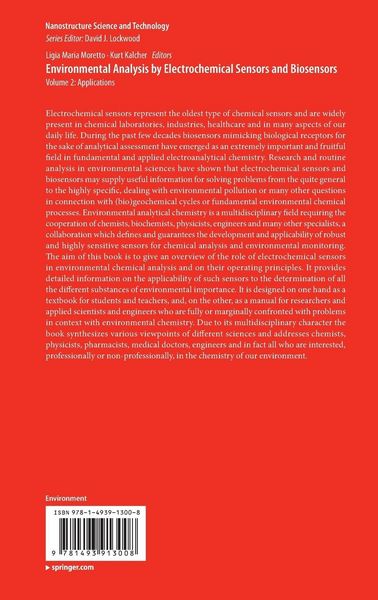
• Produktbild: Environmental Analysis by Electrochemical Sensors and Biosensors
  • Produktbild: Environmental Analysis by Electrochemical Sensors and Biosensors
  • Produktbild: Environmental Analysis by Electrochemical Sensors and Biosensors

Environmental Analysis by Electrochemical Sensors and Biosensors Applications

Fr. 172.00

inkl. gesetzl. MwSt., Versandkostenfrei


Beschreibung

Produktdetails

Einband

Gebundene Ausgabe

Erscheinungsdatum

01.11.2014

Abbildungen

XIV, 93 illus., 28 illus. in color., farbige Illustrationen, schwarz-weiss Illustrationen

Herausgeber

Ligia Maria Moretto + weitere

Verlag

Springer Us

Seitenzahl

457

Maße (L/B/H)

24.1/16/3.1 cm

Gewicht

869 g

Auflage

2015

Sprache

Englisch

ISBN

978-1-4939-1300-8

Beschreibung

Portrait

Ligia Maria Moretto graduated in Chemical Engineering at the Federal University of Rio Grande do Sul, Brazil, and received her PhD in 1994 from the University Ca’ Foscari of Venice with a thesis entitled “Ion-exchange voltammetry for the determination of copper and mercury. Application to seawater.” Her academic career began at the University of Caxias do Sul, Brazil and continued at the Research Institute of Nuclear Energy, Sao Paulo, Brazil. In 1996 she completed the habilitation as researcher in analytical chemistry at the University Ca’ Foscari of Venice. Working at the Laboratory of Electrochemical Sensors, her research field has been the development of electrochemical sensor and biosensors based on modified electrodes, the study of gold arrays and ensembles of nano electrodes, with particular attention to environmental applications. She has published more than 60 papers, several book chapters and has presented about 90 contributions at international conferences, resulting in more than 1100 citations. Prof. Moretto collaborates as invited professor and invited researcher with several institutions in Brazil, France, Argentina, Canada and the USA.

Kurt Kalcher completed his studies at the Karl-Franzens University (KFU) with a dissertation in inorganic chemistry entitled “Contributions to the Chemistry of Cyantrichloride, CINCCI2”; he also received his PhD in 1980 from the same institution. In 1981 he then did postdoctoral work at the Nuclear Research Center in Jülich (Germany) under the supervision of Professor Nürnberg and Dr. Valenta and conducted intensive electroanalytical research while he was there. Prof. Kalcher continued his academic career at KFU with his habilitation on chemically modified carbon paste electrodes in analytical chemistry in 1988. Since then, he has been employed there as an associate professor. His research interests include the development of electrochemical sensors and biosensors for the determination ofinorganic and biological analytes on the basis of carbon paste, screen-printed carbon and boron-doped diamond electrodes, as well as design, automation and data handling with small analytical devices using microprocessors. He has published around 200 papers and has presented about 200 contributions at international conferences. These activities have resulted in more than 3100 citations. Prof. Kalcher has received numerous guest professor position offers in Bosnia-Herzegovina, Poland, Slovenia and Thailand.

Produktdetails

Einband

Gebundene Ausgabe

Erscheinungsdatum

01.11.2014

Abbildungen

XIV, 93 illus., 28 illus. in color., farbige Illustrationen, schwarz-weiss Illustrationen

Herausgeber

Verlag

Springer Us

Seitenzahl

457

Maße (L/B/H)

24.1/16/3.1 cm

Gewicht

869 g

Auflage

2015

Sprache

Englisch

ISBN

978-1-4939-1300-8

Herstelleradresse

Springer-Verlag KG
Sachsenplatz 4-6
1201 Wien
AT

Email: ProductSafety@springernature.com

Kundinnen und Kunden meinen

0 Bewertungen

Informationen zu Bewertungen

Zur Abgabe einer Bewertung ist eine Anmeldung im Konto notwendig. Die Authentizität der Bewertungen wird von uns nicht überprüft. Wir behalten uns vor, Bewertungstexte, die unseren Richtlinien widersprechen, entsprechend zu kürzen oder zu löschen.

Die Bewertungen sind nach Format, Anzahl Sterne und Datum sortiert.

Verfassen Sie die erste Bewertung zu diesem Artikel

Helfen Sie anderen Kund*innen durch Ihre Meinung

Kundinnen und Kunden meinen

0 Bewertungen filtern

Die Leseprobe wird geladen.
  • Produktbild: Environmental Analysis by Electrochemical Sensors and Biosensors
  • Produktbild: Environmental Analysis by Electrochemical Sensors and Biosensors
  • Produktbild: Environmental Analysis by Electrochemical Sensors and Biosensors
  • Part 1. Sensors for Measurement of Global Parameters.- Chapter 1. Chemical Oxygen Demand.- Chapter 2. Biochemical Oxygen Demand BOD.- Chapter 3. Total Organic Carbon (TOC).- Chapter 4. Dissolved Oxygen.- Chapter 5. pH Measurements.- Part 2. Sensors and Biosensors for Inorganic Compounds of Environmental Importance.- Chapter 6. Metals.- Chapter 7. Non-Metal Inorganic Ions and Molecules.- Chapter 8. Electroanalysis and Chemical Speciation.- Chapter 9. Nanoparticles-Emerging Contaminants.- Part 3. Sensors and Biosensors for Organic Compounds of Environmental Importance.- Chapter 10. Pharmaceuticals and Personal Care Products.- Chapter 11. Surfactants.- Chapter 12. Determination of Aromatic Hydrocarbons and their Derivatives.- Chapter 13. Explosives.- Chapter 14. Pesticides.- Part 4. Electrochemical Sensors for Gases of Environmental Importance.- Chapter 15. Volatile Organic Compounds-VOC.- Chapter 16. Sulphur Compounds (H2S, S-oxides).- Chapter 17. Ammonia and Nitrogen Oxides.- Chapter 18. Carbon Oxides.- Part 5. Data Treatment of Electrochemical Sensors and Biosensors.- Chapter 19. Data Treatment of Electrochemical Sensors and Biosensors.- Index.