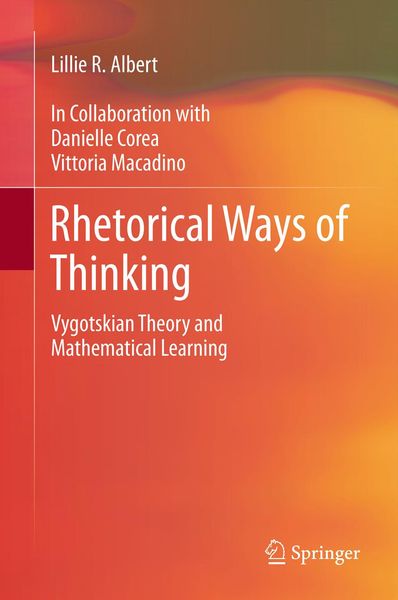
Rhetorical Ways of Thinking Vygotskian Theory and Mathematical Learning
-
- Hardcover
- Taschenbuch ausgewählt
- eBook
-
Sprache:Englisch
Fr. 192.00
inkl. gesetzl. MwSt.,
Beschreibung
Produktdetails
Einband
Taschenbuch
Erscheinungsdatum
11.06.2014
Verlag
Springer NetherlandSeitenzahl
100
Maße (L/B/H)
23.5/15.5/0.7 cm
Gewicht
190 g
Auflage
1. Auflage
Sprache
Englisch
ISBN
978-94-007-9650-8
Rhetorical Ways of Thinking focuses on how the co-construction of learning models the interpretation of a mathematical situation. It is a comprehensive examination of the role of sociocultural-historical theory developed by Vygotsky. This book puts forward the supposition that the major assumptions of sociocultural-historic theory are essential to understanding the theory’s application to mathematical pedagogy, which explores issues relevant to learning and teaching mathematics-in-context, thus providing a valuable practical tool for general mathematics education research. The most important goal, then, is to exemplify the merging of the theory with practice and the subsequent applications to mathematics teaching and learning. This monograph contains five chapters, including a primer to Vygotsky’s sociocultural historic theory, three comprehensive empirical studies examining: prospective teachers’ perception of mathematics teaching and learning and the practice of scaffolded instruction to assist practicing teachers in developing their understanding of pedagogical content knowledge. Finally, the book concludes with a contextualization of the theory, linking it to best practices in the classroom.
Kundinnen und Kunden meinen
Verfassen Sie die erste Bewertung zu diesem Artikel
Helfen Sie anderen Kund*innen durch Ihre Meinung