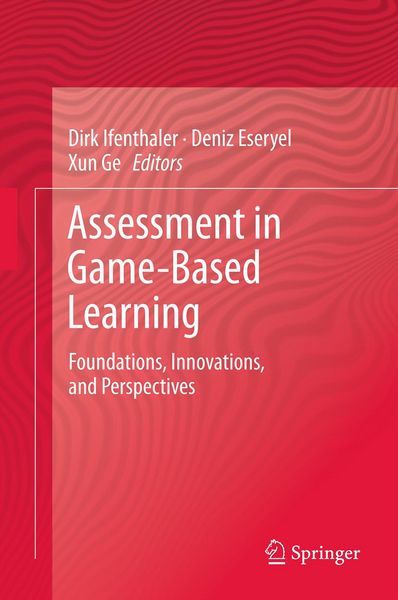
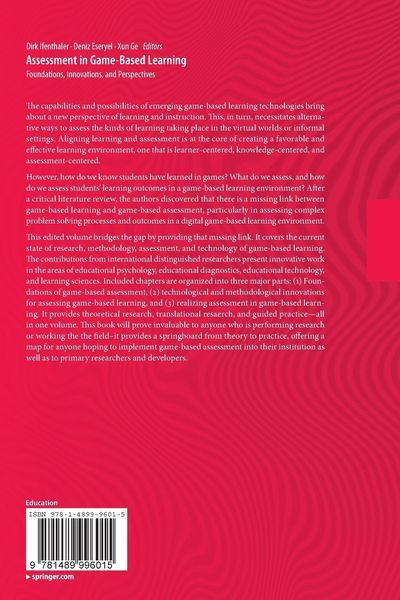
• Produktbild: Assessment in Game-Based Learning
  • Produktbild: Assessment in Game-Based Learning
  • Produktbild: Assessment in Game-Based Learning

Assessment in Game-Based Learning Foundations, Innovations, and Perspectives

Fr. 138.00

inkl. gesetzl. MwSt., Versandkostenfrei


Beschreibung

Produktdetails

Einband

Taschenbuch

Erscheinungsdatum

17.07.2014

Herausgeber

Dirk Ifenthaler + weitere

Verlag

Springer Us

Seitenzahl

464

Maße (L/B/H)

23.5/15.5/2.7 cm

Gewicht

739 g

Auflage

2012

Sprache

Englisch

ISBN

978-1-4899-9601-5

Beschreibung

Rezension

From the reviews:

“When applying video game technology to an educational process, one must ask how we know it is effective. Addressing that question is what this book is about. The book is an edited collection of 21 chapters divided into three parts … . Three outstanding strengths of the book lead me to highly recommend it. … This book would be of greatest interest to educators, academics, and researchers in game-based learning. … it will also provide valuable perspectives for video game designers.” (J. M. Artz, ACM Computing Reviews, October, 2012)

Portrait

Dirk Ifenthaler’s research interests focus on the learning-dependent progression of mental models, complex problem solving, decision making, situational awareness, and emotions. He developed automated and computer-based methodologies for the assessment and analysis of graphical and natural language representations (SMD Technology, HIMATT, AKOVIA). Additionally, he developed components of course management software and an educational simulation games (DIVOSA, SEsim). He is also interested in the development of educational software and learning management systems (LMS) as well as technology integration into the classroom. Dr. Ifenthaler has published multiple books and book chapters as well as numerous articles in leading journals of the field. Dr. Ifenthaler is the current Fullbright Scholar in Residence at the Jeannine Rainboldt College of Education, University of Oklahoma.Deniz Eseryel is an Assistant Professor in the Instructional Psychology & Technology Program at the University of Oklahoma. Her research focuses on issues related to learning, problem-solving, and expertise development in complex, ill-structured knowledge domains such as STEM. She is concerned with developing and evaluating new instructional approaches for advanced computer-based learning environments to facilitate development of complex learning and problem-solving outcomes.Xun Ge is an Associate Professor with the Program of Instructional Psychology and Technology, Department of Educational Psychology, at the University of Oklahoma. She holds a Ph.D. in Instructional Systems from the Pennsylvania State University. Dr. Ge’s primary research interest involves scaffolding student complex and ill-structured problem solving and self-regulated learning through designing and developing instructional scaffolds, learning technologies, and open learning environments. Dr. Ge has published multiple book chapters and numerous articles in leadingjournals of the field, and she is recognized for the two awards – 2003 Young Scholar by Educational Technology Research & Development and 2004 Outstanding Journal Article by Association for Educational Communications and Technology.

Produktdetails

Einband

Taschenbuch

Erscheinungsdatum

17.07.2014

Herausgeber

Verlag

Springer Us

Seitenzahl

464

Maße (L/B/H)

23.5/15.5/2.7 cm

Gewicht

739 g

Auflage

2012

Sprache

Englisch

ISBN

978-1-4899-9601-5

Herstelleradresse

Springer-Verlag KG
Sachsenplatz 4-6
1201 Wien
AT

Email: GPSR Kontakt

Noch keine Bewertungen vorhanden

Verfassen Sie die erste Bewertung zu diesem Artikel

Helfen Sie anderen Kundinnen und Kunden durch Ihre Meinung.

Kundinnen und Kunden meinen

Bewertungen (0)

Weitere Artikel finden Sie in

  • Produktbild: Assessment in Game-Based Learning
  • Produktbild: Assessment in Game-Based Learning
  • Produktbild: Assessment in Game-Based Learning
  • -Foundations of game-based assessment. - Are all games the same? –The role of construct definintion in the creation of formative assessments in game-based learning. –Games, learning and assessment. –Three things game designers need to know about assessment. –Technological and methodological innovations for assessing game-based learning. –Patterns of game playing behaviors as indicators of mastery. – Taking activity-goal alignment into open-ended environments: Assessment and automation in game-based learning. –Infomration trails: In-process assessment of game-based learning. – Timed report measures learning. –Driving assessment of students’explanations in game dialogue. –Assessing learning games for school content: A TPACK-PCARD framework and methodology. –Implementing game-based learning:The MAPLET framework as a guide to learner-centered design and assessment. – Innovative assessment technologies in educational games. –Realizing assessment in game-based learning. –Interactivity design and assessment framework for educational games to promote motivation and complex problem-solving skills. – Measurement principles for gaming. – Using institutional data to evaluate game-based instructional designs. – Examing students’ cultural identity and player styles through avatar drawings in a game-based classroom. – Measurement and analysis of learners’ motivation in game-based e-learning. – Assessment of students’ emotions in game-based learning. –Designing for participation in educational video games. – Computer games as preparation for future learning.