Gutscheinbedingungen

*Gültig bis 05.07.2026 auf (fast) alles. Ausgeschlossen sind Smartboxen, Zeitschriften, Tickets, Lebensmittel, Gaming-Elektroartikel, Tinte/Toner, Gutscheine, Geschenkkarten, Blumen und Abos | Einlösbar in allen Buchhandlungen von Orell Füssli, Barth Bücher, Buchladen Rapunzel, Papeterie Köhler, Schuler Orell Füssli, Stauffacher und ZAP unter Vorweisung des Gutscheins, auf www.orellfüssli.ch durch Eingabe des Gutscheincodes. Beim Service „eBooks verschenken“ und bei eBook-Käufen via eReader nicht einlösbar | Mindesteinkaufswert: Fr. 30.- | Nicht mit anderen Rabatten kumulierbar.

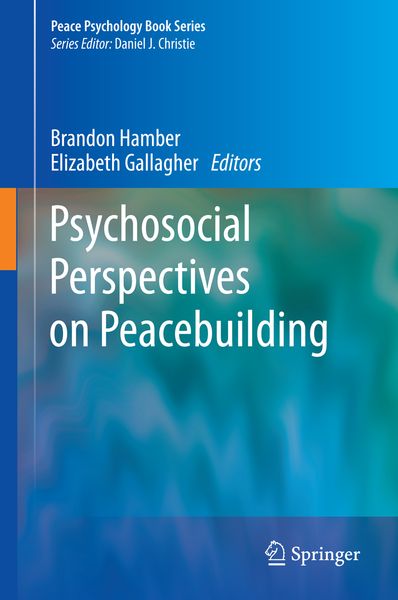
  • Produktbild: Psychosocial Perspectives on Peacebuilding
  • Produktbild: Psychosocial Perspectives on Peacebuilding

Psychosocial Perspectives on Peacebuilding

Fr. 138.00

inkl. gesetzl. MwSt., Versandkostenfrei


Beschreibung

Produktdetails

Einband

Gebundene Ausgabe

Erscheinungsdatum

18.11.2014

Abbildungen

XXI, 11 illus. in color., farbige Illustrationen

Herausgeber

Brandon Hamber + weitere

Verlag

Springer

Seitenzahl

331

Maße (L/B/H)

24.1/16/2.4 cm

Gewicht

699 g

Auflage

2015

Sprache

Englisch

ISBN

978-3-319-09936-1

Beschreibung

Portrait

Brandon Hamber , PhD is Director of the International Conflict Research Institute (INCORE), an associate site of the United Nations University based at the University of Ulster and Professor of Peace and Conflict Studies. He is also an Associate of the Transitional Justice Institute at the university. He was a Mellon Distinguished Visiting Scholar in the School of Human and Community Development and the African Centre for Migration and Society at the University of the Witwatersrand in Johannesburg (2010-2013). He trained as a Clinical Psychologist in South Africa and holds a PhD from the University of Ulster. Prior to moving to Northern Ireland, he co-ordinated the Transition and Reconciliation Unit at the Centre for the Study of Violence and Reconciliation in Johannesburg.  He has published some 40 book chapters and scientific journal articles, including Transforming Societies after Political Violence: Truth, Reconciliation, and Mental Health was published by Springer in 2009, and published in 2011 in Spanish by Ediciones Bellaterra and entitled Transformar las sociedades después de la violencia política. Verdad, reconciliación y salud mental.

Elizabeth Gallagher , Ph.D. previously worked as a Research Associate at INCORE, an associate site of the United Nations University based at the University of Ulster. She worked on the IDRC Trauma, Development and Peacebuilding Project. She graduated with a BSc (Hons) in Psychology and Organisational Science from the University of Ulster and obtained an MSc in Health Promotion from the same Institution. She has recently obtained a PhD from the School of Psychology also at the University of Ulster. She has previously worked on a cross-national study involving senior academics from Universities in The Netherlands, England, Cyprus, Israel, The Basque Country and Northern Ireland. This study assessed national identity, intergroup attitudes, and the development of enemy images withyoung children in both non-divided and divided societies. Dr Gallagher is currently based at the Institute of Nursing and Health Research at the University of Ulster where she is working on a large scale project examining the differences in how residential facilities support people with intellectual disabilities with challenging behaviour and/or mental health problems.

Produktdetails

Einband

Gebundene Ausgabe

Erscheinungsdatum

18.11.2014

Abbildungen

XXI, 11 illus. in color., farbige Illustrationen

Herausgeber

Verlag

Springer

Seitenzahl

331

Maße (L/B/H)

24.1/16/2.4 cm

Gewicht

699 g

Auflage

2015

Sprache

Englisch

ISBN

978-3-319-09936-1

Herstelleradresse

Springer-Verlag KG
Sachsenplatz 4-6
1201 Wien
AT

Email: GPSR Kontakt

Noch keine Bewertungen vorhanden

Verfassen Sie die erste Bewertung zu diesem Artikel

Helfen Sie anderen Kundinnen und Kunden durch Ihre Meinung.

Kundinnen und Kunden meinen

Bewertungen (0)

Die Leseprobe wird geladen.
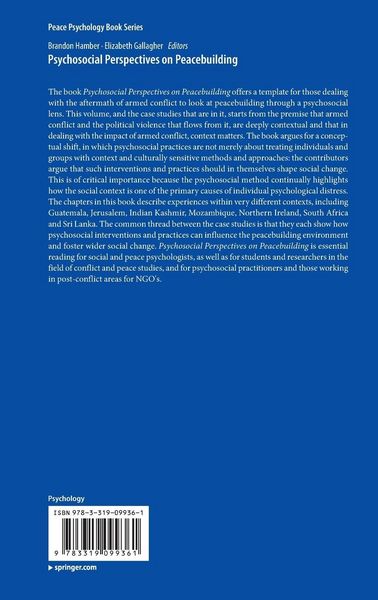
  • Produktbild: Psychosocial Perspectives on Peacebuilding
  • Produktbild: Psychosocial Perspectives on Peacebuilding
  • Chapter 1: Exploring how context matters in addressing the impact of armed conflict.- Chapter 2: Transforming conflict, changing society: Psychosocial programming in Indian Jammu and Kashmir.- Chapter 3: Addressing the psychosocial needs of young men: The case of Northern Ireland.- Chapter 4: Rethinking psychosocial programming in post-war Sri Lanka.- Chapter 5: Creative methodologies as a resource for Mayan women’s protagonism.- Chapter 6: Remembering, healing and telling: community-initiated approaches to trauma care in South Africa.- Chapter 7: Legacies of war, healing, justice and social transformation in Mozambique.- Chapter 8: Death and dying in my Jerusalem: The power of liminality.- Chapter 9: Towards contextual psychosocial practice.